AI compliance as a competitive factor: turning regulation into market advantage

“Good to Know”
Executive summary:
Your lead to the point
Here are the most critical strategic insights you need now:
- AI Act deadline & risk:National supervisory structures must be in place by August 2, 2025. There is hesitationFines of up to 7% global turnover. Act now before the framework is set.
- ISO 42001: Audit Accelerator:The world's first auditable AI management standard (Dec 2023) is key. Early implementation and certificationshorten AI Act compliance checks by up to 30%.
- Gaia-X: Technical Proof:Gaia-X Federation Services (release 25.05) provide the open source blueprint for trustworthy data rooms. Use them toTechnically securing AI Act obligations regarding transparency and traceabilityand to respond calmly to future “Show me your lineage” requests from market surveillance.
- German framework is being created NOW:The final national implementation laws and the distribution of supervisory authorities are in coordination.Acting now gives you active creative freedom, instead of just reacting when the rules are fixed.
- The 90-day sprint counts:Startimmediatelywith the inventory of your AI use cases, risk classification and the drafting of ISO 42001 policies. This is the basis for successful pilot certification and scaling in the following 6 months.
1. The Inconvenient Truth:
The true cost of procrastination in AI compliance
The introduction of the EU Artificial Intelligence Act (AI Act) is often misunderstood as a regulatory burden.
However, experienced decision-makers know that there are regulatory changesstrategic inflection points.
Those who act early define the market standard for trust and secure a decisive competitive advantage.
Anyone who hesitates pays the price – in the form of fines, innovation halts and loss of reputation.
We often hear words like these:
"We implemented the GDPR late and had to stop or massively restructure innovation projects for 18 months. That won't happen to us again with AI!
Compliance is the door opener for faster, trust-based growth in an increasingly regulated global market.
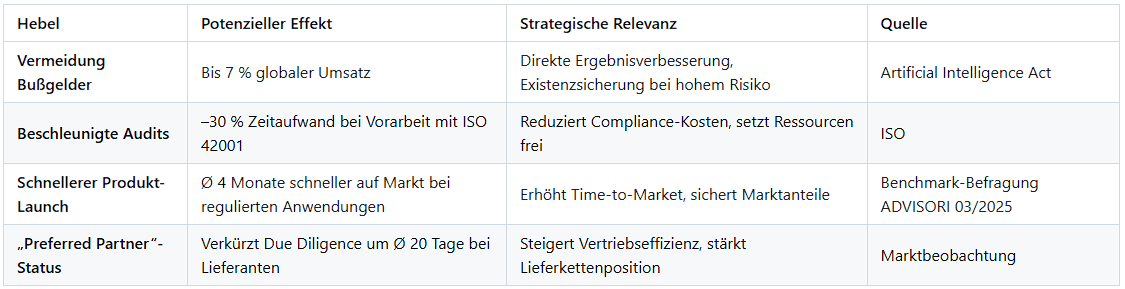
Financial levers: How you can have a direct impact on the P&L through proactive AI compliance
2. Your AI systems under the microscope:
Risk-based navigation through the AI Act
The AI Act is not a blanket ban on AI;risk-based framework. The critical strategic question is:
Which of your current or planned AI systems fall into the “high risk” category and require comprehensive proof of conformity from 2025?
Misclassification is a massive risk – financially and operationally.
Practical checklist for strategic risk assessment (internal filter)
Use these questions as an initial filter at the top management level before going into detail:
- Purpose & fundamental rights:
Does the AI use case have a direct impact on basic human rights, physical security or the legal status of people?(e.g. personnel selection, lending, autonomous control of vehicles or machines). - Domain & Appendix III:
Does the use case fall into one of the high-risk categories specifically listed in Annex III of the AI Act?(e.g. human resources, access to education, critical infrastructure, law enforcement). Check the current list carefully. - Degree of autonomy:
To what extent does the system interfere with operational processes without human supervision or intervention?(The higher the autonomy, the higher the potential risk and monitoring requirements). - Data sources & sensitivity:
Are biometric data, sensitive personal data or other particularly sensitive information used or processed?(Using prohibited biometric systems or handling sensitive data significantly increases the risk).
Mapping table: From AI Act risk to strategic governance responsibility (ISO 42001)
This mapping shows how the AI-Act risk classification is translated directly into the structure of an ISO 42001 management system and what strategic obligations are associated with it:
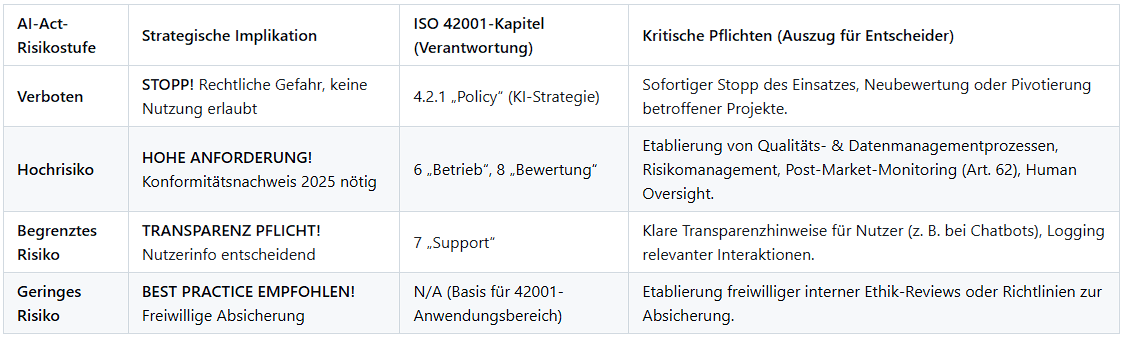
This table makes it clear: The AI Act classification is the starting point for defining the strategic priorities within your AI management system according to ISO 42001.
3. ISO/IEC 42001:
From ad hoc project to controlled AI system
Many companies today manage AI risks on a project-by-project basis. ISO 42001 changes this fundamentally: it establishes acontinuous management system(Plan-Do-Check-Act cycle) for AI.
This is the crucial step from selective compliance to strategic control and scalability. An ISO 42001 certification not only signals maturity, but also becomesTrust standardin supply chains and partnerships.
All requirements of the standard, the 38 controls, the certification process and the delineation from ISO 27001 are covered in detail in our guide: ISO 42001 certification: a complete guide to the AI management system standard
Key roles for your AI management system (fill strategically!)
A functioning system requires clear responsibilities.
Fill these roles at the appropriate management level:
- AI owner (business lead):Assumes P/L responsibility for AI use cases, strategically releases models and their use. Anchors AI risk in corporate risk management.
- AI Compliance Officer (Law/IT interface):Responsible for operationalizing compliance requirements, collecting audit evidence and translating legal requirements into technical/organizational measures.
- Data steward (data sovereignty):Curates training and operational data, monitors data quality, bias and compliance with data protection regulations. Critical for theTraceability of the data origin.
4. Gaia-X data rooms as a technical compliance accelerator and evidence
The AI Act requires transparency and traceability, especially for high-risk systems. Where did the training data come from?
How was the model validated?
Who had access?
Gaia-X provides the technical building blocks for exactly this.
TheGaia-X Federation Services (Release 25.05)offer open source components for:
- Trusted Identities:Who is allowed to access which data?
- Policy enforcement:Ensuring compliance with usage rules at a technical level.
- Data cataloging & provenance:Complete documentation of the origin, use and processing of data.
Strategic advantage: Proof of your AI trustworthiness
Anyone who migrates their AI workloads and the associated data into Gaia-X-compliant data rooms or builds them from scratch is proactively solving a central AI Act problem: theObligation to provide evidence to market surveillance.
If an authority asks in the future “Show me your lineage” (show me the origin and processing history of your data), you can provide technical proof of this via the data room.
- Example:The fictitious AutoTec AG links critical production sensor data with data from suppliers (e.g. material quality) via a Gaia-X data room. Your AI models for predictive maintenance access this space.
During an audit, you can prove the data sources, access rights and processing history at the push of a button. Effect:Reduced audit preparation effort by an estimated 40 hours per model release.
Gaia-X is therefore not just a technology project, but a strategic instrument to secure and accelerate your AI compliance.
Gaia-X Whitepager available for download at the end of the article.
5. Your roadmap to Trusted AI:
From 90-day sprint to scaling
The schedule until August 2025 is ambitious. A step-by-step, strategic approach is crucial.
Here is a proven plan:
Phase 1 (0-30 days):
Create visibility & commitment
*AI use case inventory:Identify ALL AI applications used or planned within the company. Who is the system owner? What is the purpose? What type of model is used?*First rough classification:Complete the strategic risk assessment (Chapter 2). Do use cases fall under Annex III? Immediate identification of prohibited systems.*Governance board kick-off:Establish a cross-functional committee at management level (business, IT, legal/compliance, data protection, works council) for strategic control.
Phase 2 (31-90 days):
Close gaps & lay foundations
*Gap analysis ISO 42001:Evaluate your current processes against the requirements of ISO 42001, particularly Chapters 6 (Operations) and 8 (Evaluation). Where are the biggest gaps?*Drafting critical policies:Develop initial drafts of key policies (e.g. data quality management, bias testing, human oversight processes,the design freeze policy).*Legacy decision:Make strategic decisions: Which existing AI models will be decommissioned and which need to be upgraded to meet high-risk requirements?
Phase 3 (3-6 months):
Certify & Scale
*Pilot certification:Select one or a few representative high-risk use cases for a pilot certification according to ISO 42001 with an accredited body (e.g. TÜV, SGS). Learn the audit process.*Gaia-X integration:Start by implementing the Gaia-X Federation Services components for the relevant use cases to create the technical basis for verifiability.*Training & Awareness Program:Roll out training for product managers, developers and relevant stakeholders (“AI Act & ISO 42001 in 90 minutes”). Anchor compliance in the CI/CD process for AI.
6. Strategic levers for decision-makers:
More than just following rules
Don't understand AI Act and ISO 42001 as an endpoint, but asStarting pointfor strategic differentiation:
- Risk-to-Growth Balance:Compliance not only minimizes fines, it enables themcontrolled risk, which makes innovation and market entry in sensitive sectors possible. This is the path to faster, trust-based growth.
- First mover trust dividend:As one of the first companies with a certified AI management system, you signalunsurpassed reliability. This increases the “Preferred Partner” rating among customers and significantly shortens due diligence cycles for investors and partners.
- Governance as Innovation Enabler:Clear policies and processes (via ISO 42001) reduce internal ambiguities and coordination loops. Developers know what they are doing and how to work safely. This frees up capacity andaccelerates release cycles.
- Stakeholder alignment:The structured approach according to ISO 42001 offers an ideal framework for involving critical stakeholders such as works councils, data protection officers and supervisory authorities early and constructively. Thisprevents blockagesand creates acceptance.
7. Your next step:
From Reading to Action – The 1-Minute Plan
Information without action is worthless. Take the first concrete steps now:
*Calendar block:Make a reservationwithin 48 hoursa 2-hour appointment for an initial strategic meetingAI use case inventory(Phase 1, Chapter 5).*Budget Slot:Discuss reserving a budget slot for oneISO 42001 Pilotin late Q3/Q4 2025. Guideline value for pilot certification: €50,000 - €80,000.*Gaia-X Check:Assign the IT architecture to review theGaia-X Federation Services Components(Code available at [Gaia-X Repository Link - placeholder, replace if known public link exists]). How does this fit into your existing data strategy?*Choose a sparring partner:Identify potential external sparring partners – ideally a combination of an accredited certification body and an experienced consultant with specific industry know-how in the area of AI Act/ISO 42001.
This guide condenses public regulations, standards and current market observations into an actionable strategic roadmap.
He replacesnoneLegal advice, but provides you with the strategic edge and necessary clarity that regulators, partners and investors expect from you in 2025.
Disclaimer:This article is for informational purposes and does not constitute legal advice.
Companies should seek advice from qualified legal experts and advisors regarding the specific requirements of the AI Act and other relevant regulations.
How ADVISORI can help?
They have recognized the strategic complexity and urgency of the AI Act & ISO 42001. Now every day counts for a smooth and beneficial implementation.
Trust ADVISORI FTC – yoursexperienced partner of first choicefor AI compliance that turns regulations into strategic opportunities.
Secure your personal one nowFree 30-minute strategy call.
- Clarify your most burning questions about your specific AI use cases.
- Validate your planned approach with expert feedback.
- Get concrete, actionable impulses for your 2025 roadmap.
Invest 30 minutes to save months of uncertainty.
Gaia-x 4 KI_Whitepaper
➡️Book a 30 minute free strategy call with ADVISORI FTC now
Next step: Free initial consultation
Would you like to successfully implement AI strategies in your company? Our experts will be happy to advise you - without obligation and in a practical manner.Arrange an initial consultation now →
Next step: Free initial consultation
📖 Also read:KI-MIG decided: What the AI Act Implementation Act means for companies
📖 Also read:NIS2 meets AI: Why AI governance is now mandatory
📖 Also read:KI-MIG decided: What the AI Act Implementation Act means for companies
📖 Also read:NIS2 meets AI: Why AI governance is now mandatory
Would you like to successfully implement AI strategies in your company? Our experts will be happy to advise you - without obligation and in a practical manner.Arrange an initial consultation now →

Sovereign AI · ADVISORI
Frontier AI on European infrastructure
Frontier performance, entirely in Europe and under European law: as local language models in your infrastructure or orchestrated through Synthara AI Studio.
- EU inference: no CLOUD Act, no kill switch
- GDPR-compliant on European hardware
- Live in a few weeks, no vendor lock-in
Related articles
Continue exploring with related insights from our experts.
AI Governance for Banks: Connecting Data, Models, and Internal Structures
AI governance does not replace what banks already do well. It builds on it. This article shows how data governance, model governance, and internal governance combine into a framework that satisfies supervisors and enables AI at scale: from dataset suitability and continuous monitoring to accountability across the three lines of defense.
AI Agents Explained: Definition, Examples and Enterprise Adoption. The 2026 Guide
What are AI agents? Definition, how they work, 7 enterprise examples and a 5-step adoption plan: GDPR-compliant and EU AI Act ready.
LLM security: defending generative AI with the OWASP LLM Top 10
LLM security explained: the OWASP LLM Top 10 (2025), prompt injection in depth, layered defenses, and how to govern generative AI with ISO 42001, ISO 27001 and the EU AI Act.