AI as an add-on or a break in architecture? How to manage risks and future-proof your software
Strategic overview
- Artificial intelligence is not a simple feature, but a primary driver that redefines the cornerstones of your software architecture.
- Traditional architectural patterns are reaching their limits because they are inadequate for the probabilistic and information-dependent nature of AI systems.
- Managing AI risks shifts the focus from pure code stability to rigorous control of information flows and model behavior.
- Sustainability arises through architectures that are consistently geared towards modularity and the centrality of the company's own knowledge base.
Introduction
Integrating artificial intelligence is no longer an option for technology leaders, but an operational necessity. However, attempting to simply bolt AI capabilities onto existing systems often leads to instability, uncontrollable costs, and operational risks. The decisive factor for a sustainable and value-adding AI implementation lies not in the model itself, but in a superior software architecture. This article shows you how to overcome architectural challenges, ward off hidden threats, and strategically position your systems for a future with AI.
The change: From tried and tested patterns to new realities
Classic software systems were often designed according to principles such as service-oriented architectures or microservices. Its foundation was stable, well-defined interfaces and stateless services that delivered predictable results. These approaches successfully solved challenges such as the maintainability of monolithic blocks and enabled orderly further development.
However, these proven patterns are only partially suitable for the requirements of AI systems. AI components are rarely stateless; their function depends directly on the quality and character of the training information. Their results are not deterministic but are based on probabilities. This fundamental change requires a rethink because the old guarantees of predictability and stability no longer apply.
The hidden dangers of AI integration
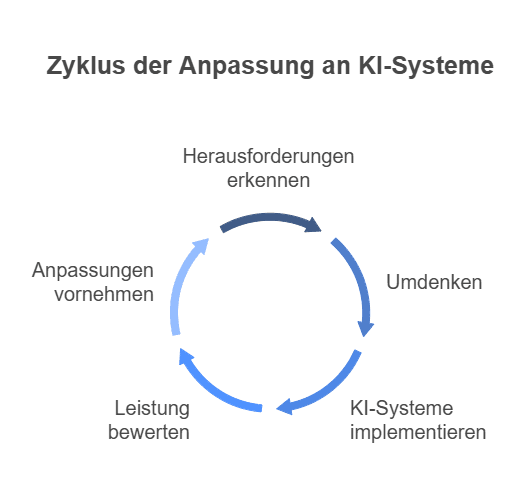
Adding AI components to existing software introduces new, serious risks that go beyond traditional technical issues.
The informational shock
AI models require a steady flow of high-quality recordings. This dependency can jeopardize the stability of your entire architecture, as fluctuations in information quality or structure directly lead to unpredictable AI behavior. The clean separation provided by APIs is undermined when the tacit assumptions about information distribution are violated.
The unpredictability of probabilistic systems
A classic service always delivers the same output for the same input. An AI model does not do this. This non-deterministic behavior poses a significant risk to the reliability of the entire system. Errors are more difficult to reproduce and the causes of wrong decisions are often deeply hidden in the statistical properties of the model.
New attack surfaces for your systems
The introduction of AI creates new security vulnerabilities. Attackers can influence the behavior of a model in their favor through targeted manipulation of the input information (“adversarial attacks”). Even more dangerous is the poisoning of the training base ("model poisoning"), which can permanently and unnoticed compromise a model.
Hidden drivers of operating costs
The demand for computing power to train and operate AI models is immense and often difficult to predict. This stress leads to significant and often escalating infrastructure costs that are rarely taken into account in the original planning and can go beyond budgets.
Regulatory and ethical hurdles
Biases in a model's knowledge base can lead to discriminatory or erroneous decisions, posing significant reputational and liability risks. At the same time, regulations such as the EU AI Act require the traceability of AI decisions, which can hardly be guaranteed from the start without a suitable architecture.
Strategies for mastering AI complexity
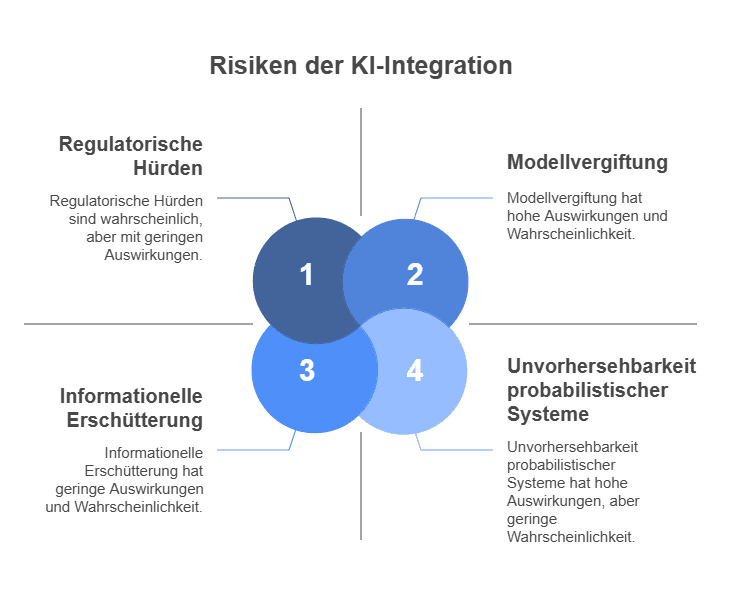
A proactive architectural approach is key to controlling these risks and safely leveraging the benefits of AI.
Architectural decoupling
Treat AI components as standalone, isolated services. Patterns like the “Sidecar” pattern allow an AI component to be placed next to an existing service without changing its core logic. This isolation encapsulates risks: incorrect AI behavior does not affect the entire system.
Stable information lifelines
Build dedicated and tightly monitored pipelines to feed information to your models. These pipelines must ensure the quality, consistency, and distribution of records before they are used for training or inference. They are the first line of defense against unpredictable model behavior.
Establish MLOps as an operational discipline
Introduce processes and tools that understand the management of AI models as a continuous cycle. Similar to DevOps for code, MLOps ensures the systematic monitoring, retraining and controlled deployment of models to ensure their performance over time.
Ensure comprehensive observability
Expand your monitoring. Don’t just measure technical metrics such as response times or resource utilization. Additionally, implement metrics that evaluate the technical performance of the model, such as the accuracy of the predictions or the detection of "model drift", i.e. the gradual decline in model quality.
Plan for explainability from the start
Firmly integrate Explainable AI (XAI) tools and methodologies into your architecture. The ability to understand why a model made a particular decision is not an afterthought, but a strategic necessity for risk management and regulatory compliance.
Future-proof software architectures in the age of AI
In order to be successful in the long term, new software projects must be based on principles that do justice to the reality of AI.
Modularity and flexibility as the top priority
Design your architecture so that individual AI models and even entire technology stacks can be easily replaced. This eliminates vendor lock-in and allows you to always use the most powerful technology available for a given problem.
The knowledge base as the core of the system
Build your architecture around a centralized, clean and accessible information platform. In a "Data-Centric Architecture" the quality and availability of records becomes the highest priority. The applications and models are servants of this valuable resource, not the other way around.
Hybrid approaches for maximum flexibility
Create the ability to flexibly distribute compute-intensive AI tasks between your own data centers and cloud providers. This allows you to conduct costly training in the cloud while keeping latency-critical inference tasks close to the user.
Promote evolutionary architectures
Establish principles that allow continuous adaptation and development of the architecture. Instead of going for a big hit, enable small, incremental changes. This means your system can keep pace with rapid developments in AI without requiring costly new developments.
Strategic Implications & Key Insights
Integrating AI requires a reevaluation of your technical strategy. The focus shifts from pure application logic to mastering information flows and probabilistic systems. Your architectural decisions today directly determine the extent of future costs, risks, and your ability to capture new business opportunities. An operational model that includes MLOps practices is not an option, but a requirement for the professional operation of intelligent systems.
Recommendation for action & outlook
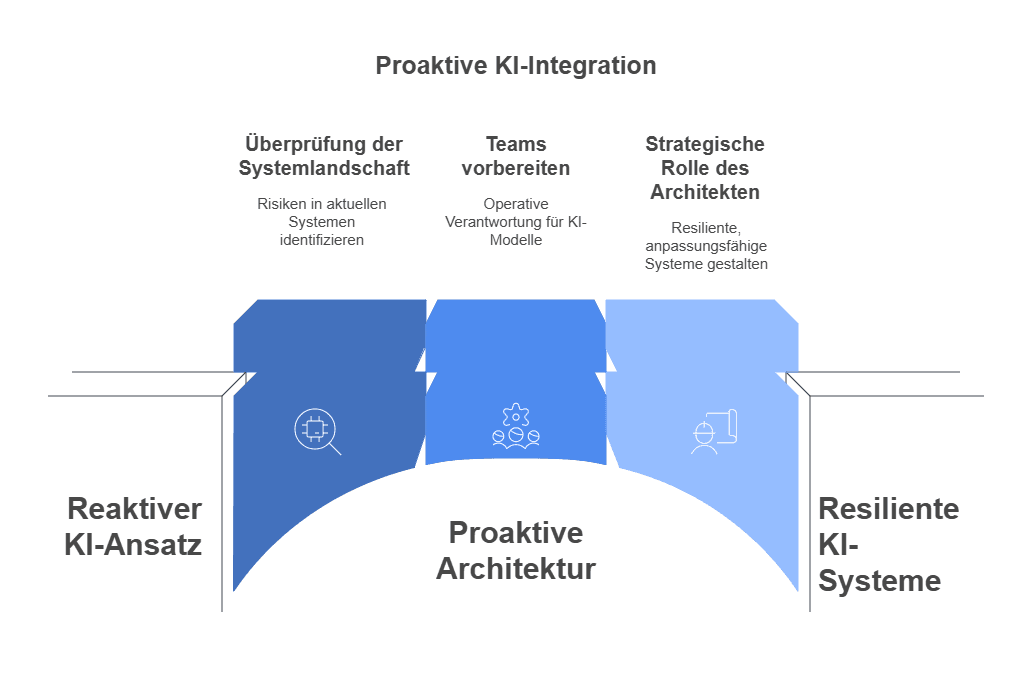
A reactive approach to AI integration inevitably leads to a dead end. A proactive, conscious approach to software architecture is essential to realize the enormous opportunities of artificial intelligence while at the same time managing the associated risks.
Start by critically examining your existing system landscape: Where do the risks described lurk? Are your teams prepared to take operational responsibility for AI models? This makes the role of the software architect even more strategic. He becomes a designer of resilient, adaptable systems that increase the value of your information assets securely and sustainably.
Next step: Free initial consultation
Would you like to address these issues strategically? Our experts will be happy to advise you - without obligation and in a practical manner.Arrange an initial consultation now →
Next step: Free initial consultation
Would you like to address these issues strategically? Our experts will be happy to advise you - without obligation and in a practical manner.Arrange an initial consultation now →
Next step: Free initial consultation
📖 Also read:Explainable AI (XAI) in software architecture: From black box to strategic tool
📖 Also read:Explainable AI (XAI) in software architecture: From black box to strategic tool
Would you like to address these issues strategically? Our experts will be happy to advise you - without obligation and in a practical manner.Arrange an initial consultation now →

Sovereign AI · ADVISORI
Frontier AI on European infrastructure
Frontier performance, entirely in Europe and under European law: as local language models in your infrastructure or orchestrated through Synthara AI Studio.
- EU inference: no CLOUD Act, no kill switch
- GDPR-compliant on European hardware
- Live in a few weeks, no vendor lock-in