BSI & ANSSI Pact: How you can now halve certification costs and accelerate market entry in Europe

What decision-makers need to know now
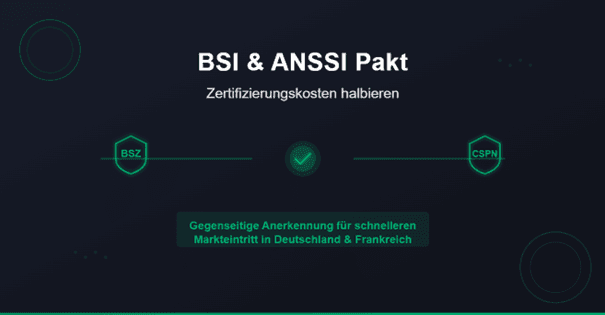
Direct cost advantage: The mutual recognition of the German BSZ and French CSPN safety certificates eliminates duplicate testing processes. For you, this means: faster market launch and significantly lower certification costs for market access in Germany and France.
Strategic competitive advantage:Companies that use or offer products with one of the two certificates strengthen their position in the supply chain. A CSPN-certified supplier is now just as relevant for the German market as a BSZ-certified one, a crucial factor for purchasing, risk management and sales.
Governance upgrade:This harmonization requires adapting your cybersecurity governance, product roadmaps and compliance strategies with a view to a more unified European market.
Hidden risks:Recognition does not automatically mean identical security. Managers need to understand the remaining differences in testing procedures and not view certificates as a replacement for comprehensive product lifecycle risk management.
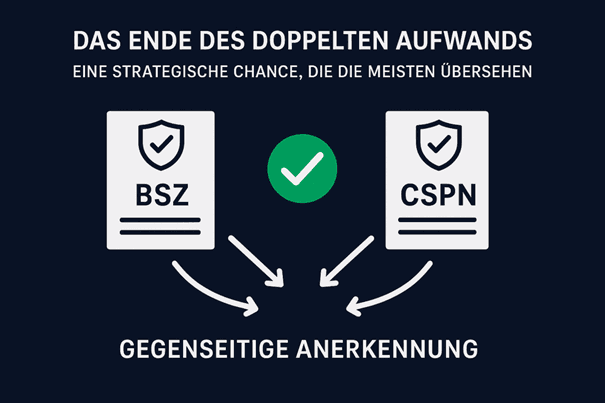
Ending Duplicate Effort: A Strategic Opportunity Most Overlook
For years, the European IT security market was fragmented.A product that was extensively certified in Germany often had to go through a similar, costly process again for the French market. These frictional losses cost time, tied up resources and slowed down innovation.
The youngest togetherPublication by the Federal Office for Information Security (BSI) and the French Agence Nationale de la sécurité des systèmes d'information (ANSSI)fundamentally changes the rules of the game. The formal mutual recognition of the BSZ (Accelerated Security Certification) and CSPN (Certification de Sécurité de Premier Level) certificates is much more than a bureaucratic note.
It is the starting signal for a more agile, cost-efficient and strategically integrated European cybersecurity market.We'll show you what's really between the lines.
Deep Dive: The three decisive levers for your company
1. Direct ROI: Reduce costs, accelerate market entry
First, the obvious: eliminating redundant certifications is a direct savings. Until now, companies that wanted to serve both the German and French markets often had to budget for two separate, complex testing procedures.
From 20 years of industry experience we know:Depending on the product complexity, such processes can cost five to six-figure amounts and take months. These resources are now free for innovation and growth.
The strategic leverage for you:
For product developers & CTOs:Adjust your product roadmap. A single certification (BSZ or CSPN) can now serve as a strategic ticket to two of Europe's largest markets. The time-to-market is drastically shortened.
For CFOs & Managing Directors:Quantify the savings. Analyze which planned certification efforts are now obsolete. This is a measurable contribution to operational efficiency and profitability.
Supply Chain Governance: From Risk Factor to Competitive Advantage
Your supply chain is only as strong as its weakest link. The selection of components and suppliers is one of the most critical tasks in risk management. Until now, the evaluation of foreign providers has often been fraught with uncertainty.
The new agreement creates a reliable basis for decision-making here. A French provider with a CSPN certificate can now be assessed with the same level of trust as a German provider with BSZ.
The counter-intuitive insight:It's not just about minimizing risks. It's about expanding your strategic purchasing pool and negotiating better conditions. You are no longer limited to a national pool of certified providers.
Practical tip:Instantly update your procurement policies and supplier evaluation matrices. The “BSZ or equivalent recognized certification (e.g. CSPN)” clause should become the standard for critical IT components.
ANSSI: CSPN certification procedure
The European dimension: More than just Germany and France
This bilateral agreement is a strong signal and a harbinger of what is being pushed forward at the EU level: a harmonized digital single market with uniform certification standards.
Companies that now align their processes and strategies with this interoperability will secure a decisive advantage. Anyone who waits until the EU-wide regulations are fully binding will only be able to react.
The strategic leverage for you:
Proactive positioning:Align your certification strategy not only with national but also with European standards. This makes your company more resilient to future regulatory changes and more attractive to international partners.
Risk minimization:The stability created by such agreements reduces business risk. You can plan and invest more long-term because the “rules of the game” become clearer and more reliable across borders.
Strategic Relevance: What this means for your role
For the CEO/Managing Director:This is a governance issue. The responsibility for a company-wide certification strategy must be clearly anchored at the C-level. It is a tool for risk management, cost reduction and securing competitive advantages.
For the CTO/CISO: Technical assessment remains crucial. You need to understand the differences between BSZ and CSPN in detail to assess whether additional testing is necessary for a highly critical system despite recognition. Certification is a baseline, not a panacea.
For the CFO:This is a clear ROI opportunity. Demand an analysis of the potential savings through eliminating double certifications and the sales opportunities through faster market access.
Your action plan for the next 90 days
Inaction is now the most expensive option. Use the momentum.
Portfolio Analysis (Week 1-2):Immediately identify which of your existing or planned products and which components of your suppliers already have BSZ or CSPN certification. Evaluate the potential.
Set up a task force (week 3):Put together a small, powerful team from product management, IT security, purchasing and legal. Task: Assess the specific impacts and develop an adapted certification roadmap by the end of the quarter.
Update processes (weeks 4-8):Integrate recognition into your supplier governance and procurement policies. Train the responsible teams (especially purchasing and compliance).
Strategic observation (ongoing):Establish active monitoring of developments at EU level. Position your organization to benefit from the next wave of harmonization rather than being overwhelmed by it.
Conclusion: From follower to designer
The joint publication of BSI and ANSSI is a rare opportunity to set an outsized lever in motion with a relatively small strategic adjustment. It enables you to reduce costs, move faster in key markets and make your organization more resilient to cyber risks and regulatory changes.
The question is not whether this harmonization affects your business, but how proactively you seize the resulting opportunities. Whoever acts now shapes the market. Whoever waits will be shaped by him. We can help you, contact us!
Next step: Free initial consultation
Would you like to strategically anchor IT security in your company? Our experts will be happy to advise you - without obligation and in a practical manner.Arrange an initial consultation now →
ISO 27001 Certification — we guide you through the process
ISMS setup, gap analysis and audit readiness in a 30-minute strategy session.
30 Minuten • Unverbindlich • Sofort verfügbar
Related articles
Continue exploring with related insights from our experts.
Cyber Insurance: Requirements, Costs, and Selection Guide for Businesses 2026
Cyber insurance covers financial losses from cyberattacks, data breaches, and IT outages. This guide explains what insurers require in 2026, coverage types, costs by company size, and how to choose the right policy — including how ISO 27001 certification reduces premiums.
Vulnerability Management: The Complete Lifecycle for Finding, Prioritizing, and Remediating Weaknesses
Over 30,000 CVEs are published annually. Effective vulnerability management prioritizes what matters most to your organization and remediates before attackers exploit. This guide covers the full lifecycle: discovery, scanning, risk-based prioritization, remediation, and compliance.
Security Awareness Training: Building Effective Programs and Measuring Impact
The human layer remains the weakest link in cybersecurity. This guide covers how to build an effective security awareness program, run phishing simulations, design role-based training, and measure whether your program actually reduces risk — with benchmarks and KPIs.