Executive Summary: What you as a manager need to know now
The grace period is over:BaFin has declared operational resilience to be one of its new top strategic goals in its recently published “Strategic Goals 2026 to 2029”. Since January 2025, the implementation of DORA has been actively examined in a risk-oriented manner - pure paper tiger concepts are not enough.
Focus on critical service providers:BaFin's audit extends intensively to the management of ICT third parties. A lack of exit strategies or inadequate contractual clauses are a red flag for supervision and a direct business risk.
Provability is everything:It's no longer a question of whether you have a policy, but whether you can fully demonstrate its effectiveness - through test protocols, KPI reports to the board and operational incident response processes.
From cost factor to competitive advantage:Companies that strategically implement DORA now not only minimize sanctions risks, but also build a demonstrably more robust organization that wins the trust of customers and investors.
The new reality: BaFin is significantly increasing the number of audits
The message from the Federal Financial Supervisory Authority (BaFin) could not be clearer. Their most recent strategic goals clearly state:
“We are significantly increasing the number of audits and making them risk-oriented and increasingly modular.”
BaFin is pushing for supervised companies and their key service providers to massively increase their resilience. Risks from ICT, outsourcing and geopolitical dependencies are under close scrutiny.
What does this mean for you? The time for preparation and theoretical concepts is over. Since DORA came into force on January 17, 2025, the supervisory authority has significantly increased its audit intensity. This article is not another DORA overview. It is a strategic briefing that decodes BaFin's current audit priorities and gives you a concrete blueprint to not only pass, but lead.
BaFin's 5 core audit areas: What really matters now
Our analysis of recent BaFin publications and market insights shows a clear pattern. Your readiness for the exam will be assessed based on these five pillars:
1. ICT Governance & Board Oversight
The regulator wants to see that resilience is “tone from the top”. Mere lip service is not enough. Auditors require the DORA strategy, the “Risk Appetite” approved by the board and quarterly KPI reports presented to the supervisory board.
Question for you: Is cyber resilience a permanent agenda item in your board meetings or just a footnote in the IT report?
2. Practical ICT risk management under DORA
BaFin examines the entire life cycle in accordance with Chapter II DORA - from identification to protection to recovery. The focus is on practical implementation. Can you demonstrate how you assess risks from new technologies and how your protective measures actually work?
3. Incident management under time pressure
The reporting deadlines are extremely tight. A serious incident requires an initial report within a maximum of 4 hours of classification. The process must work even if the core systems are down.
The inconvenient truth: Many companies have the process on paper, but few have tested it under real crisis conditions (e.g. with an emergency fallback).
4. Sophisticated resilience testing
An annual testing program is mandatory. For system-relevant institutes, Threat-Led Penetration Testing (TLPT) is added – a highly complex attack test under real conditions. BaFin expects a multi-year TLPT plan. Anyone who cannot demonstrate a strategy here signals a lack of preparation at the highest level.
5. Waterproof third-party management
This is perhaps the industry's biggest Achilles heel. BaFin requires a complete information register of all ICT service providers, contracts with DORA-specific minimum content and, above all, credible and tested exit plans.
Can you really replace a critical service provider in an emergency without jeopardizing business operations?
The Best Practice Blueprint for Leaders: From Reacting to Leading
Instead of just checking off regulatory boxes, establish resilience as a strategic capability. This blueprint shows how:
1. Establish a central storage location for exam-relevant artifacts
Set up a central, digital folder (ideally in a GRC tool) that bundles all mandatory documents, contracts and test evidence in an audit-proof manner. Clear indexing based on the BaFin structure can shorten the on-site inspection time by up to 30%.
2. Implement active third-party risk governance
Maintain the information register carefully and consistently. Actively assess concentration risks and consistently renegotiate exit rights, audit clauses and instructions when subcontracting.
3. Rehearse the emergency with incident response playbooks
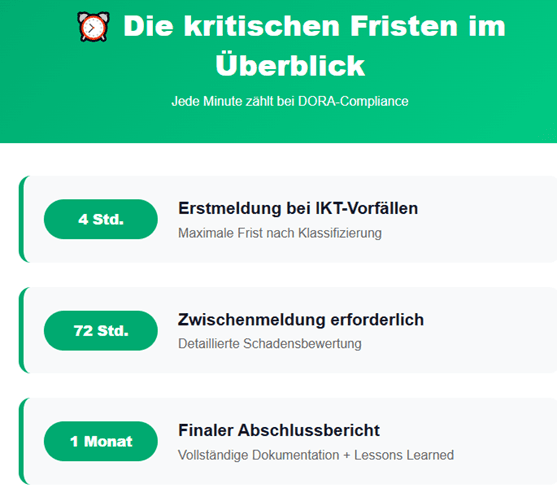
Go through the entire reporting process: immediate assessment and classification, initial report after 4 hours, interim report after 72 hours and final report after one month. This is the only way to ensure that the processes work under stress.
4. Make a smart make-or-buy decision
The pool of DORA specialists is limited. Strategically check which tasks (e.g. in second-line monitoring or testing) can be covered more efficiently and with greater expertise by managed services (“DORA-as-a-Service”).
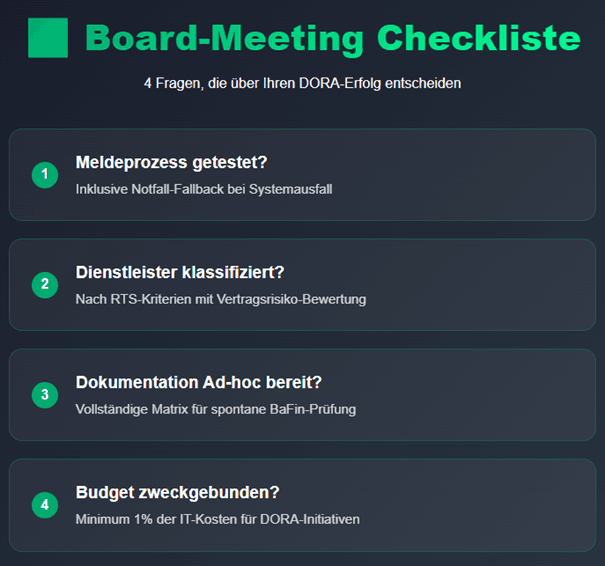
Checklist for your next board meeting
Ask these five questions to determine your organization's true level of maturity:
- Has our ICT incident reporting process, including an emergency fallback scenario, been successfully tested?
- Have we classified all critical ICT service providers according to the new RTS criteria and assessed the contractual risks?
- Is our DORA documentation matrix complete, up-to-date and immediately available for an ad hoc review by BaFin?
- Do we have an explicit annual budget of at least 1% of total IT costs earmarked for DORA resilience initiatives?
Conclusion: Your strategic move for 2025
The year 2025 marks the decisive transition from theoretical preparation to the exam-ready implementation of DORA. BaFin has clearly signaled its intention and will tighten the reins further.
Managers who act now, strengthen governance structures and create auditable evidence will not only avoid severe sanctions. You build a more robust, agile and trustworthy organization - and thus secure a decisive resilience advantage in an increasingly uncertain market environment.
ADVISORI supports you with tailor-made solutions and expertise in an honestGap analysisbased on the specific BaFin requirements. Specialized consultants can help accelerate audit readiness and uncover blind spots before the auditor does.

Also follow us onLinkedInfor further information on the subject of BaFin DORA and other exciting information from the world of information security.
Next step: Free initial consultation
📖 Also read:DORA 2026: Why 44% of financial companies are not compliant — and what to do now
📖 Also read:DORA 2026: Why 44% of financial companies are not compliant — and what to do now
Would you like to implement DORA compliance in a timely manner? Our experts will be happy to advise you - without obligation and in a practical manner.Arrange an initial consultation now →
DORA in 12 Weeks — from ICT Register to TLPT
We structure your DORA implementation in a 30-minute strategy session and deliver gap-analysis plus the rollout roadmap.
Book a DORA Strategy Session30 Minuten • Unverbindlich • Sofort verfügbar