Race for quantum sovereignty
The planned EU Quantum Act positions Europe as a leading force in quantum technologies in order to reduce dependence on the USA and China.
- Regulation meets innovation:From 2026, a comprehensive legal framework is expected that controls the promotion, standardization, security and dual-use aspects of quantum technologies.
- Opportunities for German companies:Benefit from EU funding programs, pilot lines and a strengthened ecosystem to secure growth and competitive advantages.
- Manage risks:Prepare for possible compliance costs, export controls and global competitive pressures.
- Early strategic positioningis crucial to benefit from the European quantum wave and to establish yourself as a driver of innovation.
The “EU Quantum Act” – Europe’s leap into the quantum future
The term"EU Quantum Act"represents a planned legislative framework for the European Commission. The aim is to specifically promote and regulate quantum technologies in Europe and thus strengthen Europe's technological sovereignty.Already published on July 2, 2025"Quantum Europe Strategy"is considered explicit preparation for this act.
This article highlights the project, its potential impact on German companies and start-ups and shows how you can strategically prepare for it.
Why the EU is pursuing a quantum strategy: More than just research
The EU is pursuing several strategic goals with the planned Quantum Act:
- Global leadership position: Europe should establish itself as a leading region in the global competition for quantum technologies by 2030.
- Technological sovereignty:Dependence on the USA and China, which have already made significant progress in quantum technology, should be reduced.
- Unlock enormous potential:Quantum technologies promise revolutionary advances in data processing, communication, cryptography, sensors and medical diagnostics.
- Security and dual use:Since quantum technologies have both civil and military applications, the EU wants to create a regulatory framework at an early stage.
For German companies this means:Quantum technologies are no longer purely a research topic, but are increasingly moving into the area of industrial application and regulation
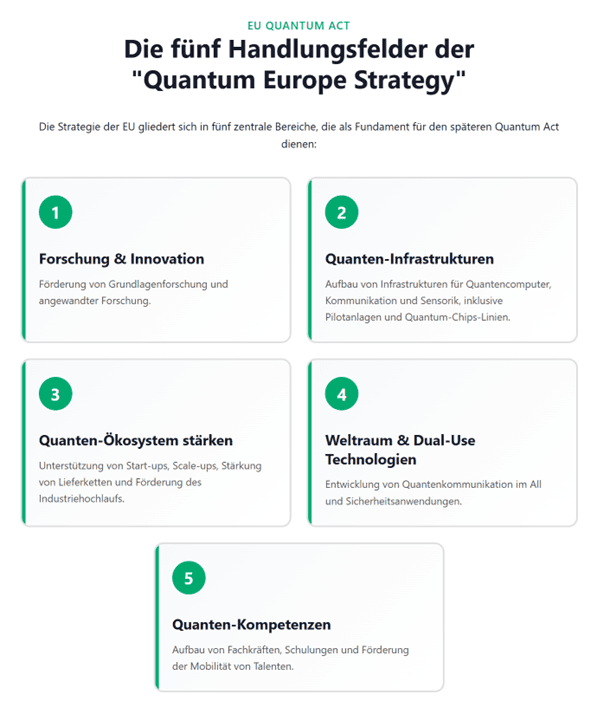
These fields of action include political as well as economic and regulatory dimensions.
What the “Quantum Act” specifically plans: A look into the future
Although the Quantum Act has not yet been passed, official documents and analyzes already reveal some key elements:
- Expected submission: The Quantum Act proposal is expected to be presented in 2026.
- Comprehensive framework:It is intended to create a framework that integrates regulatory aspects (e.g. security, standardization, dual-use) and industrial policy (chips pilot lines, infrastructure development).
- Regulatory implications:Manufacturers of quantum chips, providers of quantum communication, sensors, etc. will be subject to clearer regulation in the future, for example with regard to security, export controls and licensing requirements.
- Unternehmensrelevanz:Companies should coordinate with European funding programs (e.g. EuroHPC JU amendment) at an early stage and check participation in pilot lines.
Kurzum:The Quantum Act will not only encourage but also control.
Importance for German companies and start-ups: opportunities and obligations
Germany is already strongly positioned in the field of quantum technology – with leading research institutions, innovative start-ups and industry-related projects.The EU framework brings with it both opportunities and obligations.
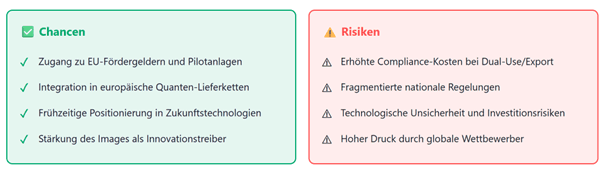
- Förderprogramme nutzen:Companies have the chance to benefit from EU funding programs (e.g. Horizon Europe, Digital Europe) if they become part of consortia at an early stage.
- Regulatory adjustment:Anyone who uses or creates quantum products, services or infrastructure in the future will have to adapt to regulatory requirements, such as security requirements, standardization and export controls.
- Start-up-Potenzial:Pilot lines and a unified EU market can offer great opportunities for start-ups, but they also increase competition and hurdles for international scaling.
- Mittelstand im Fokus:Even if many SMEs do not directly develop quantum hardware, relevant applications (sensors, communication, security) could be affected. A strategic review is therefore recommended.
Opportunities and risks for industry and medium-sized businesses
Tipps zur Vorbereitung auf den Regulatory-Rahmen
1. Bestandsaufnahme
Analyze the relevance of quantum technologies for your business (e.g. sensors, communication, security).
2. Regelwerke beobachten
Follow the development of EU regulations, especially in the area of export and security controls.
3. Lieferketten prüfen
Assess your supply chains and partners for dual-use risks, standardization and certifications.
4. Kooperationsstrategie
Consider participating in EU consortia or partnerships with universities and research institutions.
5. Team schulen
Train your team in quantum skills and raise awareness of market changes.
6. Skalierungsstrategie
Develop a strategy for scaling if your company offers quantum-related products or services.
Ausblick: Zeitplan, Meilensteine & Erwartung
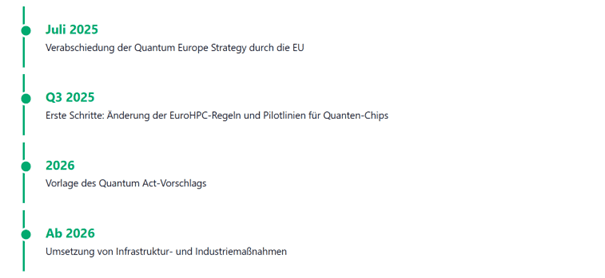
Für deutsche Unternehmen heißt das:The time to act is now – the sooner you position yourself, the better.
FAQ – häufige Fragen zum EU Quantum Act
Q1: What is the difference between the "Quantum Europe Strategy" and the "Quantum Act"?
A1:The strategy defines the strategic objectives and areas of action. The Quantum Act will be a concrete legislative framework that operationalizes, regulates and financially secures these goals.
Q2: Wann soll der Quantum Act in Kraft treten?
A2:The proposal is expected in 2026; entry into force depends on legislative procedures.
Q3: Does every company have to use quantum technology?
A3:No - but if your business model or industry is affected by this (e.g. sensors, communication, critical infrastructure), preparation makes sense.
Q4: What funding programs are available?
A4:Programs such as Horizon Europe, Digital Europe Program and pilot lines within the framework of the EuroHPC JU and the Chips JU are relevant instruments.
Q5: What risks does the Quantum Act pose?
A5:Possible risks include increased regulatory requirements, export and safety requirements, competition from global players and uncertainty due to technology maturity.
Q6: What should German medium-sized companies do now?
A6:Carry out analysis, identify partners, examine funding and consortia options, prepare supply chains for dual use/regulation.
Conclusion: Strategic recommendation for action for Germany actors
The planned oneEU Quantum Actmarks a decisive turning point for the European quantum technology landscape and thus also for German companies. Anyone who begins to strategically prepare for this today can not only take advantage of funding advantages, but also position themselves as a competent partner in an emerging ecosystem. At the same time, it is important to keep an eye on possible regulatory challenges and global competition risks. Early engagement offers you the chance to become part of the European quantum technology wave rather than just reacting to it.
Next step: Free initial consultation
Would you like to implement these topics strategically in your company? Our experts will be happy to advise you - without obligation and in a practical manner.Arrange an initial consultation now →
ISO 27001 Certification — we guide you through the process
ISMS setup, gap analysis and audit readiness in a 30-minute strategy session.
Book an ISO 27001 Session30 Minuten • Unverbindlich • Sofort verfügbar