Google's AI Finds Critical Chrome Vulnerability: A Breakthrough in Cybersecurity


Google's AI Finds Critical Chrome Zero-Day Vulnerability - A Breakthrough in theCybersecurity
An AI tool from Google has independently discovered a critical zero day security vulnerability in the world's most used browser, Google Chrome.
The news of August 27, 2025 was short, but its significance is enormous. Google's AI agent, dubbed "Big Sleep" by researchers at DeepMind and Project Zero, discovered a vulnerability called "Use-after-free in ANGLE." The vulnerability was so severe that an attacker could corrupt data and execute malicious code through a specially crafted HTML page. This would have been a real problem for millions of users.
But Google reacted quickly. An urgent update (versions 139.0.7258.154/155) for Windows and Mac has been released, and the version for Linux is also being rolled out.
The technical detail: What exactly does “use-after-free” mean?
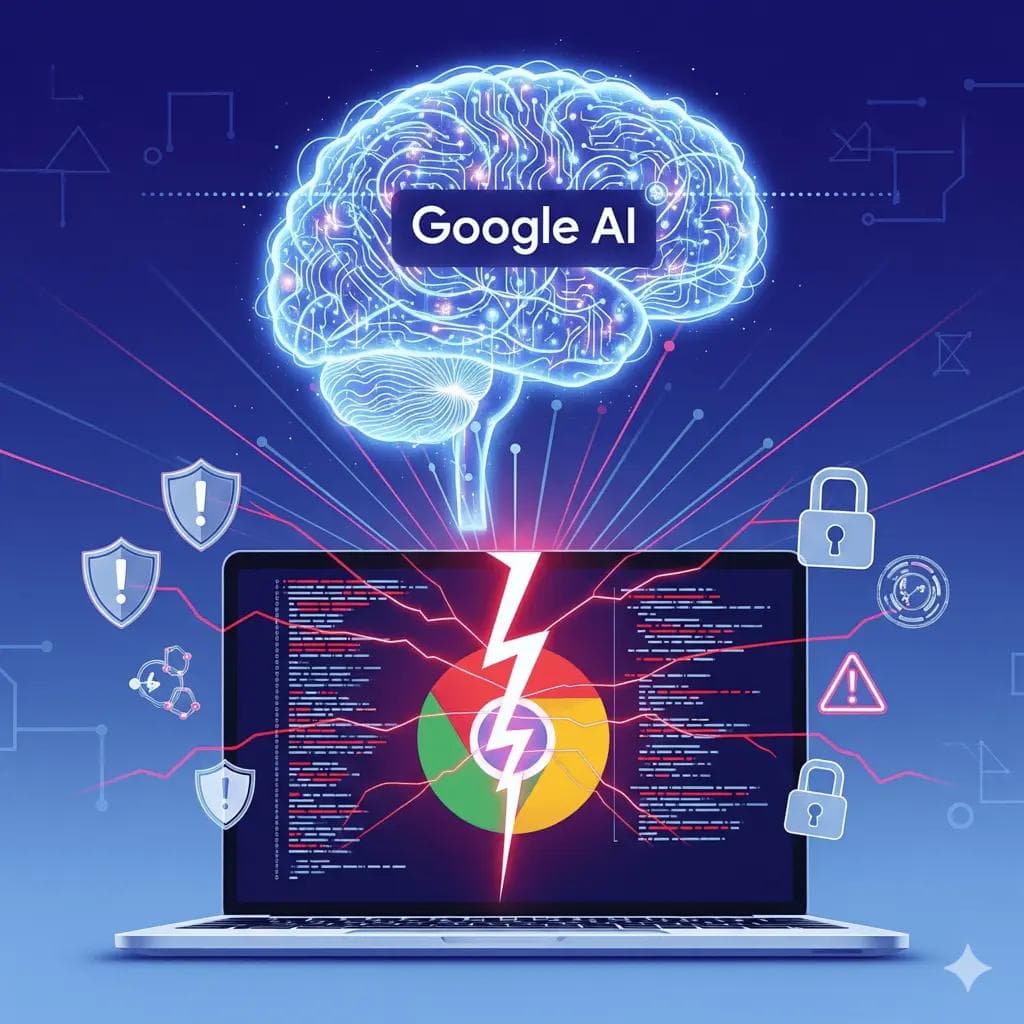
To understand why the discovery of Big Sleep is so important, you need to understand the technical side of the vulnerability. A use-after-free (UAF) error is a critical programming error that often occurs in languages such as C or C++. It occurs when a program tries to access a memory area that has already been freed by the operating system.
Normally, memory is allocated and released dynamically. A pointer points to a specific memory address. When a programmer no longer needs the memory, he releases it. The UAF error happens when a pointer still exists even after the memory is freed and the program tries to use it.
This is dangerous because this memory area can be reallocated by the operating system. If the old pointer is then used, this can lead to unpredictable problems. In the best case scenario, the program crashes. In the worst case scenario, an attacker can overwrite the shared memory with their own code. When the program then uses the pointer, the malicious code is executed. With a browser like Chrome constantly handling web pages, the risk of malicious code execution (Remote Code Execution (RCE)) is huge.
Google's AI: A new guardian in the digital space
The fact that an AI found this error and not a human expert is actually fascinating. Big Sleep is not a simple software for searching for known threats. AI uses machine learning to independently analyze code and detect complex, often hidden patterns that indicate vulnerabilities.
The results of the AI are impressive. Google Threat Intelligence's Sandra Joyce confirmed that the AI exceeded her expectations. Last year, “Big Sleep” found a hole in the widely used SQLite software and prevented attackers from exploiting it. This success, along with the recent discovery in Chrome, points to a new era in vulnerability research. Autonomous systems can comb through millions of lines of code in a fraction of the time it would take a human, finding errors so subtle that they escape human analysis.
AI in the fight against cybercrime: A new frontline
The role of AI in cybersecurity goes far beyond just vulnerability detection. It turns the entire industry from a reactive to a proactive discipline. Here are some of the most important areas of application:
- Proactive threat detection: AI systemscan analyze behavioral patterns in network traffic and detect anomalies that indicate a threat. A human would need days or weeks to do this, an AI can do it in real time.
- Predicting Attacks:With predictive analytics, AI can evaluate historical attack data to predict future attack methods. This allows companies to optimize their defenses before an attack even occurs.
- Vulnerability Management:There are so many vulnerabilities discovered every day that it is impossible for human security teams to fix them all. AI can prioritize these vulnerabilities by assessing the likelihood of exploitation, potential damage, and criticality of the affected system.
- Automated response:In the event of an attack, AI can trigger a rapid, automated response to minimize damage. This includes isolating affected systems, blocking malicious IP addresses, and patching vulnerabilities in seconds.
The future: collaboration between humans and machines
Despite these advances, AI will not replace human experts but will augment their capabilities. Cybersecurity professionals will evolve from pure data collection to strategic, creative and managerial roles. They will monitor the AI systems, interpret their results and make the important decisions.
Human intuition, judgment and the ability to think outside the box remain irreplaceable. While AI recognizes patterns, it does not understand the broader context or human motivation behind an attack. Attackers are constantly adapting their tactics. Collaboration between the analytical power of AI and the strategic foresight of humans will be the key to security in the digital future.
Conclusion: A new hope
The discovery of the Chrome vulnerability by Google's AI is more than just a technological milestone. It is a wake-up call that shows us how fragile our digital world is, and at the same time a new hope that shows us how we can protect it. In a time where AI is used by attackers and defenders, we need to develop defensiveAI systemsadvance.
Collaboration between leading technology companies like Google and the broader cybersecurity community is critical to harness the benefits of AI and minimize risks. The future of cybersecurity will not be shaped by machines alone, but by the people who design and deploy them to create a safer, more resilient digital world for all of us.

Sovereign AI · ADVISORI
Frontier AI on European infrastructure
Frontier performance, entirely in Europe and under European law: as local language models in your infrastructure or orchestrated through Synthara AI Studio.
- EU inference: no CLOUD Act, no kill switch
- GDPR-compliant on European hardware
- Live in a few weeks, no vendor lock-in
Related articles
Continue exploring with related insights from our experts.
AI Governance for Banks: Connecting Data, Models, and Internal Structures
AI governance does not replace what banks already do well. It builds on it. This article shows how data governance, model governance, and internal governance combine into a framework that satisfies supervisors and enables AI at scale: from dataset suitability and continuous monitoring to accountability across the three lines of defense.
AI Agents Explained: Definition, Examples and Enterprise Adoption. The 2026 Guide
What are AI agents? Definition, how they work, 7 enterprise examples and a 5-step adoption plan: GDPR-compliant and EU AI Act ready.

LLM security: defending generative AI with the OWASP LLM Top 10
LLM security explained: the OWASP LLM Top 10 (2025), prompt injection in depth, layered defenses, and how to govern generative AI with ISO 42001, ISO 27001 and the EU AI Act.