AI Vendor Lock-In: The 4 Types, the Cost of Exit, and How to Avoid It

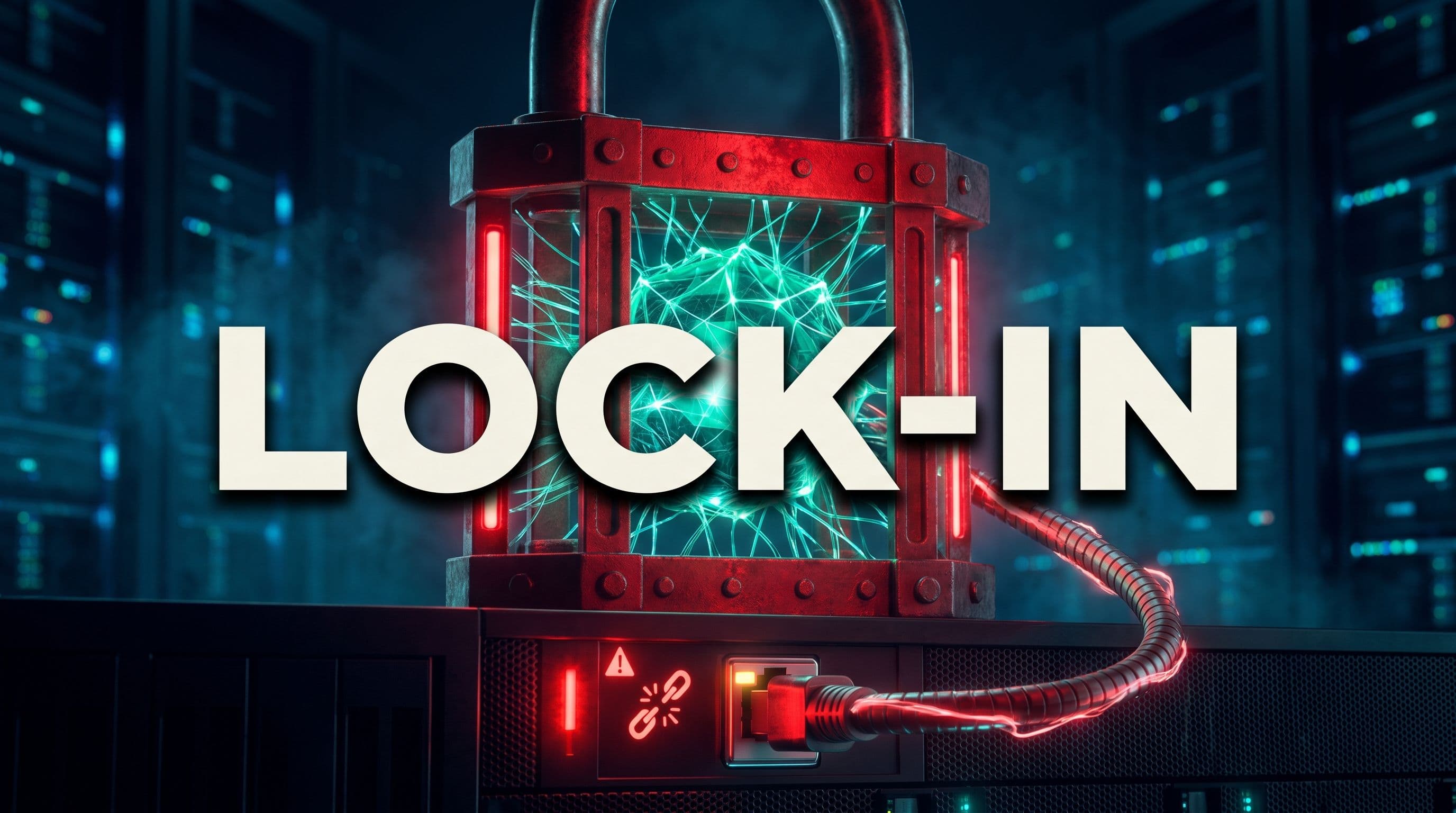
Definition: AI vendor lock-in is an undesirable dependence on a single AI provider whose models, data, APIs and infrastructure are not interchangeable, making a switch expensive or impractical. Unlike classic cloud lock-in, it binds you at the model, data, API and infrastructure layers at the same time. *(snippet-ready, ~50 words)*
When a US export-control directive took Anthropic's Fable 5 and Mythos 5 offline worldwide on 12 June 2026, the companies that kept running were the ones that could switch models in minutes. The ones that couldn't went dark. That is AI vendor lock-in — not a theoretical risk, but a Friday night when nothing works. This guide covers the four types of AI lock-in, what an exit really costs, and a playbook to become switchable.
What is AI vendor lock-in?
Lock-in occurs when changing providers becomes so costly that you stay even through price hikes, quality drops or outages. AI makes it worse for three reasons: standards are still unstable, your business data lives with the provider, and pricing models change fast. The result is negotiating weakness that grows with every integration.
The 4 types of AI vendor lock-in
Lock-in is not one problem but four, and they compound.
1. Model lock-in
Prompts, fine-tuning and few-shot examples are tuned to one model family (GPT, Claude, Gemini). Switching changes output quality — often measurably for the worse.
2. Data lock-in
Embeddings and vector indexes are provider-specific. Switching means re-vectorizing your entire knowledge base, plus egress fees and data-residency questions.
3. API / tooling lock-in
Proprietary SDKs and provider-specific function calls bury the dependency in every line of glue code.
4. Infrastructure lock-in
Models that run only on one hyperscaler tie your AI strategy to a single cloud — with all the geopolitical and regulatory exposure (CLOUD Act, export control).
The cost of exit
The true price of lock-in shows up when you try to leave: rebuilding prompts and pipelines, re-vectorizing data, retraining teams, egress fees and project delay. The rule of thumb: the longer you integrate without an abstraction layer, the higher the future cost of exit. A documented industry parallel is the Broadcom acquisition of VMware (~$69B), after which licensing and price changes trapped many customers — the same pattern threatens AI, only faster.
How to avoid AI vendor lock-in: the exit playbook
- Map your dependencies. Which process runs on which model, API and hyperscaler?
- Insert an abstraction layer. Put a vendor-neutral model router in front of every application — switching becomes configuration, not a code project.
- Run a multi-model strategy. Keep a second equivalent model per use case, tested regularly.
- Keep an open-weight backup. A self-hosted model (Mistral, Llama, Teuken) as a sovereign fallback.
- Secure data portability. Reproducible embeddings, standard export formats.
- Write exit clauses. Data return, deletion, egress, retention (ideally Zero Data Retention) and migration rights in every contract.
This extends the usual "best practices" checklists with the contractual and open-weight layers that most guides leave out.
How an LLM router solves it
An abstraction layer — an LLM router / broker — gives one unified API across many models. Your code knows only the router, not the provider; model switching, failover and cost routing happen behind it. Benchmarks show routing can cut cost dramatically: RouteLLM (UC Berkeley/LMSYS) reports up to 85% lower cost on MT-Bench at 95% of GPT-4 quality, with 30–40% typical in production. ADVISORI's Synthara broker does exactly this — vendor-neutral, protection-class-aware, with built-in failover. See the LLM router guide and the pillar on sovereign AI.
Vendor lock-in and digital sovereignty
Lock-in is the technical face of a strategic problem: dependency. After the Fable Ban, "we can't switch" is a board-level risk. The full architecture and compliance picture is in our pillar: Sovereign AI for Enterprises.
Model-agnostic architecture: how the abstraction layer works
The technical core of avoiding lock-in is the abstraction layer. Instead of your application calling OpenAI's or Anthropic's API directly, it talks only to a unified interface — the LLM router — which knows each provider's quirks and translates every request. Three consequences:
- Switching a model = configuration, not code. A new model is registered in the router config, not in hundreds of code lines.
- Business logic stays decoupled. Prompts, tools and pipelines live above the provider, not inside it.
- An outage stays local. If one provider fails, the router takes over — the application never notices.
A hard provider dependency becomes a swappable component.
Cost of exit: a concrete example
What does a forced switch actually cost? A realistic mid-market scenario:
Item · Effort (example)
- Rebuild/test prompts & pipelines — 15–30 person-days
- Re-vectorize the knowledge base — 1–2 weeks compute + validation
- Retrain teams — 5–10 person-days
- Egress fees & parallel running — four figures/month
- Project delay — 4–8 weeks
Without an abstraction layer this cost of exit rises with every integration. With a router it falls to near zero — the switch is a config change.
Single-vendor vs. multi-vendor: the direct comparison
Criterion · Single-vendor · Multi-vendor (with router)
- Resilience — single point of failure · automatic failover
- Negotiating power — low · high
- Cost control — tied to one price · route to the cheapest model
- Data control — provider-dependent · protection-class-aware
- Switching cost — high (cost of exit) · minimal (configuration)
Common mistakes when avoiding vendor lock-in
- Switching providers instead of abstracting — that just moves the lock-in.
- Treating open source as a silver bullet — without abstraction, binding remains.
- Forgetting exit clauses — without contractual data return, technical portability is worthless.
- Not keeping embeddings reproducible — or data lock-in becomes a trap.
FAQ
What is AI vendor lock-in?
Dependence on a single AI provider whose models, data, APIs and infrastructure are not interchangeable, making a switch expensive or impractical. It binds you at four layers — model, data, API and infrastructure — simultaneously.
How do you avoid AI vendor lock-in?
Insert a vendor-neutral abstraction layer (model router), run a multi-model strategy with fallbacks, keep an open-weight self-hosted backup, ensure data portability, and write exit clauses into contracts.
What are the types of AI vendor lock-in?
Model lock-in (tuned prompts/fine-tuning), data lock-in (provider-specific embeddings), API/tooling lock-in (proprietary SDKs) and infrastructure lock-in (single-hyperscaler models).
What is the cost of exit for AI?
The combined cost of rebuilding prompts and pipelines, re-vectorizing data, retraining, egress fees and delay. It rises with every integration made without an abstraction layer.
What is an LLM router/gateway?
A software layer between your application and multiple models that routes each request to the best model, enabling failover, cost savings and freedom from any single provider.
Is open source or on-premise the answer?
They are key building blocks — as a sovereign fallback and for sensitive data — but not a complete fix on their own. The decisive move is vendor-neutral abstraction across all models.
References
TechTarget — AI vendor lock-in definition & best practices · Constellation Research — avoiding lock-in in the AI age · VMware/Broadcom (~$69B) acquisition (public) · RouteLLM, LMSYS/UC Berkeley (arXiv 2406.18665); AWS routing (30–40% production). Fact-check status: `data/page-analyses/fable-ban-pillar-research.md`.
Related articles

Sovereign AI · ADVISORI × Yorizon
Frontier AI on European infrastructure
Frontier performance — entirely in Europe, under European law.
- EU inference — no CLOUD Act, no kill switch
- GDPR-compliant on European hardware
- Automatic failover via Synthara AI Studio
Related articles
Continue exploring with related insights from our experts.
The Fable Ban Explained: What Happened, Who's Affected, and What Enterprises Should Do
On 12 June 2026 a US directive took Anthropic's Fable 5 & Mythos 5 offline worldwide. What happened, who's affected, and what enterprises should do now.
AI Costs in 2026: Why Enterprise AI Spend Is Exploding — and How to Cut It
AI costs are surging in 2026 as token use outpaces falling prices. See why enterprise AI bills explode — and how LLM routing, caching & on-prem cut them.
GDPR-Compliant AI: Why US LLMs Are a Risk and How On-Premise & EU-Sovereign Models Fix It (2026)
Is ChatGPT GDPR-compliant? Why the US CLOUD Act makes US LLMs risky — and how on-premise & EU-sovereign models keep your data compliant. 2026 guide.