What Is an LLM Router? How Intelligent, Vendor-Agnostic Routing Cuts AI Cost and Risk

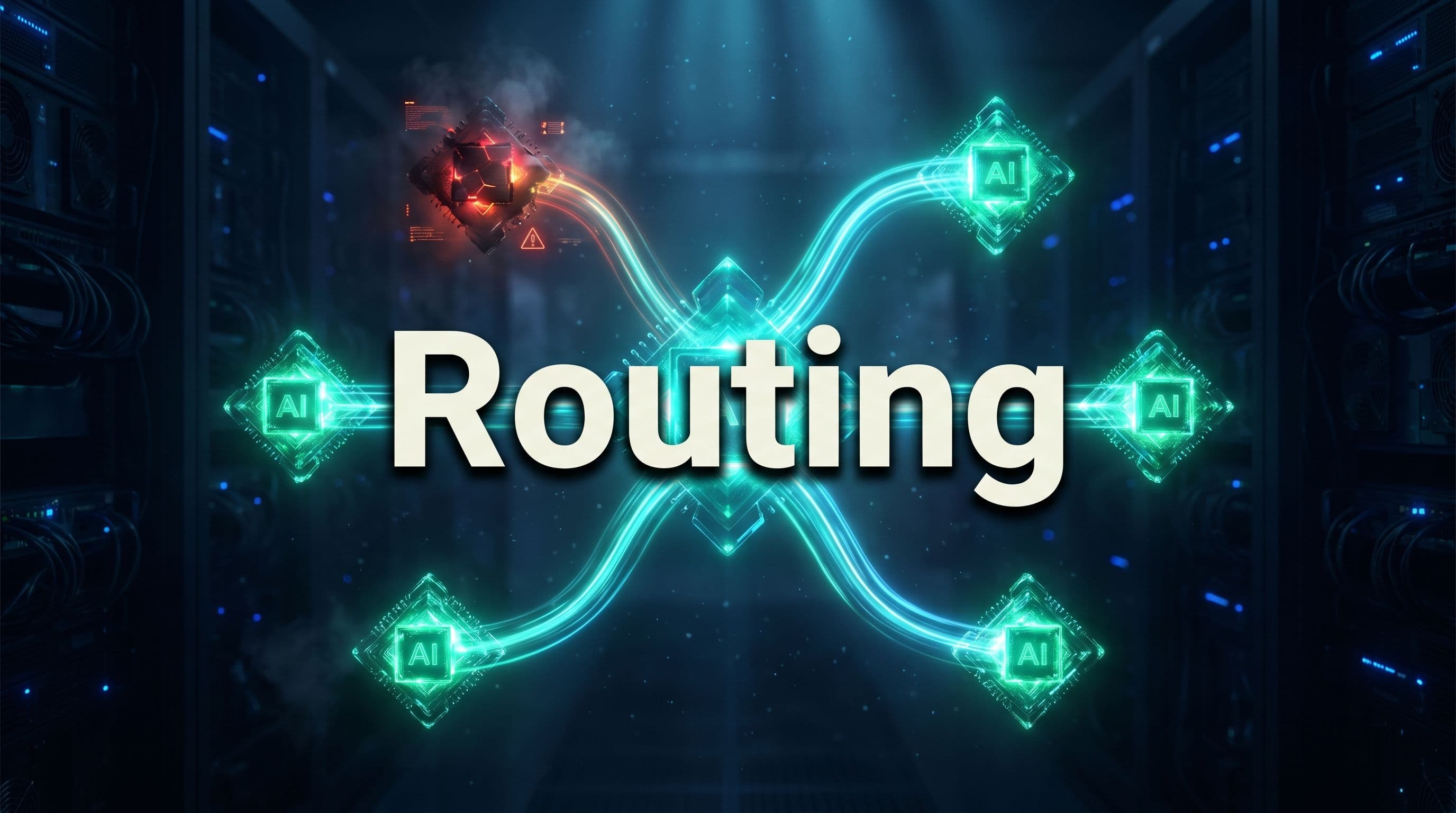
Definition: An LLM router is a control-plane layer between your application and multiple AI models that sends each request to the most suitable model based on cost, latency, quality and confidentiality. It cuts spend, removes single-vendor dependence, and adds automatic failover. *(snippet-ready, ~45 words)*
When a US export-control directive took Anthropic's Fable 5 and Mythos 5 offline worldwide on 12 June 2026, the enterprises that stayed up were the ones whose applications didn't talk to a single provider. An LLM router is what makes that possible. This guide explains what it is, how routing works, how much it saves, and what a vendor-agnostic, EU-sovereign router adds.
What is an LLM router?
An LLM router (also *AI gateway*, *model router* or *LLM broker*) is a layer between your application and many models. Instead of coding against one provider's API, your application calls the router, which picks the best model per request and exposes one unified interface.
- Analyzes each request (task type, complexity, sensitivity)
- Selects the optimal model (cheap model for simple tasks, frontier model for hard ones)
- Handles load balancing and failover across providers
- Reduces cost while maintaining quality
LLM router vs. AI gateway: what's the difference?
They overlap. A router emphasizes per-request model selection; an AI gateway adds auth, governance and observability; a broker emphasizes vendor-neutral mediation across many providers. A strong solution does all three.
How does LLM routing work?
The router scores each request against four criteria:
- Cost — simple tasks to cheap models, expensive ones only when needed.
- Latency — time-critical requests to fast, small models.
- Confidentiality / protection class — sensitive data only to EU or on-prem models.
- Quality — complex tasks to frontier models.
Routing can be static (rules), dynamic (scoring/model-based), hybrid, or learned (RL).
How much does LLM routing save? (the evidence)
- RouteLLM (UC Berkeley/LMSYS, arXiv 2406.18665): up to 85% lower cost on MT-Bench at 95% of GPT-4 quality; a matrix-factorization router hit 95% quality using only 14% strong-model calls [R1].
- AWS Bedrock Intelligent Prompt Routing: "up to 30% without compromising on accuracy," routing within a model family [R2].
- Cost spread: roughly 15–60× between budget and frontier tiers — the math behind right-sizing.
*(Use RouteLLM's benchmark figure as the headline; blanket "40–85% across the board" claims are vendor framing.)*
Vendor-agnostic routing: how it ends vendor lock-in
A provider's own router locks you in one level higher. A vendor-agnostic broker abstracts across providers (OpenAI, Anthropic, Google, Mistral, open-weight), so switching models is configuration, not code. This is the direct fix for AI vendor lock-in.
Failover and no single point of failure
This is the Fable-Ban lesson: when one provider is suddenly restricted, deprecated, or down, a vendor-agnostic router fails over to an equivalent model with no application change — no downtime, no rewrite. None of the top-ranking router guides put this resilience angle front and center; for enterprises it's the most important one.
EU-sovereign and on-prem LLM routing
A protection-class-aware router separates cleanly: confidential data → EU or on-prem model; public data → cheapest cloud model. That keeps processing GDPR-compliant while still capturing cloud cost advantages where allowed. See the sovereign AI pillar for the full architecture.
Build vs. buy
Open-source proxies like LiteLLM are a good start (self-hostable, OpenAI-compatible) but you run, monitor and govern them yourself. Hosted aggregators like OpenRouter are fast but US-hosted (a GDPR weak point) and add a surcharge. Research-grade routers (Martian, Not Diamond) and AWS Bedrock IPR sit in between. Total cost of ownership — and whether protection classes and EU sovereignty must be built in — decide the call.
Synthara — ADVISORI's vendor-agnostic, EU-sovereign broker
Synthara routes each request by confidentiality and cost across many models, with built-in failover, and runs sensitive workloads on European infrastructure via our partner Yorizon. If a provider is banned, repriced, or down, Synthara reroutes automatically.
FAQ
What is an LLM router?
An LLM router is a software layer between your application and multiple AI models that routes each request to the most suitable model by cost, latency, quality and confidentiality, providing one unified API.
How does LLM routing work?
It scores each request and selects a model using static rules, dynamic scoring, or learned policies — sending simple tasks to cheap models and hard ones to frontier models.
Is an LLM router the same as an AI gateway?
Not exactly. A router emphasizes model selection per request; a gateway adds auth, governance and observability. Strong platforms combine both, plus vendor-neutral brokering.
How much does an LLM router save?
Independent research (RouteLLM) shows up to 85% lower cost on MT-Bench at 95% of GPT-4 quality; AWS reports up to 30% within a model family. Real-world savings vary with workload.
Does routing hurt answer quality?
Not when routing is quality-aware: complex requests go to strong models, simple ones to cheaper models. Benchmarks retain ~95% of top-tier quality at far lower cost.
Can I run an LLM router on-premise / in the EU?
Yes. A protection-class-aware router sends confidential data only to EU or on-prem models, keeping processing GDPR-compliant while routing non-sensitive traffic to cheaper cloud models.
References
[R1] RouteLLM, UC Berkeley/LMSYS, arXiv 2406.18665 (ICLR 2025). · [R2] AWS Bedrock Intelligent Prompt Routing (vendor figure). · Provider pricing for cost-tier spread. Fact-check status: `data/page-analyses/fable-ban-pillar-research.md`.
Related articles

Sovereign AI · ADVISORI × Yorizon
Frontier AI on European infrastructure
Frontier performance — entirely in Europe, under European law.
- EU inference — no CLOUD Act, no kill switch
- GDPR-compliant on European hardware
- Automatic failover via Synthara AI Studio
Related articles
Continue exploring with related insights from our experts.
The Fable Ban Explained: What Happened, Who's Affected, and What Enterprises Should Do
On 12 June 2026 a US directive took Anthropic's Fable 5 & Mythos 5 offline worldwide. What happened, who's affected, and what enterprises should do now.
AI Costs in 2026: Why Enterprise AI Spend Is Exploding — and How to Cut It
AI costs are surging in 2026 as token use outpaces falling prices. See why enterprise AI bills explode — and how LLM routing, caching & on-prem cut them.

GDPR-Compliant AI: Why US LLMs Are a Risk and How On-Premise & EU-Sovereign Models Fix It (2026)
Is ChatGPT GDPR-compliant? Why the US CLOUD Act makes US LLMs risky — and how on-premise & EU-sovereign models keep your data compliant. 2026 guide.