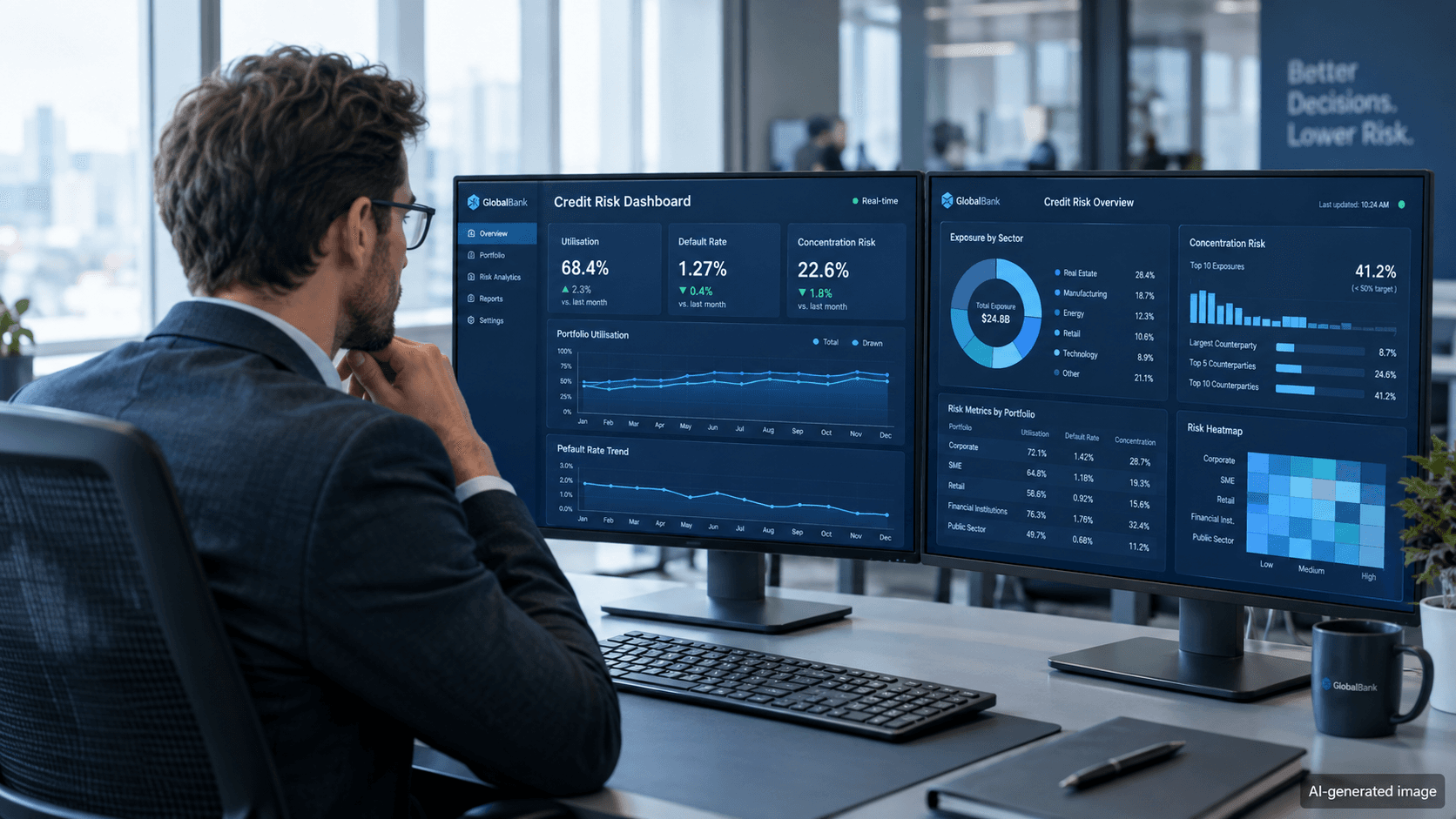
Real-time credit risk monitoring is the continuous surveillance and assessment of credit engagements with the objective to identify potential risks as soon as possible and to react with appropriate measures. What sets it apart from traditional, periodic credit risk monitoring is speed — data is processed and interpreted as it arrives, so a deteriorating exposure shows up in hours rather than at the next quarterly review.
The key components of real-time credit risk monitoring comprise:
- Data integration — bringing together the sources that describe a borrower's health
- Data processing and analysis — turning raw data into signals fast enough to act on
- Dashboards — making those signals visible to the people who decide
- Notifications — pushing a signal to a decision-maker the moment a threshold is breached
- Scenario analysis — testing how exposures behave when conditions change
Together they form the backbone of any credit risk analytics setup that claims to operate in real time.
Data Integration for Credit Risk Analysis: Pulling Together Your Credit Risk Data Sources
Every credit risk assessment is only as good as the data behind it, and that data is rarely stored in one place only. A meaningful real-time view means combining transaction data, market data, credit bureau data and real-time economic indicators into a single picture of each engagement. Data Warehouses and Data Lakes usually do the heavy lifting — the warehouse for structured, query-ready data, the lake for the raw and semi-structured feeds you want to keep for later analysis.
The practical difficulty is not only connecting the pipes. It is that these sources move at different speeds and use different identifiers. Transaction data updates by the second; bureau data might refresh monthly; a single counterparty can appear under two different names across three business lines. If you do not resolve those two identities to one entity, your concentration numbers will mislead you. But concentration risk is what real-time monitoring is meant to catch.
Two actions pay off early. First, put entity resolution and a common counterparty identifier in place before you scale the number of feeds. Second, treat data lineage as a first-class requirement: when an alert fires, you want to trace it back to the source record in seconds.
Data Processing and Analysis: How Credit Risk Analytics Keeps Pace
Once the data is together, it has to become something a decision-maker can use fast. Three techniques do most of the work. Stream processing means that data is analysed more or less as it arrives, which suits event-driven signals such as a missed payment or a covenant breach. Batch processing collects data, stores it, then processes it in scheduled runs, which is perfectly adequate for portfolio-level recalculations that do not need to happen every second.
The insight worth holding onto is that "real time" is a design choice, not a default. Not every signal justifies the cost of a streaming pipeline. A single defaulting exposure is worth catching in seconds; a marginal shift in portfolio probability of default is fine to compute overnight. Many institutions run a hybrid setup for exactly this reason: streaming for the signals that demand immediate reaction, batch for everything else.
One strategic risk sits underneath all of this: model risk. The analytics layer runs on models, and if those models are poorly documented or unvalidated, real-time delivery just means you are wrong faster. Build model governance and explainability in from the start. Regulators increasingly expect you to explain why a system flagged an exposure.
The Credit Risk Dashboard: Turning Data into a Credit Risk KPI View
A credit risk dashboard pulls data from several sources into one visual layer so the state of the book can be read at a glance. A real-time dashboard refreshes continuously and, at its best, sets current figures against historical ones. In this way a trend forming is shown rather than only a snapshot. From there you can move into forecasts and data-driven recommendations. The credit risk KPIs worth watching typically include credit utilisation, default rates, concentration risk and exposure to particular sectors or counterparties.
More on the screen does not necessarily mean more insight. A dashboard that shows forty metrics tells you nothing, because no one can act on forty things at once. Design the dashboard around the role: a board member needs portfolio concentration and trend, a portfolio manager needs exposure movements, an analyst needs the drill-down. And separate early warning indicators from lagging indicators. A default rate is lagging — by the time it moves, the loss has already happened. Rising utilisation, rating migration and widening credit spreads are credit risk early warning indicators; they tell you where the default rate is heading. A dashboard weighted toward lagging metrics feels reassuring, but it reacts too late.
Notifications: Building a Credit Risk Early Warning System
Seeing risk on a screen only helps if the right person is looking. Notifications close that gap. A credit risk monitoring system can be configured to alert risk managers or decision-makers by SMS or e-mail the moment a potential risk appears or a threshold is breached, and those warnings can also be routed straight into the risk management platform. This is the point at which a monitoring setup becomes a genuine credit risk early warning system rather than a passive reporting tool.
The failure mode is well known: alert fatigue. Send too many warnings and people stop reading them, at which point the one alert that mattered gets ignored along with the noise. Well-designed credit risk alerts stand or fall on well-chosen credit risk thresholds: Not every threshold breach deserves an SMS at midnight; reserve the loudest channels for events that need action within hours, and route lower-severity signals to a queue reviewed on a schedule.
There is a compliance dimension too. Keep an audit trail of what was flagged, who was notified and what they did about it. Supervisors want evidence that warnings led to action, and a documented escalation path is far easier to defend.
Credit Risk Scenario Analysis and the EBA Guidelines on Loan Origination and Monitoring
The final component looks forward rather than at the present. The EBA Guidelines on Loan Origination and Monitoring (EBA/GL/2020/06) require that a borrower's credit assessment include their sensitivity to external factors. Critically, that monitoring continues across the life of the loan, not only at origination. In practice this means simulating how your credit portfolios behave when conditions change: the effect of an economic downturn on default rates, or how a rise in interest rates would feed through a mortgage book.
Scenario analysis and stress testing credit portfolios are where real-time infrastructure earns a second payoff. Because the data is already integrated and current, you can rerun a scenario against today's book rather than last quarter's, and you can do it when the news breaks rather than weeks later. That matters when an interest rate decision is announced or a geopolitical shock occurs, and the credit committee wants to know the exposure on the very same day.
Scenario analysis also ties directly into IFRS 9 expected-credit-loss staging, so the forward-looking analysis you do here carries an accounting consequence, not only a risk one.
Making Real-Time Credit Risk Monitoring Work in Practice
These five components of credit risk monitoring are a chain, and the chain is as strong as its weakest link. Flawless data integration feeding a dashboard no one designed for action still misses risk. A fast streaming engine wired to alerts that everyone ignores still misses risk. The value appears when integration, analysis, visualisation, alerting and scenario work reinforce each other, and when each is backed by clear governance over data, models and escalation.
For most institutions the honest starting point is a gap assessment: which of the five is weakest today, and what does closing it require in data, technology and people? That question is more productive than any tool comparison. Done properly, real-time credit risk monitoring turns risk management from a periodic look in the rear-view mirror into a continuous, forward-looking discipline that catches problems while there is still time to act.
Frequently Asked Questions
What is real-time credit risk monitoring?
It is the continuous surveillance and assessment of credit engagements, aimed at spotting potential risks as early as possible and acting on them. Unlike periodic reviews, it processes credit-related data as it arrives, so a deteriorating exposure surfaces in hours rather than at the next scheduled review.
How do you monitor credit risk in real time?
By connecting five components in sequence: integrated data feeds, a processing layer that turns them into signals, a dashboard that makes those signals readable, alerts that push the urgent ones to a named owner, and scenario analysis that tests what happens next. Each link depends on the one before it.
How is it different from traditional credit risk monitoring?
The difference is timing. Traditional credit risk monitoring works on a cycle — monthly, quarterly — and gives you an accurate but dated picture. Real-time monitoring shortens that lag toward continuous, which changes what you can do: you react to a problem while it is forming instead of confirming it after the loss.
What data sources feed a credit risk early warning system?
Typically transaction data, market data, credit bureau data and real-time economic indicators, combined so no single feed drives the view. The harder part is reconciling them. They update at different speeds and often identify the same counterparty differently, which is why entity resolution matters as much as the feeds themselves.
Which KPIs belong on a real-time credit risk dashboard?
Credit utilisation, default rates, concentration risk and sector or counterparty exposure are the usual core. The more useful distinction is leading versus lagging: utilisation trends, rating migration and spread movements tell you where risk is heading, while default rates confirm what has already happened.
What do the EBA Guidelines on Loan Origination and Monitoring require?
Among other things, that a borrower's creditworthiness assessment considers their sensitivity to external factors, and that monitoring continues throughout the life of the exposure. That ongoing-monitoring expectation is a large part of why real-time capability has shifted from nice-to-have toward a supervisory baseline.
How do you stop a monitoring system from drowning people in alerts?
Reserve immediate channels for events that need action within hours, and route lower-severity signals to a reviewed queue. Pair that with a documented escalation path so each alert has a clear owner and a recorded response.
Do you need real-time infrastructure for everything?
No. Some signals — a default, a covenant breach — justify a streaming pipeline; others, such as portfolio-level recalibration, are perfectly fine in overnight batch runs. A hybrid design that reserves real-time processing for signals that demand immediate reaction usually gives the best return on real-time credit risk monitoring.