Your path to becoming an intelligent AI-first company
Salesforce has not only established itself as the CRM market leader, but also as a pioneer in the application and democratization of artificial intelligence in a corporate context.
Their success with platforms like Einstein, the AI Cloud, and the vision of AI agents (Agentforce) offers invaluable lessons.
This playbook distills Salesforce's core strategies and insights into a practical guide to help your company develop and implement its own successful AI strategy.
Goal of this playbook:
Giving you a clear roadmap and actionable steps to harness the transformative power of AI for your business, inspired by the best practices of an industry leader.
Part 1: The Basics – Understanding Salesforce Core Strategies
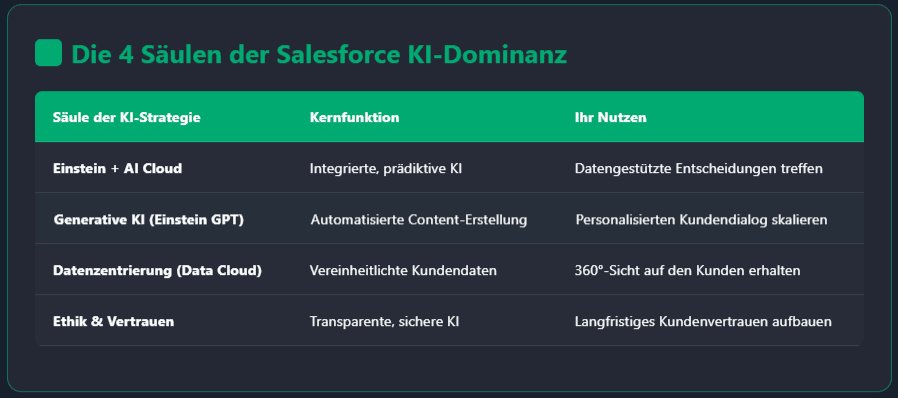
Before we dive into implementation, it's crucial to understand the fundamental pillars of Salesforce's AI strategy:
Einstein & AI Cloud: The heart of intelligence:
Einstein AI Platform:Since its launch in September 2016, Einstein has been deeply integrated into the Salesforce platform to deliver predictive analytics, automated tasks, and intelligent insights across all cloud offerings.[1][2][3] Salesforce was one of the first adopters of artificial intelligence and has introduced its AI tool Salesforce Einstein for select modules.[2]
Salesforce AI Cloud:This bundles various technologies such as Einstein, Data Cloud, Tableau, Slack, Flow and MuleSoft.[4] AI Cloud's goal is to provide companies with a trustworthy, simple and highly personalized AI solution based on real-time data.[4]
Generative AI with Einstein GPT: The revolution of interaction:
Einstein GPT:Introduced by Salesforce as the world's first generative AI specifically for CRM applications, it can deliver AI-generated content for every interaction in sales, service, marketing, commerce and IT.[5][6][7][8][9] Einstein GPT combines public and private AI models with CRM data so users can make requests directly in Salesforce.[5][10]
Application examples areSales GPTfor personalized emails,Service GPTfor service answers,Marketing GPTfor campaign content andCommerce GPTfor personalized shopping experiences.[11][12][13][14]
Agentforce: The future of autonomous work:
AI agents designed to carry out complex tasks autonomously, increase productivity and support human employees.[15][16] Salesforce CEO Marc Benioff describedAgentforce 2.0as an evolution of the company's digital work platform with new thinking, integration and customization functions.[16][17] On 17 December 2024, Salesforce announced full availability of Agentforce 2.0 for February 2025.[16][17]
Salesforce completed its acquisition of Convergence.ai on 11 June 2025.[15][18][19][20][21] Convergence.ai specializes in developing AI agents that can autonomously execute complex, multi-step workflows in dynamic user interfaces.[15][18][19][20][21]
Ethics and trust as a foundation:
Salesforce has thatOffice of Ethical and Humane Use of Technologyfounded to monitor the ethical implications of its technology.[22][23][24][25][26]
TheAI ethics principlesSalesforce includes accountability, transparency, inclusion, empowerment, sustainability, accuracy, security and honesty.[23][24]
TheEinstein Trust Layeris a security layer designed to protect the privacy and security of corporate data when using generative AI.[5][27][28][29][30][31][32] For example, it prevents sensitive customer data from being stored by third-party Large Language Models (LLMs).[27][28][31]
Data Cloud: The Fuel for AI:
The data cloud plays a central role by making it possible to unify customer data from different sources and make it usable for AI applications in real time.[4][33] It is intended to ensure that AI models work with relevant and up-to-date information.[4]
Democratization through developer and customization tools:
Einstein for Developers:A generative AI tool that supports development teams in software development by providing tailored coding suggestions based on the company's own code information.[5][34][35][36][37][38]
Builders (Model Builder, Prompt Builder, Copilot Builder):A suite of low-code tools that enable non-technical users to build AI models, structure prompts, and customize Einstein Copilot.[5][39]
Einstein co-pilot:A conversational AI assistant deeply integrated into the Salesforce platform that helps users answer questions and automate workflows.[5][39]
Part 2: Your AI Strategy Playbook – Learn and Implement from Salesforce
This roadmap, inspired by Salesforce, guides you step-by-step to successful AI implementation:
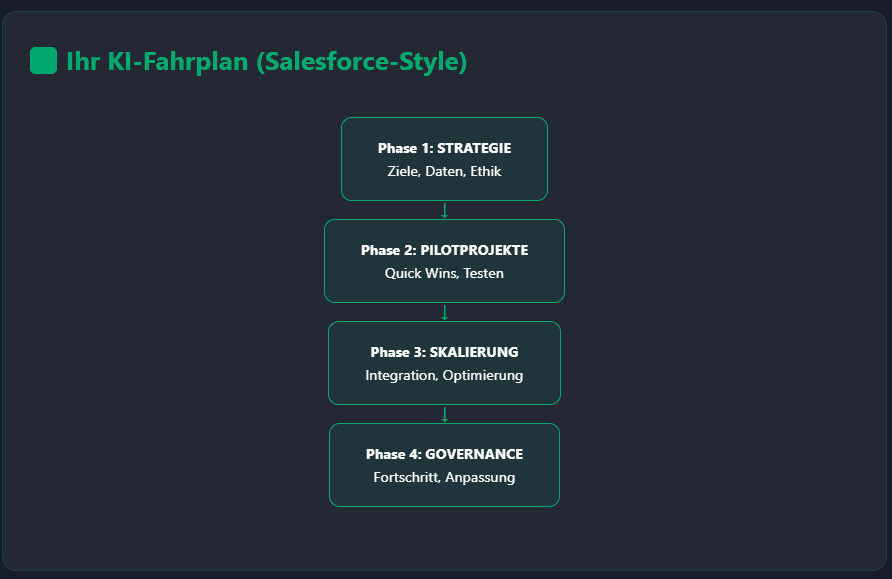
Phase 1: Strategy, preparation and foundation laying
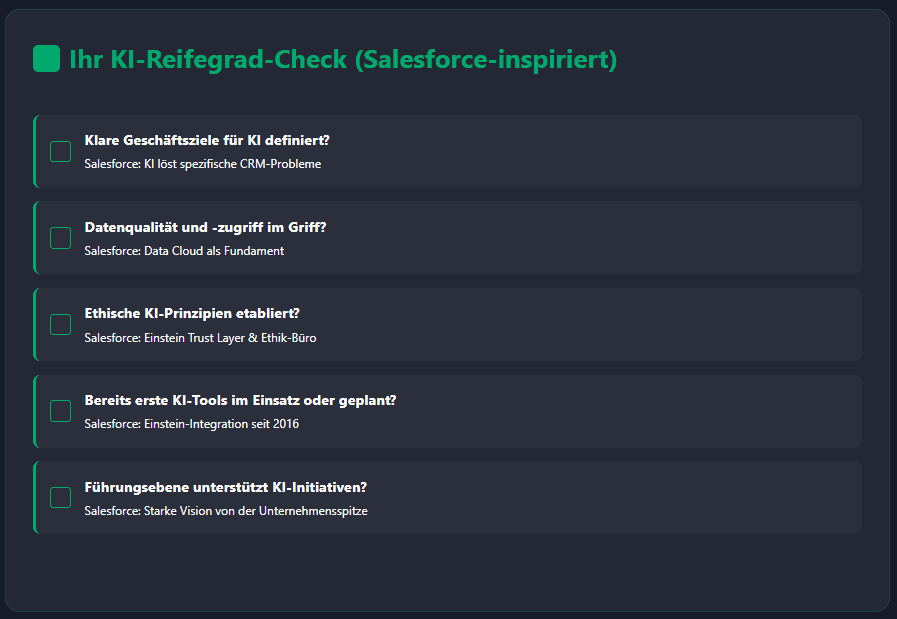
Step 1: Define business goals & identify AI potential.
Salesforce lesson:AI is used to solve concrete business problems and create value for customers.
Your actions:What specific challenges (e.g. customer service efficiency, sales productivity, marketing personalization) should AI address in your company? Define measurable KPIs (Key Performance Indicators).
Example:Goal: Reduce the average processing time of customer inquiries by 20%. KPI: Average processing time.
Step 2: Assess data readiness and establish data governance.
Salesforce lesson:The data cloud is central. Clean, unified data is essential.[4]
Your actions:Analyze your current data landscape. Is your data clean, accessible and integrated? Invest in data cleansing, integration, and governance processes. Designate data controllers.
Expert tip:Avoid the “inadequate data quality” pitfall. Start improving your database early.[40]
Step 3: Define ethical guidelines.
Salesforce lesson:Trust through ethical AI (Einstein Trust Layer, ethical principles).[22][23][24][25][26][27][28][29][30][31][32]
Your actions:Develop internal guidelines for the responsible use of AI. Consider privacy, transparency, fairness and possible bias.
Expert tip:Incorporate ethics from the start ("Ethics by Design") to avoid later problems and loss of trust.[23][25]
Step 4: Convince management and form a cross-functional team.
Salesforce lesson:Strong leadership and broad acceptance are crucial.
Your actions:Secure the support of top management. Put together a team with representatives from IT, specialist departments (sales, marketing, service) and ideally data experts.
Example:The core AI team consists of the CIO, the head of marketing, a sales manager and a data analyst.
Phase 2: Pilots, initial implementations and learning
Step 5: Start with “Quick Wins” and native AI tools.
Salesforce lesson:Einstein offers built-in AI capabilities that get you started quickly.[2][32][40]
Your actions:Identify use cases with high value and relatively low complexity. If possible, use AI functions that already exist in your existing software (e.g. CRM, marketing automation).
Example:Implementation of AI-supported lead scoring in the CRM system to prioritize sales leads.
Step 6: Run and test pilot projects.
Salesforce lesson:Iterative development and continuous learning.
Your actions:Run clearly defined pilot projects in a controlled environment. Measure results and collect feedback.
Expert tip:Don't underestimate the complexity. A pilot project helps to identify challenges at an early stage.
Step 7: Train employees and promote acceptance.
Salesforce lesson:AI is intended to expand human capabilities.[24]
Your actions:Invest in training to explain to your employees how the new AI tools work and how they can be used. Proactively address fears and resistance through clear communication.
Expert tip:A good change management process is crucial to avoid the “lack of user adoption” pitfall.
Phase 3: Scaling, Integration and Optimization
Step 8: Scale successful pilots and deeply integrate AI.
Salesforce lesson:AI is deeply integrated into all Salesforce applications via the AI Cloud.[4][32]
Your actions:Roll out successful pilot applications gradually throughout the company. Ensure seamless integration of AI solutions into existing workflows and systems.
Example:After the successful pilot of the AI chatbot in customer service, it will be expanded to all relevant channels and connected more deeply to the knowledge database and CRM.
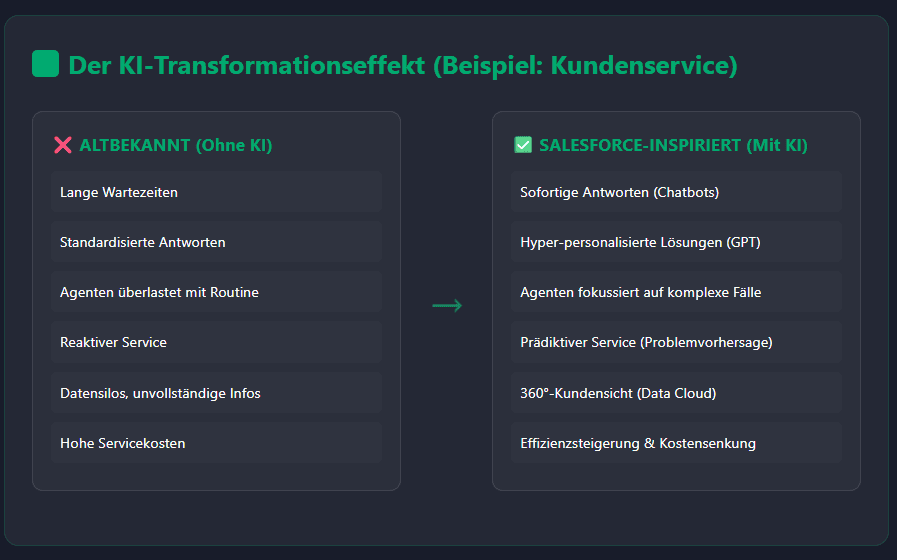
Step 9: Continuously measure, analyze and optimize.
Salesforce lesson:Constant development and adaptation.[24]
Your actions:Monitor the performance of your AI applications using defined KPIs. Use analyzes to identify potential for improvement and regularly optimize models.
Expert tip:Don't neglect model maintenance. AI models age and need to be kept up to date.[40]
Step 10: Check the use of generative AI and AI assistants.
Salesforce lesson:Einstein GPT and Einstein Copilot demonstrate the potential for personalized content creation and intelligent assistance.[5][6][7][39]
Your actions:Evaluate where generative AI (e.g. for email drafting, content ideation, code generation) and AI assistants can improve productivity and customer experience in your company.
Example:Using a generative AI tool to create initial drafts of product descriptions or personalized marketing emails.
Phase 4: Advanced Capabilities, Governance and Future Proofing
Step 11: Consider developing your own AI models and agents (if appropriate).
Salesforce lesson:Agentforce and the Builders tools enable more sophisticated, tailored AI solutions.[5][16][17]
Your actions:If standard solutions reach their limits and you have the appropriate resources and data, consider developing your own AI models or using configurable AI agents for specific, complex tasks.
Step 12: Establish robust AI governance and an ethics board.
Salesforce lesson:The Office of Ethical and Humane Use and the Einstein Trust Layer are central pillars.[22][23][24][25][26][27][28][29][30][31][32]
Your actions:Formalize your AI governance structure. If necessary, establish a committee to assess the ethical implications of new AI applications and enforce policies. Ensure transparency and traceability of AI decisions.
Step 13: Focus on continuous learning and adaptation.
Salesforce lesson:The AI landscape is dynamic.[24] Salesforce CEO Marc Benioff has suggested that productivity gains from AI could mean the company may stop hiring new software engineers in 2025.[33][41][42][43][44]
Your actions:Stay informed about new developments in the AI field. Foster a culture of learning and experimentation. Be prepared to adapt your strategy as technologies and market conditions change.
Expert tip:Avoid a technology-only approach. The focus must always be on business value.
Part 3: Essential Lessons and Pitfalls – The Salesforce Perspective
Key insights for your business (inspired by Salesforce):
Customer centricity:Always focus AI on improving the customer experience.
Data as gold:Invest in data quality and management.[4]
Trust is currency:Prioritize ethical AI and data protection.[22][23][24][25][26][27][28][29][30][31][32]
Democratization promotes innovation:Enable broad access to AI tools.[5][34][35][36][37][38][39]
Integration is power:Embed AI deeply into your processes.[4][32]
Start small, grow smart:Iterative approach reduces risks.
Use partnerships:Collaborations can accelerate access to know-how (e.g. Salesforce and OpenAI or Google Cloud).[5][17]
Pitfalls to Avoid (and How Salesforce Addresses Them):
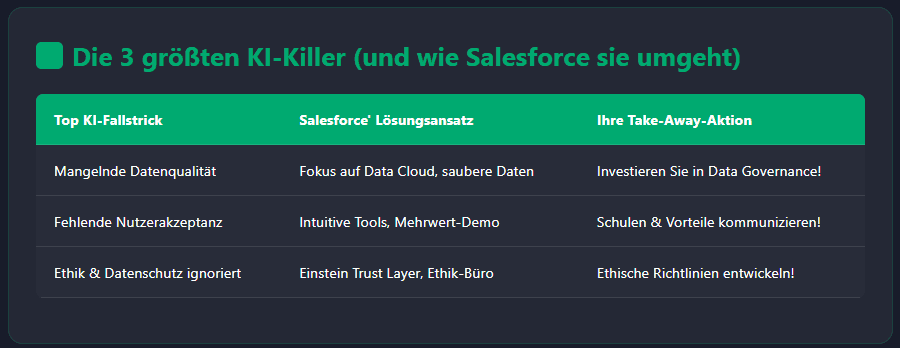
Lack of clear strategic vision:(Salesforce: Clear focus on CRM improvement).
Your tip:Define clear, measurable goals for your AI initiatives from the start.
Inadequate data quality and management:(Salesforce: Data Cloud as a central solution).[4]
Your tip:Invest early in data cleansing, integration and governance.
Underestimating complexity and expertise:(Salesforce: Offers training and easy-to-use tools like Builders).[5][25]
Your tip:Plan sufficient resources for training and, if necessary, external expertise.
Ignoring ethical and privacy concerns:(Salesforce: Einstein Trust Layer, Office of Ethical and Humane Use).[22][23][24][25][26][27][28][29][30][31][32]
Your tip:Make ethics and data protection integral to your AI strategy.
Lack of user adoption and change management:(Salesforce: Focus on expanding human capabilities, intuitive tools).[24]
Your tip:Communicate the benefits clearly and involve employees at an early stage.
Unrealistic expectations of ROI:(Salesforce: Focused on incremental value creation).
Your tip:Start with use cases that provide clear and measurable value.
Technology-fixated approach:(Salesforce: AI always serves business purpose and customer benefit).
Your tip:Always keep an eye on the business value and the impact on people and processes.
Neglecting model maintenance and development:(Salesforce: Continuous Development of Einstein).[24][40]
Your tip:Plan resources for ongoing monitoring and optimization of your AI models.
Your journey begins now: Next steps
This playbook provides a framework inspired by one of the most successful AI practitioners. The next step is to apply these insights to your company’s unique context.
Evaluate your current status:Where do you stand in terms of data maturity, technical infrastructure and AI know-how?
Identify 2-3 pilot projects:Select areas where AI can quickly add visible value.
Assemble your AI core team:Define roles and responsibilities.
Start developing your specific AI roadmap:
Use this playbook as a foundation
The journey to AI-powered transformation is a marathon, not a sprint.
With a clear AI strategy from ADVISORI FTC, a focus on trust and a commitment to continuous learning, your company, inspired by Salesforce, can successfully tap the enormous potential of artificial intelligence.
Sources:
- salesforce.com
- artemis-innovations.de
- thepowerofai.de
- salesforce.com
- salesforceben.com
- comselect.de
- salesforce.com
- marketscreener.com
- abilex.de
- advanis.ch
- cxtoday.com
- constellationr.com
- julianlankstead.com
- salesforce.com
- comselect.de
- salesforce.com
- noltic.com
- salesforceben.com
- cxtoday.com
- verdict.co.uk
- aktien-mag.de
- salesforce.com
- salesforce.com
- xtivia.com
- forbes.com
- ronkaufman.com
- salesforce.com
- salesforce.com
- apexhours.com
- getgenerative.ai
- youtube.com
- bounteous.com
- salesforceben.com
- apexhours.com
- salesforceben.com
- salesforceben.com
- salesforcegeek.in
- salesforce.com
- eweek.com
- demandblue.com
- salesforceben.com
- itpro.com
- windowscentral.com
- theregister.com
Next step: Free initial consultation
Would you like to successfully implement AI strategies in your company? Our experts will be happy to advise you - without obligation and in a practical manner.Arrange an initial consultation now →

Sovereign AI · ADVISORI
Frontier AI on European infrastructure
Frontier performance, entirely in Europe and under European law: as local language models in your infrastructure or orchestrated through Synthara AI Studio.
- EU inference: no CLOUD Act, no kill switch
- GDPR-compliant on European hardware
- Live in a few weeks, no vendor lock-in