BCBS 239 Principles: Your Compass for Data-Driven Decisions in the Financial Sector
What is BCBS 239? Definition and Background
BCBS 239 — officially titled "Principles for effective risk data aggregation and risk reporting" — was published in January 2013 by the Basel Committee on Banking Supervision. The regulation was a direct response to the 2007–2008 global financial crisis, which exposed critical weaknesses in banks' ability to aggregate risk data quickly and accurately. During the crisis, many institutions were unable to provide senior management and supervisors with timely, reliable information about their overall risk exposure — a failure that contributed significantly to the severity of the downturn.
The standard defines 14 principles for risk data aggregation and risk reporting that banks must implement to ensure sound risk management. Compliance has been mandatory for Global Systemically Important Banks (G-SIBs) since January 2016. National supervisors are also strongly encouraged to apply these principles to domestic systemically important banks (D-SIBs). In practice, BCBS 239 has become a benchmark for data governance and risk infrastructure at financial institutions worldwide.
The 14 BCBS 239 Principles at a Glance
The 14 principles are organized into four categories: Governance and Infrastructure, Risk Data Aggregation, Risk Reporting, and Supervisory Review. Together, they form a comprehensive framework that covers the entire data lifecycle — from collection and storage through aggregation, quality assurance, reporting, and supervisory oversight.
Category 1: Governance and Infrastructure (Principles 1–2)
Principle 1 — Governance: The board of directors and senior management bear overall responsibility for the risk data aggregation and reporting framework. They must establish governance structures, assign clear roles, and ensure adequate resources for maintaining data quality and reporting capabilities.
Principle 2 — Data Architecture and IT Infrastructure: Banks must maintain an integrated data architecture and IT infrastructure that fully supports risk data aggregation and reporting under both normal and stress conditions. This includes a single authoritative source for risk data, clear data taxonomies, and robust data lineage.
Category 2: Risk Data Aggregation (Principles 3–6)
Principle 3 — Accuracy and Integrity: Risk data must be accurate, reliable, and free from material errors. Banks should minimize manual workarounds and implement automated data quality checks, reconciliation processes, and clear escalation procedures for data issues.
Principle 4 — Completeness: Aggregated risk data must capture all material risk data across all business lines, legal entities, asset types, and geographies. No material risk exposures should be excluded from the aggregation process.
Principle 5 — Timeliness: Banks must be able to generate aggregate risk data rapidly to meet all normal and crisis reporting requirements. In stress situations, banks should be capable of producing ad-hoc risk reports within 24 hours or even shorter timeframes as required by supervisors.
Principle 6 — Adaptability: Risk data aggregation systems must be flexible enough to accommodate new risk categories, emerging stress scenarios, and ad-hoc data requests. The infrastructure should allow for rapid adjustments without requiring fundamental system redesigns.
Category 3: Risk Reporting (Principles 7–11)
Principle 7 — Report Accuracy: Risk reports must accurately and precisely convey aggregated risk data. Reports should be validated and reconciled against source data to ensure reliability, with clear documentation of any approximations or estimates used.
Principle 8 — Comprehensiveness: Risk reports must cover all material risk areas within the organization at an appropriate level of granularity. This includes credit risk, market risk, liquidity risk, operational risk, and any other risks deemed material by the institution.
Principle 9 — Clarity and Usefulness: Risk reports must be clear, concise, and specifically tailored for their intended recipients. Reports should support informed decision-making by presenting information in a way that is easy to understand, with appropriate context and actionable insights.
Principle 10 — Frequency: The frequency of risk report production and distribution must be adjustable based on the nature of risks, the speed at which they can change, and the needs of recipients. During stress periods, reporting frequency should increase up to intraday as needed.
Principle 11 — Distribution: Risk reports must be distributed to the relevant parties in a confidential manner while ensuring they reach the right decision-makers promptly. Appropriate access controls and information security measures must be in place.
Category 4: Supervisory Review (Principles 12–14)
Principle 12 — Review: Supervisors should periodically review and evaluate a bank's compliance with the BCBS 239 principles. This includes assessing the adequacy of data aggregation capabilities, reporting practices, and the overall governance framework.
Principle 13 — Remedial Actions: Supervisors must have the tools and authority to require remedial actions and impose corrective measures when a bank fails to meet the principles. This may include capital surcharges, mandatory action plans with defined timelines, and restrictions on business activities.
Principle 14 — Home/Host Cooperation: Supervisors must cooperate across jurisdictions to ensure effective oversight of internationally active banks. Home and host supervisors should share information and coordinate their assessments of cross-border banking groups' data aggregation and reporting capabilities.
BCBS 239 Implementation Checklist for Banks
✓ Conduct a gap analysis: Assess current risk data aggregation and reporting capabilities against all 14 principles to identify deficiencies and prioritize remediation efforts.
✓ Establish data governance: Define clear ownership, roles, and responsibilities for risk data across the organization. Implement a data governance committee with board-level sponsorship.
✓ Build a unified data architecture: Create an integrated data platform with a single source of truth for risk data, consistent taxonomies, and full data lineage from source to report.
✓ Automate data quality: Replace manual spreadsheet processes with automated validation rules, reconciliation checks, and exception handling workflows to reduce errors and improve timeliness.
✓ Implement stress-ready reporting: Ensure systems can produce ad-hoc risk reports within 24 hours and scale reporting frequency to intraday during crisis situations.
✓ Document and validate: Maintain comprehensive documentation of data flows, aggregation methods, and report generation processes. Conduct regular internal audits and validation exercises.
✓ Plan for continuous improvement: BCBS 239 compliance is not a one-time project. Establish ongoing monitoring, regular self-assessments, and a roadmap for continuous enhancement of risk data capabilities.
What is BCBS 239? Definition and Background
BCBS 239 — officially titled "Principles for effective risk data aggregation and risk reporting" — was published in January 2013 by the Basel Committee on Banking Supervision. The regulation was a direct response to the 2007–2008 global financial crisis, which exposed critical weaknesses in banks' ability to aggregate risk data quickly and accurately. During the crisis, many institutions were unable to provide senior management and supervisors with timely, reliable information about their overall risk exposure — a failure that contributed significantly to the severity of the downturn.
The standard defines 14 principles for risk data aggregation and risk reporting that banks must implement to ensure sound risk management. Compliance has been mandatory for Global Systemically Important Banks (G-SIBs) since January 2016. National supervisors are also strongly encouraged to apply these principles to domestic systemically important banks (D-SIBs). In practice, BCBS 239 has become a benchmark for data governance and risk infrastructure at financial institutions worldwide.
The 14 BCBS 239 Principles at a Glance
The 14 principles are organized into four categories: Governance and Infrastructure, Risk Data Aggregation, Risk Reporting, and Supervisory Review. Together, they form a comprehensive framework that covers the entire data lifecycle — from collection and storage through aggregation, quality assurance, reporting, and supervisory oversight.
Category 1: Governance and Infrastructure (Principles 1–2)
Principle 1 — Governance: The board of directors and senior management bear overall responsibility for the risk data aggregation and reporting framework. They must establish governance structures, assign clear roles, and ensure adequate resources for maintaining data quality and reporting capabilities.
Principle 2 — Data Architecture and IT Infrastructure: Banks must maintain an integrated data architecture and IT infrastructure that fully supports risk data aggregation and reporting under both normal and stress conditions. This includes a single authoritative source for risk data, clear data taxonomies, and robust data lineage.
Category 2: Risk Data Aggregation (Principles 3–6)
Principle 3 — Accuracy and Integrity: Risk data must be accurate, reliable, and free from material errors. Banks should minimize manual workarounds and implement automated data quality checks, reconciliation processes, and clear escalation procedures for data issues.
Principle 4 — Completeness: Aggregated risk data must capture all material risk data across all business lines, legal entities, asset types, and geographies. No material risk exposures should be excluded from the aggregation process.
Principle 5 — Timeliness: Banks must be able to generate aggregate risk data rapidly to meet all normal and crisis reporting requirements. In stress situations, banks should be capable of producing ad-hoc risk reports within 24 hours or even shorter timeframes as required by supervisors.
Principle 6 — Adaptability: Risk data aggregation systems must be flexible enough to accommodate new risk categories, emerging stress scenarios, and ad-hoc data requests. The infrastructure should allow for rapid adjustments without requiring fundamental system redesigns.
Category 3: Risk Reporting (Principles 7–11)
Principle 7 — Report Accuracy: Risk reports must accurately and precisely convey aggregated risk data. Reports should be validated and reconciled against source data to ensure reliability, with clear documentation of any approximations or estimates used.
Principle 8 — Comprehensiveness: Risk reports must cover all material risk areas within the organization at an appropriate level of granularity. This includes credit risk, market risk, liquidity risk, operational risk, and any other risks deemed material by the institution.
Principle 9 — Clarity and Usefulness: Risk reports must be clear, concise, and specifically tailored for their intended recipients. Reports should support informed decision-making by presenting information in a way that is easy to understand, with appropriate context and actionable insights.
Principle 10 — Frequency: The frequency of risk report production and distribution must be adjustable based on the nature of risks, the speed at which they can change, and the needs of recipients. During stress periods, reporting frequency should increase up to intraday as needed.
Principle 11 — Distribution: Risk reports must be distributed to the relevant parties in a confidential manner while ensuring they reach the right decision-makers promptly. Appropriate access controls and information security measures must be in place.
Category 4: Supervisory Review (Principles 12–14)
Principle 12 — Review: Supervisors should periodically review and evaluate a bank's compliance with the BCBS 239 principles. This includes assessing the adequacy of data aggregation capabilities, reporting practices, and the overall governance framework.
Principle 13 — Remedial Actions: Supervisors must have the tools and authority to require remedial actions and impose corrective measures when a bank fails to meet the principles. This may include capital surcharges, mandatory action plans with defined timelines, and restrictions on business activities.
Principle 14 — Home/Host Cooperation: Supervisors must cooperate across jurisdictions to ensure effective oversight of internationally active banks. Home and host supervisors should share information and coordinate their assessments of cross-border banking groups' data aggregation and reporting capabilities.
BCBS 239 Implementation Checklist for Banks
✓ Conduct a gap analysis: Assess current risk data aggregation and reporting capabilities against all 14 principles to identify deficiencies and prioritize remediation efforts.
✓ Establish data governance: Define clear ownership, roles, and responsibilities for risk data across the organization. Implement a data governance committee with board-level sponsorship.
✓ Build a unified data architecture: Create an integrated data platform with a single source of truth for risk data, consistent taxonomies, and full data lineage from source to report.
✓ Automate data quality: Replace manual spreadsheet processes with automated validation rules, reconciliation checks, and exception handling workflows to reduce errors and improve timeliness.
✓ Implement stress-ready reporting: Ensure systems can produce ad-hoc risk reports within 24 hours and scale reporting frequency to intraday during crisis situations.
✓ Document and validate: Maintain comprehensive documentation of data flows, aggregation methods, and report generation processes. Conduct regular internal audits and validation exercises.
✓ Plan for continuous improvement: BCBS 239 compliance is not a one-time project. Establish ongoing monitoring, regular self-assessments, and a roadmap for continuous enhancement of risk data capabilities.
Executive summary
BCBS 239 is no longer just a compliance issue, but a crucial factor for the future viability of your bank.Learn how to not only fulfill risk data aggregation and reporting, but use it as a strategic advantage to reduce costs, increase efficiency and make informed decisions. Act now before the regulator does!
The most important thing in brief: your knowledge advantage as a decision-maker
- Strategic leverage, not just compliance:BCBS 239 is much more than a mandatory regulatory exercise. It is a fundamental driver for a data-driven corporate culture, improved decision-making,increased agilityand sustainable competitive advantages.
- Supervisory pressure increases significantly:Deficits in the implementation of BCBS 239 lead to noticeably increasing pressure from the ECB and BaFin. The consequences range from increased capital requirements (P2R) to operational restrictions – a direct risk to your balance sheet and reputation.
- Foundation for the future:A robust, BCBS 239-compliant data architecture is the indispensable basis for dealing with future regulatory waves (e.g. IReF, ESG reporting) and the successful implementation of digitalization strategies (AI, advanced analytics) as well as ensuring crisis resilience.
- Governance and culture are crucial:The “soft” factors – strong data governance, clear responsibilities carried by the board right down to the departments and a data-savvy corporate culture – are often more critical to success than pure technology investments. Real “tone from the top” and “board engagement” are required here.
- Measurable added value beyond risk:Consistent implementation not only enables more precise risk control, but also opens up significant efficiency potential (e.g. through consistent automation and process optimization) and profit opportunities (e.g. through better data quality for product development and pricing).
Introduction: Why BCBS 239 needs to be at the top of your strategic agenda now
The 2008 financial crisis exposed a critical vulnerability in the global banking system: the inability of many institutions to identify, aggregate and report risks quickly and accurately. In response, the Basel Committee on Banking Supervision published the “Principles for effective risk data aggregation and risk reporting” (BCBS 239) in 2013. But even more than a decade later, many institutes are still struggling with full implementation. The supervisory authorities, especially the ECB, are increasingly losing patience.
This article is not another technical guide. It is a strategic compass for you as a decision maker. We shed light on why BCBS 239 can no longer be viewed as an isolated compliance task, but must be understood as a central pillar of your corporate strategy. We show:
- How BCBS 239 is deeply integrated into national (MaRisk) and European regulations and underlines their strategic importance.
- What immediate impact the principles have on critical areas such as IFRS, FRTB and AnaCredit and how you can use synergies.
- What strategic and operational imperatives arise for your institute to not only remain compliant but also competitive.
- How the expectations of the supervisory authorities (ECB, BaFin) have become more stringent and what concrete measures you now need to take to minimize risks and take advantage of opportunities.
Together, let's uncover the "Untold Stories" behind BCBS 239 and understand how to transform these principles from a liability into a true strategic advantage.
1. BCBS 239 & MaRisk:
More than just a tick on the checklist
The strategic anchoring in German supervisory law
The principles of BCBS 239 were not simply “noted”; they were actively incorporated into national supervisory practice. In Germany, this happened primarily through BaFin's minimum requirements for risk management (MaRisk). This was no coincidence, but a strategic decision to put data quality at the center of risk management and to clearly anchor responsibility for it at board level.
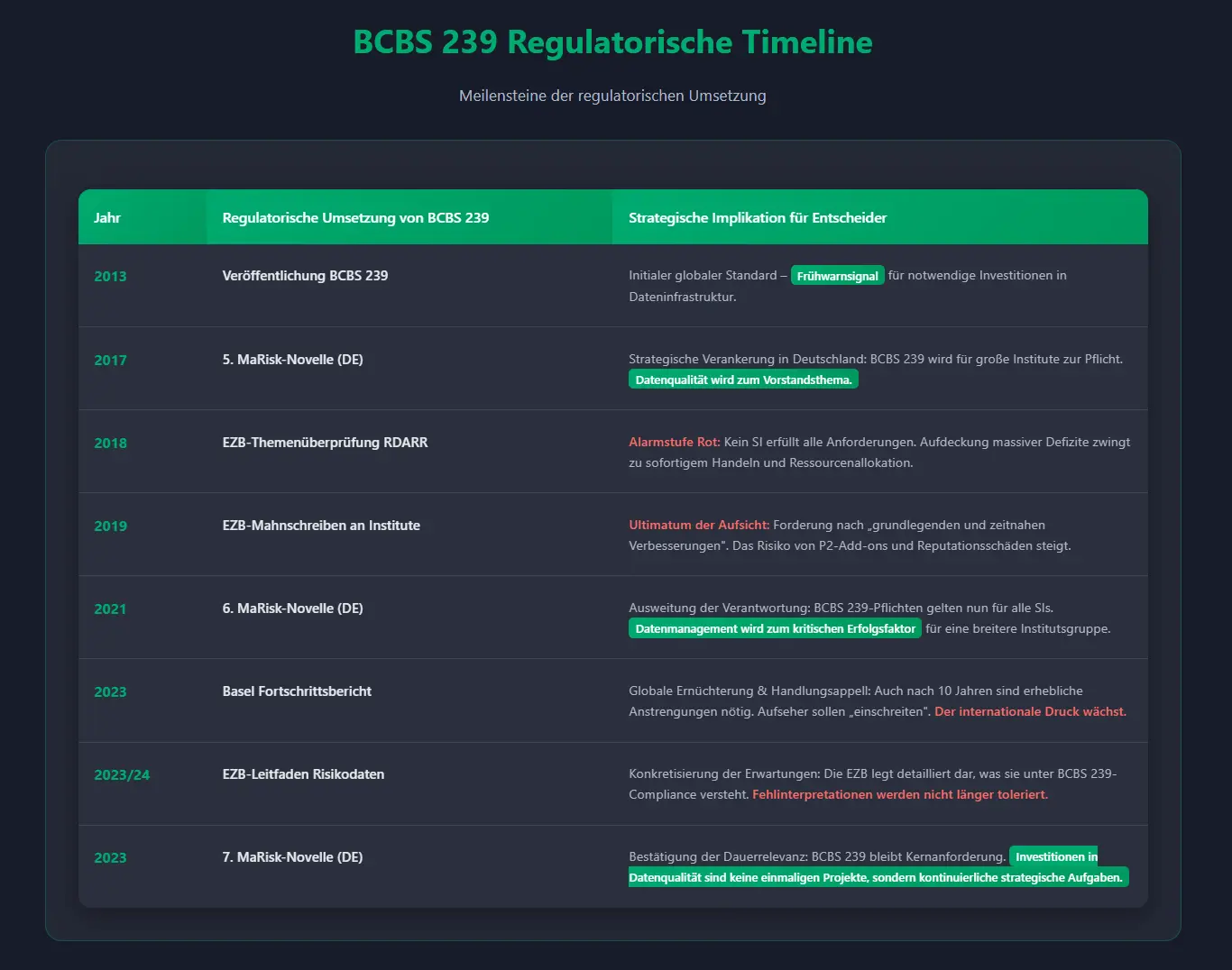
The wake-up call of MaRisk 2017 (5th amendment):
BaFin itself described the implementation of BCBS 239 as “one of the central reasons” for this amendment. With the module AT 4.3.4 “Data management, data quality and risk data aggregation” explicit requirements for data architecture and quality for system-relevant institutions were formulated for the first time. The strategic thrust was clear: to create a robust IT infrastructure that enables timely, automated and accurate risk aggregation. The goal: decision-makers should be able to “react immediately to changes in the risk situation […]”. At the same time, in the moduleBT3The risk reporting requirements for all institutions have been tightened - a clear signal of its industry-wide importance.
The tightening by MaRisk 2021 (6th amendment):
The supervision stepped up. The requirements from AT 4.3.4 have been extended to all significant institutions (SIs). This now affected around 20 German banks, which had to anchor a comprehensive data aggregation strategy at board level. The message: Data quality is no longer a niche issue, but rather a supervisory focus with strategic relevance for a broader range of institutions.
Continuous relevance – MaRisk 2023 (7th amendment):
Although new topics such as ESG risks came into focus, the BCBS 239-based requirements remainedunwavering quality standard for risk dataconsist. This underlines the long-term strategic importance.
Milestones of regulatory implementation
2. The domino effect:
How BCBS 239 redefines the rules of the game for IFRS, FRTB, AnaCredit & Co
The core principles of BCBS 239 – data quality, accuracy, completeness, timeliness, consistency and adaptivity – are so fundamental that they inevitably spill over into other regulatory areas. Modern, strategic bank management requires integrated data management. Anyone who masters BCBS 239 creates the basis for much more.
Regulatory reporting (COREP/FINREP):
The demand for “One Truth”
The ECB explicitly expects that a bank's data governance frameworkall supervisory reporting processescovers. MaRisk AT 4.3.4 requires the comparison of risk data with reporting data.
- Strategic implication:No more data silos! BCBS 239 enforces a consistent data basis. This not only reduces error rates and supervisory inquiries, but also reduces reporting costs in the long term. Institutes that are leaders here gain in efficiency and credibility.
- Untold Story:The ability to automatically reconcile AnaCredit data with FINREP/COREP, as the majority of banks do, is a direct outgrowth of the BCBS 239 logic and an indicator of operational excellence.
IFRS financial reporting:
Bridge between risk and balance sheet
The ECB guidelines require oneGroup-wide integrated data architecturefor risk, supervisoryandFinancial reporting. Key figures according to IFRS 9 (e.g. expected credit losses) require reliable risk data.
- Strategic implication:BCBS 239 promotes the convergence of risk management and financial reporting. This enables more precise, risk-adjusted management and more transparent communication with investors. A “Single Source of Truth” is becoming a reality.
- Untold Story:Banks that use BCBS 239 as an opportunity to integrate risk and financial data budgets can not only implement IFRS 9 more efficiently, but also put their capital allocation and profitability analyzes on a more solid basis.
Market risk and FRTB: There is no stable house without a data foundation
The Fundamental Review of the Trading Book (FRTB) places immense demands on the daily, granular recording and aggregation of risk data. BCBS 239 Principle 6 (Adaptability) is essential for this.
- Strategic implication:BCBS 239 is theBasic requirementfor the successful implementation of FRTB. Institutions that have modernized their data infrastructure as part of BCBS 239 have a clear time and cost advantage.
- Untold Story:Supervisors view a robust BCBS 239 implementation as a litmus test of a bank's ability to reliably run complex models such as FRTB or sophisticated stress tests. Anyone who slips up here risks higher capital requirements or even restrictions in trading.
Granular credit data (AnaCredit & Co.): Quality in detail
AnaCredit requires detailed, Europe-wide defined data for each loan. This requires clearly identifiable, consistently named and automatically consolidable data – core requirements of BCBS 239.
- Strategic implication:The data quality standards and central data hierarchies established by BCBS 239 are worth their weight in gold for fulfilling granular reporting obligations. Synergies in the IT infrastructure can save significant costs.
- Untold Story:The challenge from AnaCredit has further increased the pressure for strict data quality management and thus indirectly cemented the importance of BCBS 239 as an overarching quality framework for all data flows.
Strategic conclusion to point 2:BCBS 239 is not an isolated topic, but rather the linchpin for a variety of data-driven regulatory requirements. An investment in BCBS 239-compliant structures pays off in several ways by facilitating compliance in other areas, reducing costs and increasing strategic agility. It is the foundation on which a modern, efficient and resilient banking IT and process landscape is built.
3. From cost factor to value driver:
Strategic and Operational Imperatives through BCBS 239
Implementing BCBS 239 is a transformation, not a one-time project. It requires strategic foresight and operational excellence. Anyone who recognizes this can turn the regulatory necessity into a real competitive advantage.
Data governance and organizational structure:
Data quality is a top priority
Principle 1 of BCBS 239 calls for taking responsibility for
Data risks and quality by the board.
- Strategic imperative:Establish powerful data governance with clear roles (Chief Data Officer, Data Owner, Data Stewards) and responsibilities. Data quality must become part of the risk culture, supported by the “tone from the top”.
- Operational implementation:Implement cross-functional data quality committees. Adapt job profiles and invest in training.
- Untold Story:The ECB is considering including the data skills of business managers in fit and proper assessments. This signals that data management expertise is becoming a key qualification in top management.
IT architecture and data infrastructure:
The end of data silos
A company-wide, integrated data architecture is required.
- Strategic imperative:Invest in building central data platforms (data warehouse/lake) that integrate risk, financial and reporting data. Break down historical silos.
- Operational implementation:Modernize core banking and risk systems for automated interfaces. Define and implement centralized data hierarchies and dictionaries.
- Untold Story:Modern data platforms not only shorten reporting times drastically (from >40 days to a few days or even ad hoc), but also create the agility to be able to react quickly to new requirements (FRTB, stress tests) - a decisive competitive advantage.
Data quality management:
Trust is good, control is better
BCBS 239 requires continuous data quality management with internal standards and monitoring.
- Strategic imperative:Make data quality a measurable and controllable factor. Establish an internal control system for data.
- Operational implementation:Develop data quality KPIs, automated validations and escalation processes. Implement an independent validation function (2nd line).
- Untold Story:These are solid dataBasis for digitization projects. Institutions with excellent data quality can use innovations such as AI in risk modeling more successfully and with less risk.
Reporting processes and content:
From compulsory to freestyle
BCBS 239 aims for more frequent, timely and recipient-focused risk reporting.
- Strategic imperative:Develop reporting from pure information provision to a true strategic management tool.
- Operational implementation:Formalize standard reports, customize reporting calendars, and create processes for rapid, ad-hoc analysis in crisis situations.
- Untold Story:The ability to deliver group-wide exposure overviews within 1-2 days (as required in COVID-19 stress tests) is a direct measure of BCBS 239 readiness and can be critical to survival in crises.
Costs, benefits and long-term transformation: The marathon is worth it
The initial investment is significant, but the long-term benefits outweigh them.
- Strategic imperative:Don't view BCBS 239 as a cost item, but rather as an investment in the future viability and efficiency of your institute.
- Operational implementation:Closely link BCBS 239 projects to business strategy and digitalization initiatives. Identify quick wins (e.g. eliminating manual processes).
- Untold Story:Institutions with a “single source of truth” can allocate capital more precisely, analyze customer profitability more granularly and react more quickly to market changes. BCBS 239 is the catalyst for understanding and using data as a strategic asset.
Transformation of
Challenges into opportunities

4. The clock is ticking:
Current implementation status and the unmistakable expectations of the ECB and BaFin
Despite the clear benefits and lengthy deadlines, regulators are becoming increasingly impatient with progress in implementing BCBS 239. The message from Frankfurt and Berlin is clear: the time to wait is over.
European level – ECB/SSM:
Patience is running out
The ECB has had BCBS 239 as a supervisory priority for years. The results of the 2018 topic test were sobering:"no significant institution had fully complied with the principles". The result was warning letters and clear demands“substantial and timely improvements”.
TheECB Guide to Effective Risk Data Aggregation and Reporting (RDARR), finalized in May 2024, is a turning point. It specifies expectations and sends an unmistakable signal:
- Comprehensive data governance framework:What is required is a group-wide approach that includes all key subgroups as well as financial and supervisory reports. No more isolated solutions!
- Clear roles and responsibilities:The appointment of data owners and a central data governance function are non-negotiable. The ECB emphasizes the need for organizational anchoring.
- Integrated data architecture:A “group-wide integrated data architecture” with a data dictionary and clear data lineage is mandatory. Transparency down to the last detail is expected.
- Ambitious data quality controls:What is needed is institutionalized quality management with ambitious internal goals that go beyond the minimum and their independent validation.
- Board awareness and monitoring:The board must actively control and monitor. Management's data competence could become part of the suitability test in the future - a strong signal of strategic importance.
The ECB's strategic message:Full and sustainable implementation of BCBS 239 is now imperative. Deficiencies in risk data can lead to increased capital requirements (P2R) or obligations. RDARR was the worst-rated area in the SREP in 2023 - a clear indication of a need for action.
4.2 National level – BaFin/Bundesbank: Focus on consistent implementation
BaFin and the Bundesbank consistently implement the European requirements and have formulated clear expectations regarding MaRisk:
Exam focus
Compliance with AT 4.3.4 is an integral part of annual audits and special MaRisk audits. Defects lead to catalogs of measures with strict follow-up.
LSIs in view
Even less significant institutions (LSIs) must ensure data quality that is proportional to the business model. BCBS 239 principles are considered best practice here.
Strict interpretation
German supervision is known for a detailed and often strict interpretation. The required comparison of risk data with accounting data and the documentation requirement for manual adjustments are examples of this.
Current implementation status and outlook
Although major German banks have gone through extensive BCBS 239 programs, one“full compliance green”rarely. The Basel Progress Report 2023 emphasizes that“additional work required in all banks”is. The supervisory authority will take a particularly close look at medium-sized institutions, which have only been fully obliged since 2021.
The strategic implication for you:Hesitation is no longer an option. The regulator expects every significant institution to have one by 2025robust risk data and reporting landscapecan demonstrate. Initiatives such as the European Integrated Reporting (IReF) will further tighten the requirements for data consistency and implicitly build on BCBS 239.
Strategic implications & key takeaways for decision makers
- BCBS 239 is not a project, but a paradigm shift:It requires a fundamental shift in culture, processes and technology towards a data-centric organization. This is an ongoing task for top management that requires active board commitment and the promotion of a company-wide data culture.
- Data excellence is the key to future viability:Only with high-quality, timely and aggregatable data – the quality of which is ensured by independent validation processes and a clear data line – can banks manage complex risks, efficiently meet regulatory requirements and successfully implement digital innovations.
- Proactive action is more cost-effective than reactive crisis management:Investing in a solid data infrastructure, consistent automation and governance not only avoids expensive regulatory sanctions, but also creates operational efficiency, strategic agility and crisis resilience.
- The supervisory authority is serious – ignoring is not an option:The ECB and BaFin will maintain the pressure and take consistent action in the event of non-compliance. The “grace period” is definitely over.
Conclusion: See BCBS 239 as a strategic opportunity
BCBS 239 has evolved from a technical guideline to a key strategic imperative for the financial industry. It calls for a culture change – away from fragmented data silos and towards oneData Driven Bank, where reliable information forms the basis of every decision.
For you as a decision-maker this means:
- Check the status quo:Where does your institute really stand in terms of implementing BCBS 239, not just on paper, but in actual practice?
- Strengthen governance:Is responsibility for data quality clearly anchored at board level and extended down to the departments?
- Invest strategically:Use the requirements of BCBS 239 as a catalyst for modernizing your IT landscape and optimizing your processes.
- Think beyond compliance:Recognize the potential for increased efficiency, improved risk management and new business opportunities that lies in an excellent database.
Successfully mastering the BCBS 239 challenges is not just a question of regulatory compliance, but a crucial factor for the resilience, competitiveness and future viability of your institute. Start today by seeing BCBS 239 not as a burden, but as a strategic opportunity and set the course for a data-driven future. Those who lead this change will be the winners in tomorrow's financial market.
Next step: Free initial consultation
Would you like to address these issues strategically? Our experts will be happy to advise you - without obligation and in a practical manner.Arrange an initial consultation now →
Frequently Asked Questions About BCBS 239
What is BCBS 239 and why is it important?
BCBS 239 is a Basel Committee standard with 14 principles for effective risk data aggregation and risk reporting, mandatory for globally systemically important banks (G-SIBs).
What are the 14 principles of BCBS 239?
The 14 principles cover four categories: Governance and Infrastructure (1-2), Risk Data Aggregation capabilities (3-6: Accuracy, Completeness, Timeliness, Adaptability), Risk Reporting practices (7-11: Accuracy, Comprehensiveness, Clarity, Frequency, Distribution), and Supervisory Review (12-14).
Who is affected by BCBS 239?
Primarily G-SIBs and D-SIBs, but regulators increasingly expect smaller banks to appropriately implement the principles, especially regarding data quality and risk management.
ISO 31000, MaRisk and DORA — integrated risk management
We develop your risk framework in a 30-minute strategy session — industry-specific and audit-ready.
Book a Risk Strategy Session30 Minuten • Unverbindlich • Sofort verfügbar