Business intelligenceas a strategic competitive advantage: What decision-makers need to know in 2025
Table of Contents
- Business intelligence as a strategic competitive advantage
- The measurable ROI of business intelligence
- The leading BI technologies
- Concrete competitive advantages through modern BI solutions
- The biggest implementation hurdles
- Best practices for successful BI integration
- The connection between BI maturity and company success
- Conclusion
In a data-driven business world, business intelligence (BI) is no longer an optional extra - it is the key to sustainable corporate success. As a consultant for digitalization strategies, I experience every day how companies can significantly improve their market position through the targeted use of BI solutions.
While large corporations are already benefiting extensively from these technologies, German medium-sized companies are often still at the beginning of this transformation. However, my experiences show that there is enormous potential here.
In this article you will find out what specific competitive advantages BI offers, how investments actually pay off and which strategies are crucial for successful implementation - all based on current studies and practical experience from 2025.
The measurable ROI of business intelligence: convincing numbers
Let's first talk about return - because ultimately this is the key figure that counts for you as a decision-maker. The latest studies from the MIT Sloan Management Review impressively confirm that companies with a mature data strategy achieve on average 4% higher productivity and 6% higher profits than their less data-oriented competitors.
Even more impressive: 65% of data-driven mid-sized companies outperform their competition financially, while only 33% of data-poor companies do so. On average, successful analytics projects lead to 8% revenue growth while reducing costs by 10%.
A concrete example from medium-sized businesses illustrates this potential:
A medium-sized retail company invested EUR 75,000 in a BI solution (EUR 41,000 for SaaS licenses, EUR 30,000 for implementation and EUR 4,000 for training). The result? 15% lower storage costs and 10% increase in sales within the first year.
These numbers show that BI investments can quickly pay for themselves - provided the implementation is strategic and holistic.
The leading BI technologies that ensure your competitive advantage
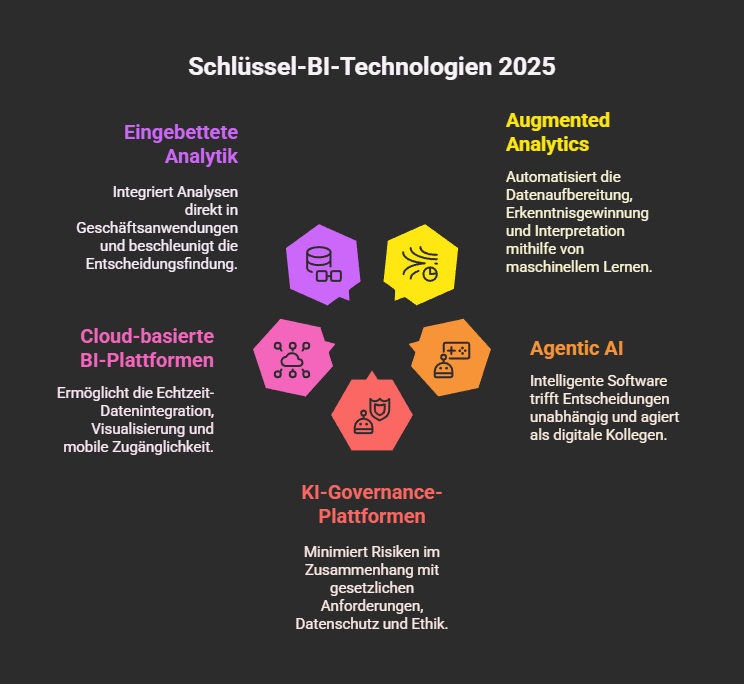
As a decision-maker, you need to know which technologies really make a difference. Based on the latest analyst reports fromGartnerandForresterFive key technologies are emerging for 2025:
1. Augmented Analytics with AI integration
Augmented analytics is at the forefront of business intelligence trends 2025. This advanced form of data analysis uses machine learning and AI to automate data preparation, insight generation and interpretation.
According to the latest Forrester Wave™ assessment (Q2 2025), MicrosoftPower BIthe leading platform in this category with the highest rating of any provider in generative AI functionality.
2. Agent-based AI (Agentic AI)
Gartner identifies Agentic AI as one of the most important technology trends for 2025. These intelligent software programs can make decisions and take actions independently by meaningfully combining different AI technologies.
They act as competent digital colleagues who derive insights from data that is often not even visible to human employees - a huge productivity boost for the entire company.
3. AI governance platforms
As AI becomes more widespread, the risks regarding legal requirements, data protection and ethical issues also increase. AI governance platforms are designed to minimize these risks and ensure responsible use of AI.
These platforms are becoming particularly important in regulated industries and in Europe with the introduction of the AI Act.
4. Cloud-based BI platforms
Cloud-based BI solutions like Domo enable real-time data integration, extensive visualization options and mobile accessibility. The Gartner Magic Quadrant 2025 ranks Domo as a Visionary Vendor, recognized for its ability to process large amounts of data and deliver real-time insights.
5. Embedded Analytics and Decision Intelligence
Sisense is highlighted as a Visionary in the Gartner Magic Quadrant, particularly for its embedded analytics capabilities and ability to process large and complex data sets. This technology makes it possible to integrate analytics directly into business applications, accelerating decision-making processes and democratizing access to data.
Concrete competitive advantages through modern BI solutions
Implementing these technologies leads to measurable competitive advantages in various business areas:
Optimized supply chains and logistics
In the logistics industry, companies like DHL have implemented AI-powered optimization algorithms for route planning. This resulted in an ROI increase of up to 15% within 12 to 18 months.
Data-based optimization made it possible to shorten delivery times, reduce fuel consumption and increase customer satisfaction.
Personalized customer marketing
Retail benefits significantly from AI-based personalization tools. Amazon was able to achieve an impressive increase in sales of up to 35% by using advanced BI solutions for product recommendations.
This personalization allows companies to more precisely anticipate customer needs and create tailored offers.
Increasing efficiency in the healthcare system
In the healthcare sector, implementing BI systems to automate patient management and improve diagnostics has resulted in cost savings of 20% in two years for some hospitals.
This increase in efficiency allows medical facilities to serve more patients while improving the quality of care.
Digitalized business processes
Companies that digitize their business processes can increase their productivity by an average of 3.3%. Well-known examples such as Siemens and AXA Germany have achieved significant efficiency improvements through AI and digitalized processes.
The biggest implementation hurdles – and how to overcome them
As a decision-maker, you not only need to know the opportunities, but also the challenges. Here are the key hurdles to BI implementation and how you can overcome them:
Data quality and system integration
A recent IBM study identified inadequate data quality as the most common problem when implementing AI solutions in Germany (51% of respondents). In addition, 44% of companies report difficulties integrating new AI solutions into existing systems.
Solution strategy:
- Comprehensive data cleansing initiatives prior to BI implementation
- Use of data mapping and ETL tools (Extract, Transform, Load)
- Gradual integration instead of a complete system change
Shortage of skilled workers
The shortage of skilled workers remains one of the biggest challenges, especially for medium-sized companies. According to BVMW, 62% of medium-sized companies fear that they will not be able to fill vacant training positions in the coming year.
Solution strategy:
- Investing in further training for existing employees
- Collaboration with external partners and consultants
- Leverage BI platforms with lower complexity and more intuitive user interfaces
Digitalization lag in medium-sized businesses
Compared to large companies, medium-sized companies are significantly behind in various aspects of digitalization. The use of cloud solutions is 35% among SMEs compared to 70% among large companies, and for automated business processes the difference is even 40% (20% for SMEs vs. 60% for large companies).
Solution strategy:
- Focusing on pragmatic and cost-effective solutions
- Use of flexible and agile processes
- Clear prioritization of core processes that can be optimized through digitalization
- Involvement of employees in the digitalization process
Best practices for successful BI integration
As an experienced consultant, I recommend the following best practices for a successful BI implementation:
Strategic planning and change management
According to oneMcKinsey-Survey from 2022, digitalization initiatives in corporations fail more often due to a lack of change management than due to the technology itself. It is therefore crucial that you:
- Develop a clear vision and objective for your BI investments
- Establish a structured change management process that includes all hierarchical levels
- Implement a comprehensive communications strategy that demonstrates the benefits of BI implementation
Use open source and hybrid approaches
The increasing use of open source solutions is becoming apparent as an important trend: 31% of German companies state that more than half of their current AI solutions are based on open source. By 2025, 49% expect the use of open source AI to be a key area of optimization.
Successful strategies include:
- Combination of proprietary and open source solutions
- Building internal competencies for open source technologies
- Integration of cloud-based services for flexible scaling
Promote data democratization and self-service BI
An often overlooked success factor is the broad anchoring of BI in the corporate culture. Promote data democratization by:
- Providing user-friendly self-service BI tools
- Training employees from all departments in the use of data analysis tools
- Establishing a data literacy program
- Ensuring data quality and consistency through central governance
The connection between BI maturity and company success
Research-based findings show a clear connection between a company's BI maturity and its economic success. Various maturity models help you assess your current status and plan the next steps:
Gartner's Maturity Model for Business Intelligence and Performance Management identifies five levels of maturity: unaware, tactical, focused, strategic and pervasive. The assessment covers three key areas: people, processes, metrics and technology.
The TDWI BI and AI Maturity Model provides a framework for organizations to understand where they are, where they have been, and where they still need to go to support great data practices. This model also takes into account the components of the data ecosystem and data governance.
What's particularly important to understand is that business value and ROI accelerate in the final three stages of maturity as BI becomes an enterprise-wide initiative. While early maturity levels often show fragmented initiatives and limited success, advanced maturity levels enable strategic use of BI across all business areas.
A new factor is AI readiness: TDWI has developed a dedicated AI Readiness Assessment to help organizations better understand what it takes to support a successful AI program. This assessment objectively measures an organization's AI readiness across five dimensions and recognizes that advanced AI capabilities must be built on a solid BI foundation.
Conclusion: BI as a core component of your corporate strategy
Business intelligence has evolved from a technical tool to a strategic competitive advantage. The study results clearly show that companies that successfully implement BI can achieve significant financial and operational benefits.
There is still considerable potential for German medium-sized businesses to catch up on the digitalization gap and achieve competitive advantages through targeted BI investments. The success factors lie not only in the technology itself, but also in the organization, the employees and the corporate culture.
Developing BI capabilities is not a one-time project, but a continuous process that requires a gradual increase in data maturity. Companies that approach this process strategically and integrate it into their overall strategy will continue to be successful in the future and secure competitive advantages.
As an experienced consultant, I would be happy to assist you in developing and implementing your individual BI strategy. Let us work together to create a data-driven company that will remain competitive in the future.
Do you have questions about implementing business intelligence in your company?Contact us for a non-binding consultation.
Last updated: June 2025
Next step: Free initial consultation
Would you like to address these issues strategically? Our experts will be happy to advise you - without obligation and in a practical manner.Arrange an initial consultation now →
Next step: Free initial consultation
Would you like to address these issues strategically? Our experts will be happy to advise you - without obligation and in a practical manner.Arrange an initial consultation now →
Next step: Free initial consultation
Would you like to address these issues strategically? Our experts will be happy to advise you - without obligation and in a practical manner.Arrange an initial consultation now →
Enterprise AI for regulated industries — from strategy to production
EU AI Act, GDPR, MLOps and productive AI in a 30-minute strategy session — vendor-independent and ISO 27001-certified.
Book an AI Strategy Session30 Minuten • Unverbindlich • Sofort verfügbar