
Klarna record sales per employee thanks to AI strategy – 5 learnings + ROADMAP

Klarna’s AI ROI decoded
What leaders need to learn now
Quick overview: Swedish BNPL pioneer Klarna drives its revenue per employee to nearly $1 million after generative AI now automates over 200 processes. But quality problems are forcing fintech to bring people back. For C-level teams, the lesson is twofold: AI can unlock radical efficiency – but only with clear guardrails, thoughtful workforce design and relentless customer centricity.
“Good to know” executive summary
- Sales per capita are approaching $1 million– more than doubling in two years. (Fine Extra Research,LinkedIn)
- 200+ AI use cases, 62% of all service chats automatedCost per interaction drops by 40%. (AIM Research,The Financial Brand)
- 700 jobs replaced by AI, workforce -40% since 2022Productivity increases massively, fixed costs fall. (CBS News,Business World)
- Quality drop → return of human agentsKlarna launches flexible gig model for error correction. (The Times of India,Success Quarterly)
- Financial proofQ1 2025 +15% revenue, $3 million profit; US business +33% – AI pays offbottom lineout of. (Reuters,Crowdfund Insiders)
1. The raw numbers – why Klarna electrifies global decision-makers
AI strategy leads to record productivity in three strategic dimensions
Klarna’s aggressive AI integration is not just a technology project. It is a radical restructuring of operations, service and risk. The results are impressive and show the potential that is released when AI is used consistentlyBusiness Outcomesis aligned.
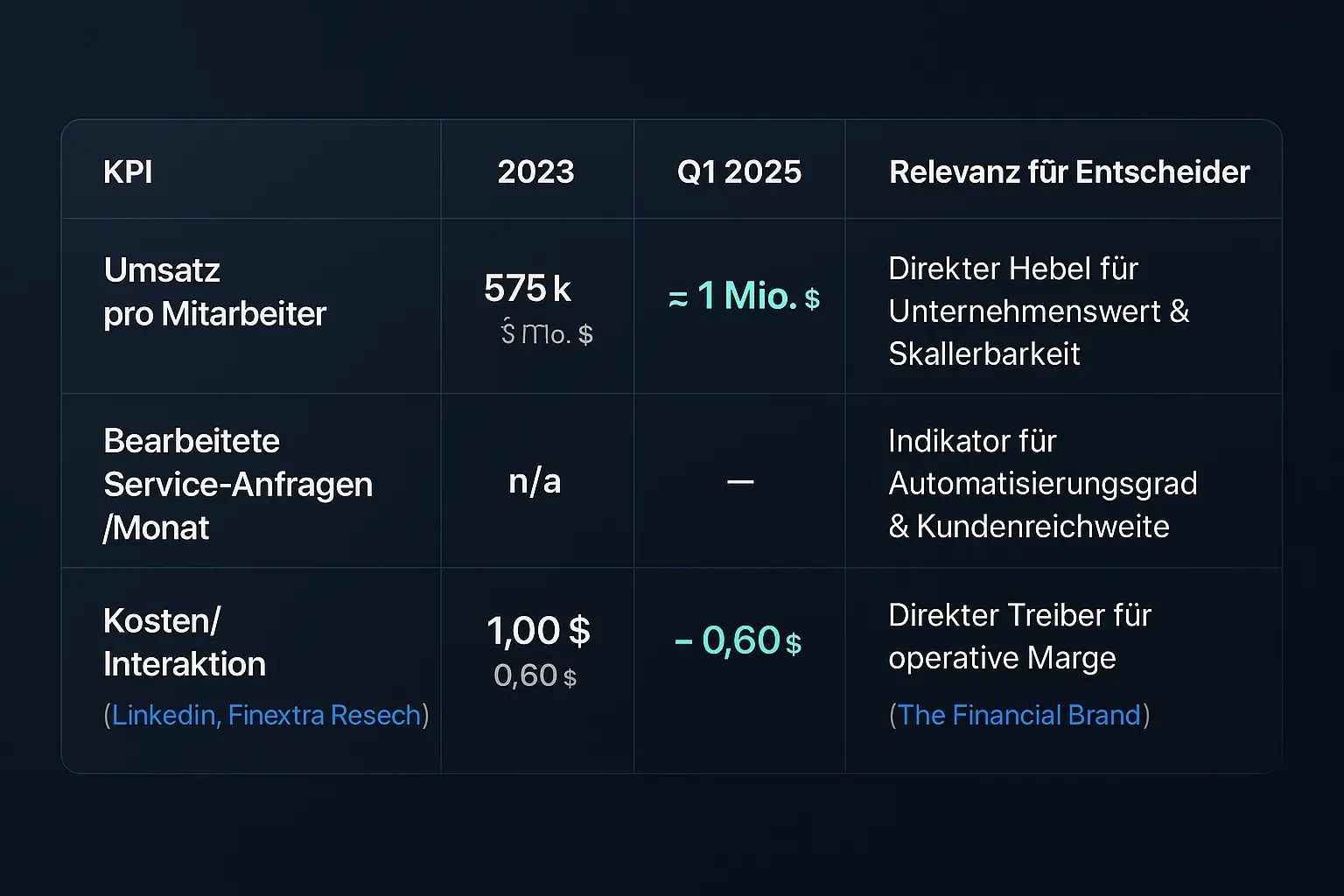
(LinkedIn,Fine Extra Research)(The Financial Brand)(AIM Research)
Untold Insight: Unlike many first movers, Klarna linked its AI rollouts directly to scorecards forUnit Economics(e.g. service costs per customer, revenue per process) – not on tech KPIs like “chatbot usage”. This secured top management attention and financial justification from Day 1.
2. AI as an efficiency turbo – but only with a business filter
Klarna used generative AI not just for the “wow effect”, but specifically where high manual effort is based on structured or semi-structured data. The most important use cases
- Service automation (high-volume, low-complexity)
- The GPT-4-based “Klarna Agent” now processes and resolves almost two thirds of all routine inquiries (returns, payments, cancellations).
- Average processing time drops from 7 minutes to Ø 2 minutes – a massive gain in capacity. (The Financial Brand)
- Fewer queries and ticket bounce rates indirectly improve the Net Promoter Score (NPS) and reduce operational costs (OpEx) by 25%. (AIM Research)
- Risk scoring & lending (data-intensive)
- Generative AI also analyzes less obvious data in real time (e.g. text-based social signals, transaction patterns beyond hard scores).
- Result Default rates drop by a remarkable 56% as risks are identified more precisely. (Klarna)
- Marketing content scaling (creative & multilingual)
- An internal Large Language Model (LLM) automatically generates marketing and advertising texts in over 23 languages.
- A/B tests and campaigns can be set up in hours instead of days; pure campaign creation costs fell by 18%. (embryo)
Practical tip for your company: Identify the first AI use cases where theService Intensityhigh and thatRegulatory riskis manageable. Customer service is often a good starting point as it reduces direct costs and provides the learning experience for more complex areas (such as risk or core processes).
3. The limits of full automation – and the costs of “cold efficiency”
Klarna's initial enthusiasm led to maximum automation in the service. But the downside emerged about 12 months after the extensive rollout: a wave of customer complaints about impersonal, rigid or simply incorrect answers from the bots. (Success Quarterly)
The strategic doctrine:Customer Experience Debtaccumulates invisibly. If you optimize purely for efficiency and the human factor or the ability to recognize exceptions and react empathetically is eliminated, sooner or later this will manifest itself in declining customer satisfaction, increasing complaint rates and, in the worst case, in cancellations or brand damage.
CEO Sebastian Siemiatkowski reacted pragmatically. Instead of continuing to push for 100% automation, Klarna stopped bot expansion for complex cases and beganto hire human agents again. (The Times of India)
4. Workforce 4.0 – from rigid FTEs to flexible skill pools
At Klarna, the return of human agents does not mean a complete withdrawal from AI. Instead, fintech is evolving into a hybrid model that holds an important lesson for all companies in the AI transition
- The staffing shiftThe workforce shrank from 5,500 to around 3,400 permanent employees (-40%) through AI and natural fluctuation - the efficiency gains are real and led to significant cost reductions. (Business World)
- The gig layerThe newly hired employees often work in flexible part-time or on-call models, organized in short micro-shifts (e.g. 4 hours each). This model allows Klarna to respond quickly to peak times (e.g. after holidays) and minimize waiting times without having to bear the fixed costs of a large, fully employed workforce. Priority is given to students in rural regions who benefit from the flexibility. (The Times of India)
Untold Insight: During this workforce restructuring it became clear that company co-determination (in Germany and Sweden) can become a critical path. AI rollouts with significant job impacts require early involvement and negotiations with works councils - Klarna had to make adjustments here, which led to delays. Plan this aspect strategically.
5. Strategic AI implications for your company – What you can do now
- The ROI narrative is not optionalEvery AI project must be clear from the startSales or cost deltasbe linked. Report to the board quarterly on these financial impacts, not just tech metrics.
- Hybrid service as an intelligent standardPlan a back-up team of human experts from the startException handlingand complex cases. A pure bot deployment not only scales efficiency, but also the risk of service failures and customer frustration.
- Skill redeployment via job cutsUse the capacity freed up by automation to upskill employees for higher-value, strategic tasks (e.g. upselling, complex problem solving, data ops, AI prompt optimization). This ensures internal know-how and employee loyalty.
- Governance sprint before rolloutDefine clear “go/no-go” parameters for AI interactions with customers (e.g. escalation thresholds, sensitive topics). Test bot performance and customer satisfactionweeklyand adjust quickly. Compliance and traceability (who decided what and when – bot or human?) will be crucial with the EU AI regulation at the latest.
6. AI Strategy Roadmap
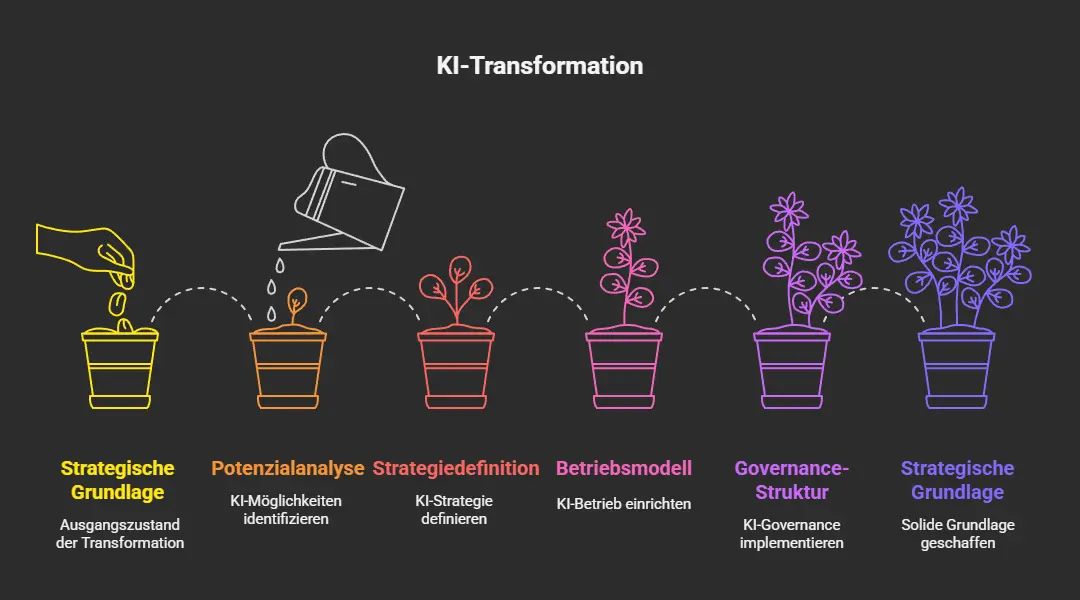
The Klarna learnings show that a successful AI transformation begins with a clear strategic foundation. This foundation - consisting of potential analysis, strategy, operating model and governance - can be laid in just 4 weeks with the right approach. This is phase 1 of your transformation.
Overview:
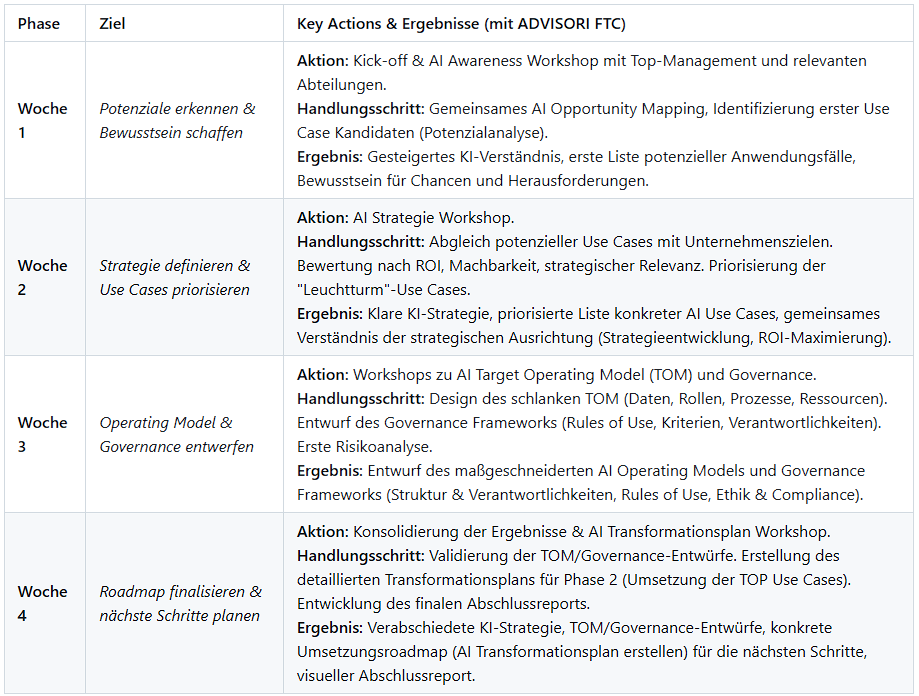
After completing these intensive 4 weeks, you will not only have a sound AI strategy, but also the blueprint and governance to start implementing your top use cases in Phase 2 (based on the requirements engineering and AI use case implementation roadmap, which typically takes another 4+ weeks).
Successful AI transformation:
4 WEEK ROADMAP
This guide presents the essential steps for a successful AI transformation, based on Klarna learnings. The focus is on creating a clear strategic foundation, which consists of a potential analysis, a strategy, an operating model and governance. With the right approach, this foundation can be laid in as little as 4 weeks, which is the first step in your transformation.
The basics of AI transformation
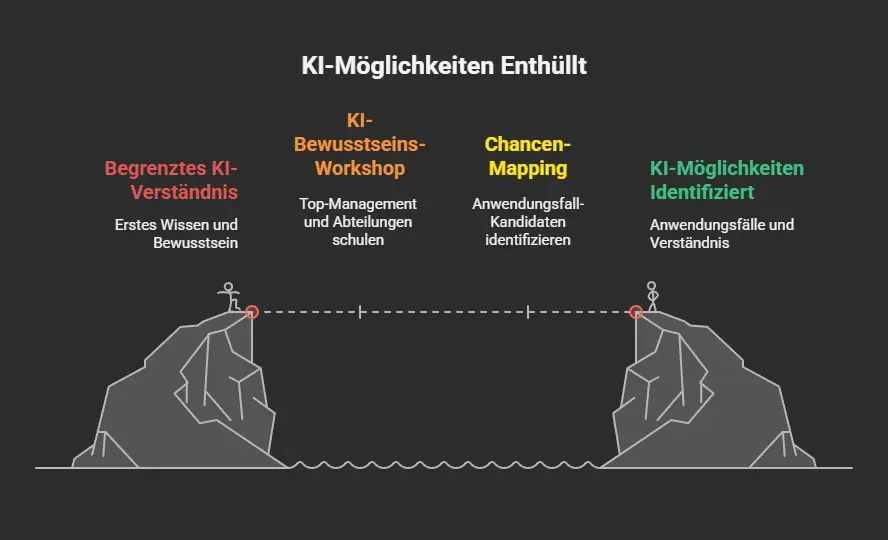
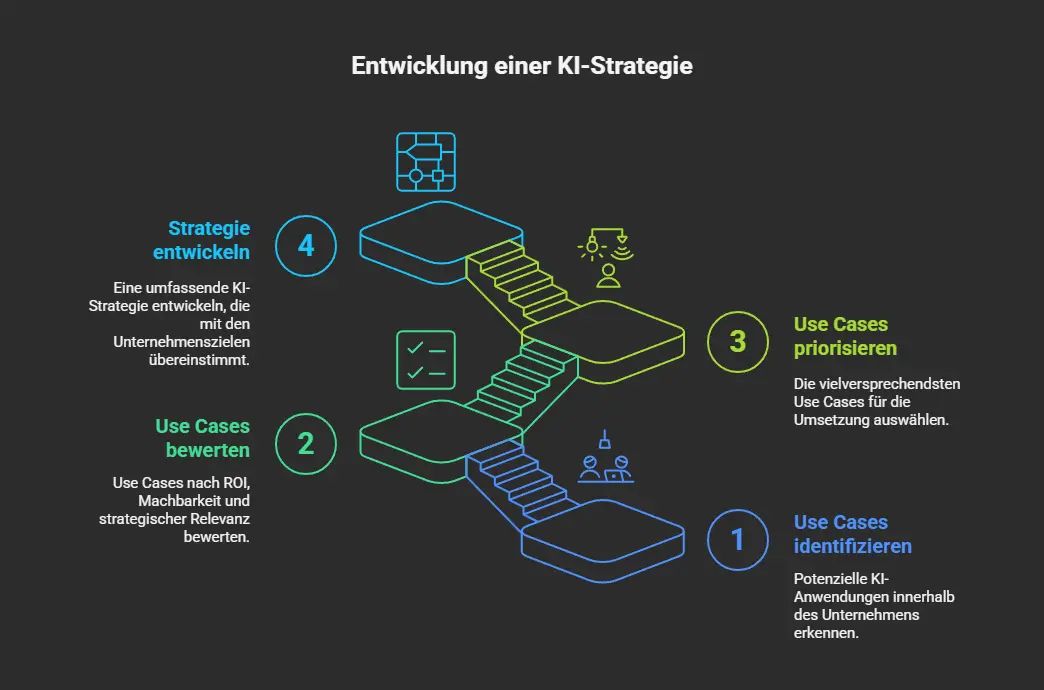
Week 1: Recognize potential & create awareness
- Action:Kick-off & AI Awareness Workshop with top management and relevant departments.
- Action step:Joint AI opportunity mapping, identification of first use case candidates (potential analysis).
- Result:Increased understanding of AI, initial list of potential use cases, awareness of opportunities and challenges.
Week 2: Define strategy & prioritize use cases
- Action:AI strategy workshop.
- Action step:Comparison of potential use cases with company goals. Evaluation based on ROI, feasibility, strategic relevance. Prioritization of “lighthouse” use cases.
- Result:Clear AI strategy, prioritized list of specific AI use cases, shared understanding of the strategic direction (strategy development, ROI maximization).
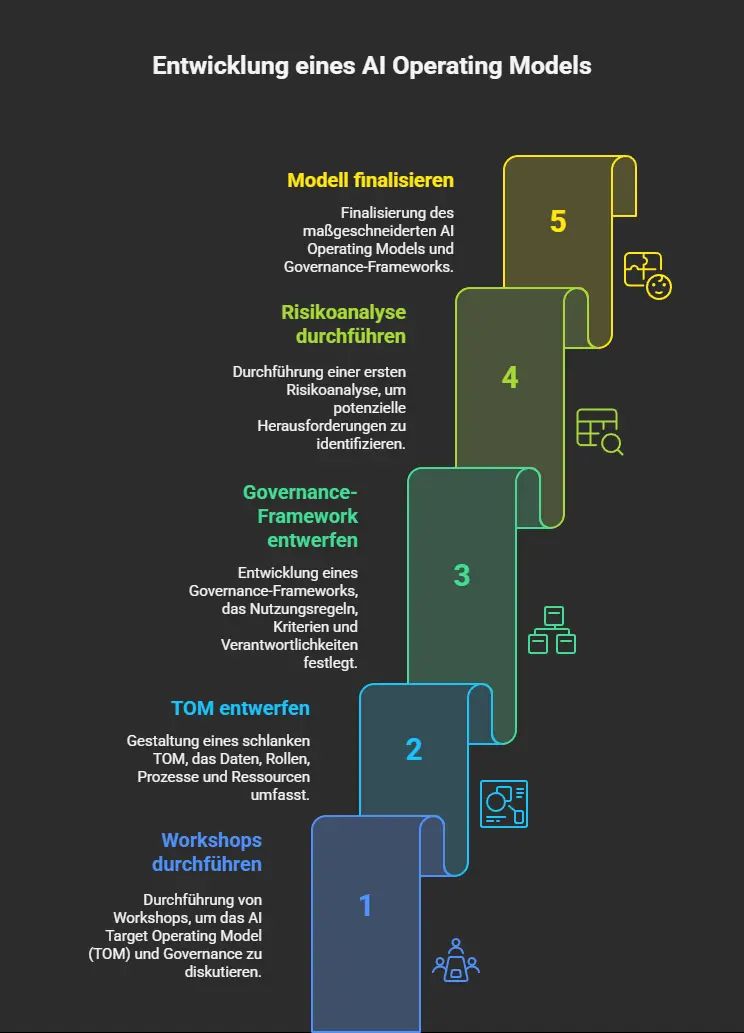
Week 3: Design Operating Model & Governance
- Action:Workshops on AI Target Operating Model (TOM) and Governance.
- Action step:Design of the lean TOM (data, roles, processes, resources). Draft of the governance framework (rules of use, criteria, responsibilities). Initial risk analysis.
- Result:Design of the tailor-made AI operating model and governance framework (structure & responsibilities, rules of use, ethics & compliance).
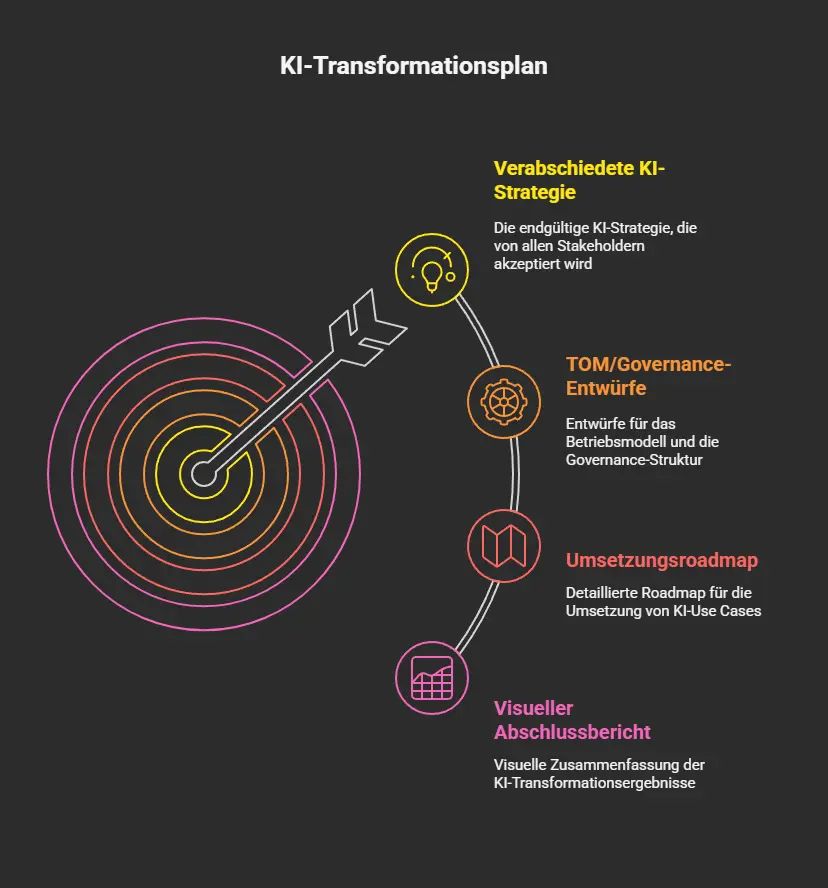
Week 4: Finalize roadmap & plan next steps
- Action:Consolidation of results & AI transformation plan workshop.
- Action step:Validation of TOM/Governance drafts. Creation of the detailed transformation plan for phase 2 (implementation of the TOP use cases). Development of the final final report.
- Result:Adopted AI strategy, TOM/governance drafts, concrete implementation roadmap (create AI transformation plan) for the next steps, visual final report.
After completing these intensive 4 weeks, you will not only have a sound AI strategy, but also the blueprint and governance to begin implementing your top use cases in Phase 2. This phase is based on the requirements engineering and the implementation roadmap for AI use cases, which typically takes another 4+ weeks.
7. Key takeaways for the strategic agenda
- Efficiency is not everything, experience is kingScale AI wherever it isreal valuedelivers, but never neglect the human touchpoints. Balance is crucial for long-term customer success.
- Measuring instead of hopingOnly hard KPIs like revenue per head, cost per ticket and NPS (or similar CX metrics) show thisrealAI ROI.
- Rethink workforce designAgile, flexible skill pools (made up of employees and possibly external specialists/gig workers) beat linear job cuts. Social responsibility and co-determination are not brakes, but rather strategic factors in Europe.
- Regulatory readinessProactive governance and complete documentation of all model changes are mandatory - supervisory authorities will be watching closely from 2026.
8. Your next step
WithADVISORI FTCto success
The Klarna results are a wake-up call and a blueprint at the same time. They show the immense potential for disruptive efficiency gains through AI. At the same time, they reveal the critical pitfalls in implementing human factors, governance and the need for flexible operating models.
Successfully navigating this complexity requires more than just an understanding of technology. It requires strategic foresight, deep operational know-how and a clear roadmap that connects technology, people and compliance.
This is where an experienced partner comes into play.
ADVISORI FTCspecializes in safely accompanying managers like you through this transformation. We combine strategic advice with a sound understanding of technology and the necessary regulatory expertise (financial, technology, compliance) to transform your AI ambitions into measurable, sustainable results. From identifying the most profitable use cases to setting up agile pilot projects to implementing the necessary governance and workforce strategies - we provide the necessary expertise from a single source.
Your next step to implementing the Klarna effect in your companyLet us analyze in a non-binding conversation how Klarna learnings can be specifically applied to your business models and challenges. Develop a tailor-made AI roadmap with us that goes beyond the pure tech rollout andrealCreates business value.
Contact ADVISORI FTC today for your initial strategy session and start your successful AI transformation.
Sources
- Times of India, May 21, 2025 (The Times of India)
- LinkedIn F-1 Breakdown, Apr 2025 (LinkedIn)
- AIM Research, Feb 2024 (AIM Research)
- Success Quarterly, May 11, 2025 (Success Quarterly)
- Klarna Regulatory News, Aug 2024 (Klarna)
- The Financial Brand, Jan 2024 (The Financial Brand)
- BW BusinessWorld, May 15, 2025 (Business World)
- Reuters, May 19, 2025 (Reuters)
- Business of Apps, Feb 2025 (Business of Apps)
- CBS News, Mar 2024 (CBS News)
- CrowdFund Insider, May 20, 2025 (Crowdfund Insiders)
- Financial IT, May 20, 2025 (Financial IT)
- Finextra, May 20, 2025 (Fine Extra Research)
- StatsUp, Jan 2025 (Analyze)
- Embryo, Mar 2025 (embryo)
Next step: Free initial consultation
Would you like to address these issues strategically? Our experts will be happy to advise you - without obligation and in a practical manner.Arrange an initial consultation now →