Scenario Techniques for Operational Resilience – Recognizing “Grey Rhinos” as a Success Factor
Introduction: Resilience in digital transformation
Digital transformation, geopolitical uncertainties and new regulatory requirements such asDORAhave increased the pressure on companies to be not only robust, but resilient. But resilience means more than just a good emergency plan - it requires forward-looking thinking and action.
Scenario techniquesare essential, especially when weak signals are the only leading indicators of upcoming upheavals. This article sheds light on why scenario planning is now more critical than ever, how it can be done successfully and how organizations canSignal monitoringcan effectively integrate into their practice.
Why scenario planning is critical – permacrises and regulation as drivers
At the latest when theDigital Operational Resilience Act (DORA)It becomes clear: the time for selective risk analyzes is over. DORA requires that financial companies structurally strengthen their operational resilience - this also includes simulating extreme but plausible scenarios.Article 10The regulation explicitly calls for regular scenarios supported by threat simulations that test critical processes for their resilience.
It's not about classicBusiness continuity plans, but about the ability to respond quickly to unforeseen events - also so-called"Black Swans"– to be able to react. Events like 9/11 or COVID-19 are rare, but have massive consequences. Scenario planning helps to be prepared for such extreme situations - even if there are no or only a few specific leading indicators.
How scenario planning works – why probabilities are not enough
In practice, many risk assessments are heavily influenced by the probabilities of occurrence. But this is exactly where the problem lies: highly disruptive events such as financial crises or geopolitical conflicts can hardly be described with reliable probabilities. This is why a purely probabilistic approach is often too slow – and dangerous.
An effective alternative approach: thedeductive derivation of scenariosbased on weak signals. Signals – e.g. B. technological trends, regulatory tendencies or geopolitical shifts - not just observed, but put into causal relationships. The difference: It's not about exact predictions, but about recognizinghigh impact scenariosand the derivation of effective strategies.
Three Types of Events in Strategic Foresight
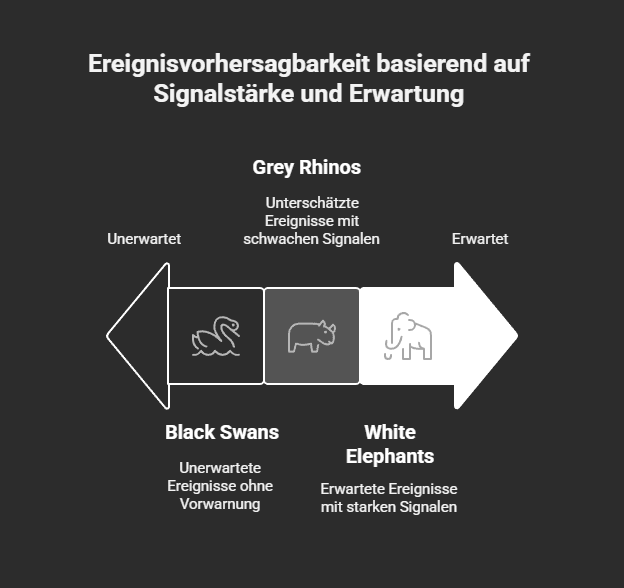
InStrategic Foresight-Context, a distinction is made between three types of events:
- Black Swans: Unexpected, without specific signals, e.g. E.g. 9/11
- Gray Rhinos: Unlikely and often underestimated events, e.g. E.g. financial crises, pandemics
- White Elephants: Obvious developments with strong signals, e.g. B. Climate change
StraightGray Rhinosoffer opportunities for proactive resilience – if weak signals are identified and analyzed early on.
How scenario planning can be implemented in practice – including signal monitoring
The integration ofScenario planningin corporate processes is not a one-off project, but an iterative process. Structured processes that derive strategic options from a central question across scenarios and can be continuously enriched with signals are effective:
An exemplary 7-step scenario planning process
- Define the central question & time horizon– Determination of the specific decision needs and the relevant planning horizon (typically 1-2 years).
- Identify key themes– Systematic recording of all relevant influencing factors from technology, regulations, market environment and social trends.
- Prioritize topics– Evaluate the identified factors according to degree of influence and uncertainty to focus on the most critical variables.
- Develop scenario logic– Building consistent narratives by combining the prioritized factors into plausible scenarios.
- Quantify scenarios– Translation of the qualitative scenarios into measurable parameters and concrete effects on the company.
- Derive strategic options– Development of specific alternative courses of action and packages of measures for each scenario.
- Define signals as leading indicators– Establish observable indicators that show movement towards the different scenarios.
In the last step, specific indicators are defined for each scenario - for exampleCyber threat trends, geopolitical unrest or disease outbreaks. These metrics are calculated using specialized,AI-powered platforms(e.g. Dataminr, Flashpoint, Recorded Future or BlueDot) from news feeds, social media, dark/deep web and official data sources are continuously collected and evaluated in real time.
Advantages of successful signal monitoring
A successful oneSignal monitoringallowed:
- Early identification of escalating trends
- Dynamic adjustment of response plans
- Better allocation of resources to relevant strategies
The goal: continuously record and evaluate dynamic changes in the threat situation and adapt scenarios accordingly.
Use Case: Gray Rhino “Pandemic caused by US Aid cuts & vaccine skepticism” for financial companies
1. Scenario definition:
Financial institutions analyze the risk of apandemic outbreak, triggered by drastic cuts in US health aid and growing vaccine skepticism in key regions.
2. Central question & time horizon:
How does one such outbreak affect the next one?12-18 monthsthe operational continuity, accessibility of branches and availability of employees?
3. Identify key themes:
The main drivers are the decline in government vaccination programs, falling vaccination rates, gaps in the supply of essential medicines and increasing mobility despite health crises.
4. Scenario logic & worst case:
InWorst casevaccine skepticism escalates into mass disease outbreaks; At the same time, there is a lack of financial support for international aid organizations due to US Aid cuts. Added to this is the outbreak of a new, highly contagious virus variant that is spreading globally, overwhelming healthcare systems and tightening travel and trade restrictions - a combined effectGray Rhinowith underestimated leading indicators.
5. Scenario quantification:
An increase in disease incidence is modeled200%in affected countries,30%higher absenteeism among employees and a25%Reduction in cross-border business trips; become at the same time40%of global logistics capacities affected by pandemic measures. Knowledge holders and critical employees fall ill and are absent in the long term.
6. Strategic options:
Banks are strengthening theirsdigital services, expand home office and telemedicine collaborations with healthcare providers, implement flexible staff pools and create emergency teams for rapid staff replacement and IT support.
7. Define leading indicators:
Vaccination rate statistics, budget votes in the US Congress, social media debates about compulsory vaccination, news about NGO funding cuts and initial ones need to be monitoredWHO warningsto new pathogen clusters.
8. Signal Monitoring:
AI-driven platformssuch as Dataminr, Flashpoint and BlueDot search news feeds, social media, government bulletins and NGO websites in real time to identify surging signals and deliver combined pandemic alerts.
9. Advantages:
Continuous monitoring enables early adjustment of personnel and IT capacities, optimizes crisis communication and promotes the strategic adjustment of business models, as well as the integration of resilient third parties in the provision of time-critical services.
10. Conclusion:
Throughdeductive scenario planningand targeted signal monitoring ensure that financial institutions secure theirOperational resilienceagainst pandemic Gray Rhinos – before they become an existential threat.
Conclusion – foresight beats probability
In a world characterized by volatility,Resiliencemore than just robust processes.Scenario techniquesoffer a systematic way to effectively prepare companies for “Grey Rhinos”.Leading indicators– i.e. weak signals – are not a luxury, but a necessity.
Anyone who invests in asking the right questions today and deriving structured scenarios will be able to react faster tomorrow, control more efficiently and remain resilient in the long term.
Do you have specific questions about the conception, development and implementation of a scenario framework to strengthen your resilience program?Arrange a non-binding consultation with our experts today.
Next step: Free initial consultation
Would you like to strengthen operational resilience in your company? Our experts will be happy to advise you - without obligation and in a practical manner.Arrange an initial consultation now →
ISO 27001 Certification — we guide you through the process
ISMS setup, gap analysis and audit readiness in a 30-minute strategy session.
Book an ISO 27001 Session30 Minuten • Unverbindlich • Sofort verfügbar