Invoice Verification with AI: Definition, Process, Required Fields & Checklist (2026)

Invoice verification is the systematic check of an incoming invoice for formal correctness (mandatory fields required by VAT law), factual accuracy (do the delivered goods, quantity and price match the purchase order?) and arithmetic accuracy (are all totals and tax amounts correct?) before it is approved and paid. It protects companies from incorrect and duplicate payments, secures input-tax (VAT) deduction and is the foundation of audit-proof bookkeeping.
This guide explains the types of invoice verification, the process step by step, the mandatory fields no invoice may be missing (with a checklist to tick off), how 3-way matching works, and how modern companies verify every invoice with AI in seconds instead of minutes.
Key takeaways
• Three dimensions: formal (mandatory fields), factual (delivery/purchase order) and arithmetic (totals/tax).
• If a mandatory field is missing, input-tax (VAT) deduction is at risk and the invoice must be corrected.
• Responsibility is usually shared between accounts payable and the requesting department (four-eyes principle).
• Since January 2025, companies in Germany must be able to receive e-invoices (ZUGFeRD, XRechnung) in B2B.
• AI-based solutions now verify every invoice template-free, including unknown layouts, with up to 80 % touchless processing.
What is invoice verification? (Definition)
Invoice verification (also called incoming-invoice checking or accounts payable invoice processing) is the control process by which a company checks every incoming supplier or service invoice before releasing it for payment. The goal is to ensure the invoice is formally correct, factually justified and arithmetically accurate, so that only services actually rendered are paid at the agreed price.
It is a central control in the purchase-to-pay process and, at the same time, a tax necessity: only a compliant invoice entitles a company to deduct input tax (VAT).
Why invoice verification matters
- Secures VAT deduction: if a mandatory field is missing, the tax authority can deny input-tax deduction. That costs real money.
- Prevents incorrect and duplicate payments: inflated amounts, duplicate submissions or changed bank details are caught before payment.
- Protects cash flow: early-payment discounts are only captured with timely, correct verification.
- Ensures compliance: every verification decision must be traceable in an audit-proof way.
How much does manual verification really cost you?
Calculate your savings potential in 30 seconds, based on your invoice volume.
Calculate your potential →
The 3 types of invoice verification
A complete invoice verification covers three dimensions. In practice, "formal" and "arithmetic" are often combined, but technically they are three distinct checks.
1. Formal verification
This checks whether the invoice contains all legally required fields (under applicable VAT law, e.g. §14 UStG in Germany). If a field is missing, the invoice is formally incorrect and VAT deduction is at risk. Checked items include the name and address of both parties, the tax or VAT ID number, the invoice date, a sequential invoice number, a description of the service, the net amount and the tax amount.
2. Factual verification
Factual verification answers the question: is the invoice justified in principle and in amount? Was the service actually delivered? Do quantity, price and terms match the purchase order and goods receipt? This is classically done via the 3-way match (comparing invoice, purchase order and goods receipt). The requesting department usually performs this check.
3. Arithmetic verification
Arithmetic verification recalculates all totals, line items, discounts and tax amounts. Is quantity times unit price correct? Is the stated tax rate applied correctly? Do the net amounts plus VAT add up to the gross total?
See it in action:
Watch the live demo video →
The invoice verification process in 5 steps
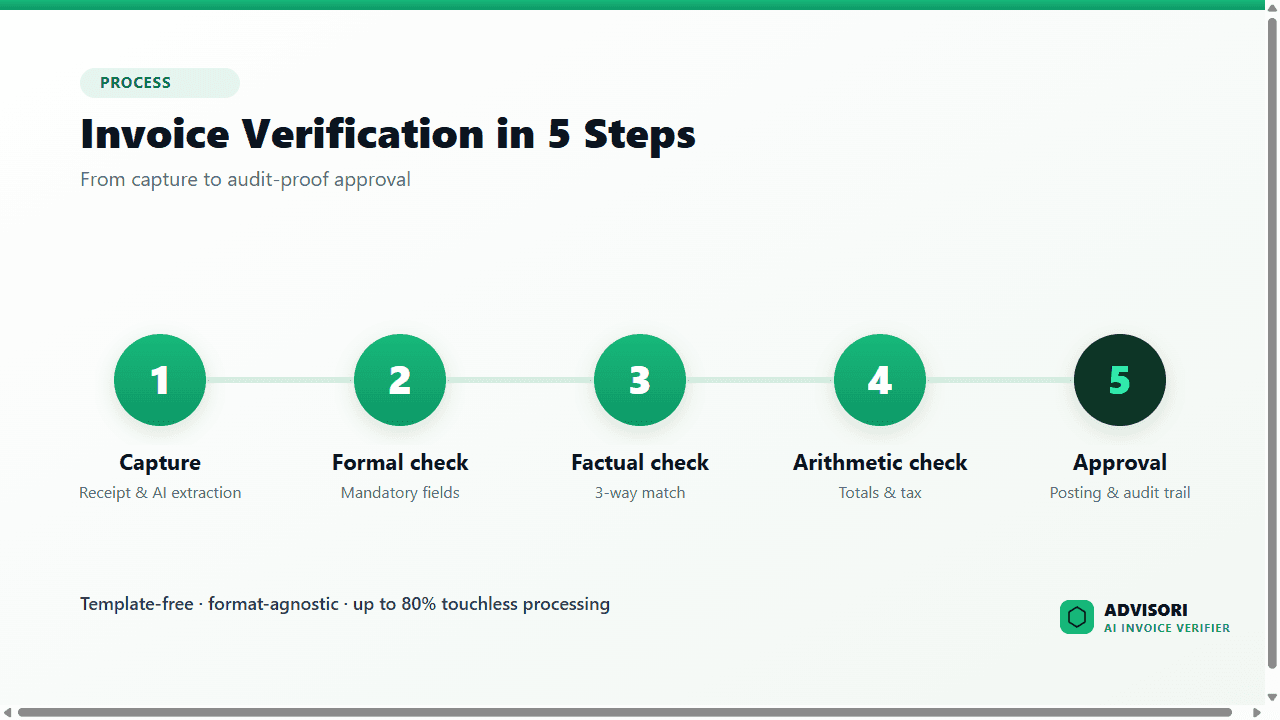
- Invoice receipt & capture. The invoice arrives by email, post, upload or as an e-invoice (ZUGFeRD, XRechnung) and is captured. With digital verification, AI reads the relevant fields automatically.
- Formal check. Verification of all mandatory fields. If something is missing, the invoice is returned to the supplier for correction.
- Factual check (3-way match). Comparison against purchase order and goods receipt. Deviations in quantity, price or terms are clarified.
- Arithmetic check. Recalculation of all line items, totals and tax amounts.
- Approval & posting. If verification passes, the invoice is approved (often under the four-eyes principle), then posted and paid. Every decision is logged in an audit-proof way.
Invoice verification checklist: mandatory fields
These fields must appear on every full invoice. Simplified rules apply to small-value invoices.
- Full name and address of the supplier
- Full name and address of the customer
- Tax number or VAT identification number
- Invoice issue date
- Sequential, unique invoice number
- Quantity and type of goods, or scope of the service
- Date of delivery or service
- Net amount, broken down by tax rate
- Applicable tax rate and tax amount (or note on exemption)
- Any agreed reductions (e.g. early-payment discount)
FREE TOOL: Verify your e-invoice in 30 seconds
Upload a ZUGFeRD or XRechnung file and instantly see whether the format and mandatory fields are compliant. No sign-up required.
Check an e-invoice now →
Who is responsible for invoice verification?
Responsibility is usually shared:
- Accounts payable handles formal and arithmetic verification, plus capture and posting.
- The requesting department handles factual verification, because only it can judge whether the service and quantity are correct.
- Final approval is often done under the four-eyes principle by an authorized person, depending on amount thresholds and the internal approval workflow.
In small companies, the entire check often sits with one person or the tax advisor. In larger organizations, a digital invoice workflow routes responsibilities automatically.
Verifying e-invoices: what applies since 2025
Since 1 January 2025, companies in Germany must be able to receive and process e-invoices in B2B. An e-invoice is not simply a PDF, but a structured data set in a format such as ZUGFeRD (PDF with embedded XML) or XRechnung (pure XML), both based on the European standard EN 16931.
Verifying an e-invoice adds two layers:
- Format conformity: does the data set match the required standard (e.g. EN 16931)?
- Content validation: are the mandatory fields complete and correct inside the structured data set?
The obligation to issue e-invoices is being phased in from 2027 and 2028 depending on revenue. Companies that digitize verification now are ready for every stage, and aligned with the EU's ViDA (VAT in the Digital Age) direction.
From manual to AI-based invoice verification
This is how invoice verification evolves, and where the biggest lever for efficiency and security lies:
- **Manual**: Every invoice is keyed and matched by hand; Slow, expensive, error-prone
- **Classic OCR**: Text recognition with one template per supplier; Templates break on every layout change; high maintenance
- **AI-based**: AI understands every layout, even unknown ones, and keeps learning; Requires a modern solution
The decisive difference: classic OCR needs a template for every supplier. A new supplier or a changed invoice layout means project effort, and the system breaks regularly. AI-based, template-free invoice verification understands the layout instead, even for an invoice it sees for the first time.
THE DIFFERENCE: The only solution that understands every invoice without a template
The ADVISORI AI invoice verifier is format-agnostic, industry-independent and continuously learning. New invoice types are set up in minutes, not projects. Compliant with VAT law, GoBD and GDPR, operated in Germany.
• Up to 80 % of invoices processed touchless, with no human intervention
• PDF, scan, ZUGFeRD and XRechnung handled equally
• Integrated with SAP, DATEV and more via connector or API
Explore the solution →
Automated invoice verification with AI: how extraction works
Modern solutions automate all three verification dimensions with artificial intelligence. Instead of a person keying and ticking off every invoice, AI takes over, like this:
- AI extraction instead of templates: the AI recognizes layout and fields on its own (supplier, amounts, line items, tax, IBAN), even on an invoice it sees for the first time. No per-supplier training, no template mapping.
- Automatic validation: mandatory fields, tax logic and arithmetic totals are checked in a single pass. The 3-way match against purchase order and goods receipt runs automatically.
- Continuous learning: every correction flows back into the model. Accuracy improves with each processed invoice, without re-implementation.
- Touchless processing: unambiguous invoices run fully automatically, up to 80 % with no human intervention. Only exceptions reach a person.
- Escalation instead of blind approval: uncertain or deviating cases are flagged and routed into the four-eyes principle, instead of being waved through.
The decisive difference from classic OCR automation: a modern AI needs no templates, no regex and no project per supplier. It understands the invoice instead of matching a rigid pattern. This is exactly the jump from "digitized" to "truly automated".
Detecting invoice fraud and duplicates during verification
Modern invoice verification also protects against financial loss from fraud:
- Duplicates: exact and near-identical duplicate invoices are detected before they are paid twice.
- Changed bank details: an IBAN that differs from the master record is a classic warning sign of payment redirection (business email compromise).
- Unusual patterns: suspicious amounts, frequencies or suppliers are flagged and escalated instead of approved blindly.
Retention and audit-proof compliance
Invoices are tax-relevant documents and are subject to a retention period of typically ten years. Compliance rules (e.g. GoBD in Germany) require that verification is documented in an audit-proof way: who checked and approved what, and when? A digital solution produces this complete audit trail automatically, while manual checking with a stamp and a folder does not.
Benefits of digital invoice verification
- Faster: processing time per invoice drops from minutes to seconds.
- Cheaper: up to 80 % touchless processing frees staff for higher-value work.
- Safer: duplicates, fraud and formal errors are reliably caught.
- Compliant: a complete, audit-proof trail for every verification.
- Future-proof: e-invoicing mandates are covered from day one.
See the AI invoice verifier on your own invoices.
In a 30-minute live demo, we verify your real invoice formats and calculate your business case concretely. No obligation, with your real invoices.
Book a live demo →
Further reading in this cluster: To automate the process step by step, see Automate Invoice Verification with AI. For what matters specifically with e-invoices, see How to Validate an E-Invoice. To automate the approval of verified invoices, see Automate Invoice Approval with AI. Why template-based OCR fails on changing invoice layouts is explained in OCR vs. AI Extraction: Why Templates Fail.
Frequently asked questions about invoice verification (FAQ)
What do you do in invoice verification?
You check an incoming invoice formally (mandatory fields), factually (was the service delivered in this quantity and at this price?) and arithmetically (are all totals and tax amounts correct?) before it is approved and paid.
What are the types of invoice verification?
There are three: formal verification (mandatory fields), factual verification (service, quantity and price matched against the purchase order) and arithmetic verification (totals and tax amounts).
Who performs invoice verification?
Usually accounts payable together with the requesting department. Accounts payable handles the formal and arithmetic checks; the department handles the factual check. Approval is often done under the four-eyes principle.
How do you verify an invoice correctly?
You work through the mandatory fields, match the invoice against the purchase order and goods receipt (3-way match) and recalculate all totals. Digital solutions automate these three steps and document them in an audit-proof way.
How can you verify an e-invoice?
An e-invoice (ZUGFeRD, XRechnung) is checked on two levels: format conformity of the structured data set and completeness of the mandatory fields. With an e-invoice verification tool this takes seconds, even without accounting software.
What happens if an invoice has a formal error?
A formally incorrect invoice does not entitle you to deduct input tax. It should be returned to the supplier for correction, who then issues a corrected invoice.
About ADVISORI FTC GmbH: ADVISORI builds AI-based, compliant solutions for automated invoice verification, operated in Germany. Certified to ISO 27001, ISO/IEC 42001 and SOC 2 Type II.
Related articles
Continue exploring with related insights from our experts.
OCR vs. AI Extraction for Invoices: Why Templates Fail (2026)
OCR vs. AI extraction for invoices: the difference between template-based OCR, iOCR and template-free AI, why templates fail, a real example, comparison table and selection criteria.
Automate Invoice Approval with AI: Workflow, Approval Matrix & Software (2026)
Automate the invoice approval workflow with AI: how the digital approval process works, the four-eyes principle and approval matrix, SAP/DATEV integration, GoBD audit trail and selection criteria.
Germany's E-Invoicing Mandate 2025-2028: Deadlines, Who's Affected & Exemptions
Germany's B2B e-invoicing mandate: receiving obligation since 2025, issuing from 2027 (turnover over EUR 800,000) and 2028. Who is affected, which exemptions apply and how to prepare.