1. Home/
  2. Services/
  3. Digital Transformation/
  4. Data Analytics/
  5. Data Engineering/
  6. Data Lake Implementierung En

Newsletter abonnieren

Bleiben Sie auf dem Laufenden mit den neuesten Trends und Entwicklungen

Durch Abonnieren stimmen Sie unseren Datenschutzbestimmungen zu.

A
ADVISORI FTC GmbH

Transformation. Innovation. Sicherheit.

Firmenadresse

Kaiserstraße 44

60329 Frankfurt am Main

Deutschland

Auf Karte ansehen

Kontakt

info@advisori.de+49 69 913 113-01

Mo-Fr: 9:00 - 18:00 Uhr

Unternehmen

Leistungen

Social Media

Folgen Sie uns und bleiben Sie auf dem neuesten Stand.

  • /
  • /

© 2024 ADVISORI FTC GmbH. Alle Rechte vorbehalten.

ADVISORI Logo
BlogCase StudiesAbout Us
info@advisori.de+49 69 913 113-01
Your browser does not support the video tag.
From concept to successful delivery

Data Lake Implementation

Transform your data landscape with a tailored Data Lake solution. We support you in the successful implementation of a scalable, future-proof Data Lake — from strategic planning through technical implementation to productive operations and continuous expansion.

  • ✓Proven implementation methodology for fast and sustainable results
  • ✓End-to-end support from requirements analysis through to productive operations
  • ✓Integration of existing data sources and legacy systems into modern Data Lake architectures
  • ✓Building internal competencies for sustainable operations and further development

Your strategic success starts here

Our clients trust our expertise in digital transformation, compliance, and risk management

30 Minutes • Non-binding • Immediately available

For optimal preparation of your strategy session:

  • Your strategic goals and objectives
  • Desired business outcomes and ROI
  • Steps already taken

Or contact us directly:

info@advisori.de+49 69 913 113-01

Certifications, Partners and more...
ISO 9001 CertifiedISO 27001 CertifiedISO 14001 CertifiedBeyondTrust PartnerBVMW Bundesverband MitgliedMitigant PartnerGoogle PartnerTop 100 InnovatorMicrosoft AzureAmazon Web Services

Professional Data Lake Implementation for Your Organization

Our Strengths

  • Comprehensive expertise in modern Data Lake technologies and cloud platforms
  • Proven implementation methodology with demonstrable successes
  • Interdisciplinary team of Data Engineers, architects, and business consultants
  • Vendor-independent consulting and tailored solution concepts
⚠

Expert Tip

The key to a successful Data Lake implementation lies in a balanced relationship between quick wins and strategic, long-term alignment. Our experience shows that an MVP approach (Minimum Viable Product) with a clearly defined, value-creating use case significantly increases the probability of success. Such a "lighthouse use case" not only creates early successes, but also helps to overcome organizational hurdles and gain important learnings for later project phases.

ADVISORI in Numbers

11+

Years of Experience

120+

Employees

520+

Projects

Our proven methodology for Data Lake implementation combines strategic planning, agile development, and continuous improvement. This structured approach ensures that your Data Lake is not only technically sound, but also meets business requirements and is accepted by users.

Our Approach:

Phase 1: Assessment & Strategy - Analysis of the existing data landscape and processes, definition of strategic goals and prioritized use cases, creation of a Data Lake roadmap

Phase 2: Architecture & Design - Development of a future-proof Data Lake architecture, selection of appropriate technologies, definition of data models and governance frameworks

Phase 3: MVP Implementation - Agile delivery of a Minimum Viable Product with the first prioritized use cases, build-out of core infrastructure, integration of initial data sources

Phase 4: Scaling & Expansion - Incremental extension with additional data sources and use cases, performance optimization, expansion of self-service capabilities

Phase 5: Operations & Continuous Improvement - Establishment of operational processes, knowledge transfer, continuous development and optimization of the Data Lake

"A successful Data Lake implementation is a balance of technological expertise and organizational change management. The decisive factor is not the technology itself, but how it is integrated into the organizational reality and delivers genuine value to business units. Our approach therefore combines technical excellence with a pragmatic methodology and intensive involvement of business stakeholders."

Asan Stefanski

Asan Stefanski

Head of Digital Transformation

Expertise & Experience:

11+ years of experience, Applied Computer Science degree, Strategic planning and management of AI projects, Cyber Security, Secure Software Development, AI

LinkedIn Profile

Our Services

We offer you tailored solutions for your digital transformation

Data Lake Consulting & Strategy

Development of a tailored Data Lake strategy with a clear roadmap, prioritized use cases, and technology recommendations. Our experienced consultants support you in defining a future-proof vision for your Data Lake and planning the necessary steps to realize it.

  • Assessment of your existing data landscape and identification of optimization potential
  • Definition and prioritization of use cases with measurable business value
  • Development of a technical target architecture and technology recommendations
  • Creation of an implementation roadmap with milestones and resource planning

Technical Data Lake Implementation

Professional implementation of your Data Lake based on modern technologies and best practices. Our experienced Data Engineers and cloud specialists implement your Data Lake architecture efficiently and in a future-proof manner — whether on-premise, in the cloud, or as a hybrid solution.

  • Build-out of the Data Lake infrastructure (storage, compute, networking)
  • Development and implementation of data pipelines for various data sources
  • Integration of data processing frameworks for batch and stream processing
  • Implementation of security and governance mechanisms

Data Integration & Migration

Seamless integration of your existing data sources and legacy systems into your new Data Lake. We develop reliable, scalable data pipelines that collect, transform, and make available data from a wide variety of sources in your Data Lake.

  • Development of ETL/ELT processes for structured and unstructured data
  • Integration of legacy systems and enterprise applications
  • Implementation of Change Data Capture (CDC) for real-time data integration
  • Data migration from existing data warehouses and data platforms

Data Lake Governance & Operations

Establishment of sustainable governance structures and operating models for your Data Lake. We support you in implementing the necessary processes, roles, and tools to ensure the long-term quality, security, and value of your Data Lake.

  • Development of Data Governance frameworks and policies
  • Implementation of metadata management and data cataloging
  • Build-out of monitoring, logging, and alerting systems
  • Definition of operational processes and training of your teams

Looking for a complete overview of all our services?

View Complete Service Overview

Our Areas of Expertise in Digital Transformation

Discover our specialized areas of digital transformation

Digital Strategy

Development and implementation of AI-supported strategies for your company's digital transformation to secure sustainable competitive advantages.

▼
    • Digital Vision & Roadmap
    • Business Model Innovation
    • Digital Value Chain
    • Digital Ecosystems
    • Platform Business Models
Data Management & Data Governance

Establish a robust data foundation as the basis for growth and efficiency through strategic data management and comprehensive data governance.

▼
    • Data Governance & Data Integration
    • Data Quality Management & Data Aggregation
    • Automated Reporting
    • Test Management
Digital Maturity

Precisely determine your digital maturity level, identify potential in industry comparison, and derive targeted measures for your successful digital future.

▼
    • Maturity Analysis
    • Benchmark Assessment
    • Technology Radar
    • Transformation Readiness
    • Gap Analysis
Innovation Management

Foster a sustainable innovation culture and systematically transform ideas into marketable digital products and services for your competitive advantage.

▼
    • Digital Innovation Labs
    • Design Thinking
    • Rapid Prototyping
    • Digital Products & Services
    • Innovation Portfolio
Technology Consulting

Maximize the value of your technology investments through expert consulting in the selection, customization, and seamless implementation of optimal software solutions for your business processes.

▼
    • Requirements Analysis and Software Selection
    • Customization and Integration of Standard Software
    • Planning and Implementation of Standard Software
Data Analytics

Transform your data into strategic capital: From data preparation through Business Intelligence to Advanced Analytics and innovative data products – for measurable business success.

▼
    • Data Products
      • Data Product Development
      • Monetization Models
      • Data-as-a-Service
      • API Product Development
      • Data Mesh Architecture
    • Advanced Analytics
      • Predictive Analytics
      • Prescriptive Analytics
      • Real-Time Analytics
      • Big Data Solutions
      • Machine Learning
    • Business Intelligence
      • Self-Service BI
      • Reporting & Dashboards
      • Data Visualization
      • KPI Management
      • Analytics Democratization
    • Data Engineering
      • Data Lake Setup
      • Data Lake Implementation
      • ETL (Extract, Transform, Load)
      • Data Quality Management
        • DQ Implementation
        • DQ Audit
        • DQ Requirements Engineering
      • Master Data Management
        • Master Data Management Implementation
        • Master Data Management Health Check
Process Automation

Increase efficiency and reduce costs through intelligent automation and optimization of your business processes for maximum productivity.

▼
    • Intelligent Automation
      • Process Mining
      • RPA Implementation
      • Cognitive Automation
      • Workflow Automation
      • Smart Operations
AI & Artificial Intelligence

Leverage the potential of AI safely and in regulatory compliance, from strategy through security to compliance.

▼
    • Securing AI Systems
    • Adversarial AI Attacks
    • Building Internal AI Competencies
    • Azure OpenAI Security
    • AI Security Consulting
    • Data Poisoning AI
    • Data Integration For AI
    • Preventing Data Leaks Through LLMs
    • Data Security For AI
    • Data Protection In AI
    • Data Protection For AI
    • Data Strategy For AI
    • Deployment Of AI Models
    • GDPR For AI
    • GDPR-Compliant AI Solutions
    • Explainable AI
    • EU AI Act
    • Explainable AI
    • Risks From AI
    • AI Use Case Identification
    • AI Consulting
    • AI Image Recognition
    • AI Chatbot
    • AI Compliance
    • AI Computer Vision
    • AI Data Preparation
    • AI Data Cleansing
    • AI Deep Learning
    • AI Ethics Consulting
    • AI Ethics And Security
    • AI For Human Resources
    • AI For Companies
    • AI Gap Assessment
    • AI Governance
    • AI In Finance

Frequently Asked Questions about Data Lake Implementation

What are the most important steps in a successful Data Lake implementation?

A successful Data Lake implementation follows a structured approach that takes into account technical, organizational, and business aspects in order to create lasting value.

🎯 Strategic Planning and Preparation

• Define business goals: Clear formulation of desired business outcomes and success criteria
• Prioritize use cases: Identification of value-creating use cases with measurable business impact
• Stakeholder analysis: Early involvement of relevant business units and decision-makers
• Identify data sources: Capture and evaluation of available internal and external data sources

🏗 ️ Architecture Design and Technology Selection

• Develop target architecture: Design of a scalable, future-proof Data Lake architecture
• Technology evaluation: Selection of appropriate technologies based on requirements and constraints
• Data modeling: Definition of data structures and metadata concepts
• Governance framework: Development of policies for data security, quality, and access management

🚀 Agile Implementation and MVP

• Infrastructure setup: Build-out of the foundational Data Lake infrastructure (storage, compute, networking)
• Data pipelines: Implementation of initial data pipelines for priority source systems
• MVP development: Delivery of a Minimum Viable Product with the first use case
• Validation: Testing and optimization against defined success criteria

🔄 Scaling and Expansion

• Incremental expansion: Step-by-step integration of additional data sources and use cases
• Optimization: Performance tuning and improvement of data quality
• Self-service: Expansion of self-service analytics capabilities for business units
• Automation: Implementation of automated processes for data integration and management

🛠 ️ Operating Model and Continuous Improvement

• Monitoring setup: Implementation of monitoring and alerting mechanisms
• Operational processes: Definition of roles, responsibilities, and support processes
• Knowledge transfer: Training and enablement of internal teams
• Continuous optimization: Regular reviews and further development based on user feedbackParticularly important for success is an iterative approach that delivers value early and enables continuous learning. The combination of agile implementation and strategic alignment ensures that the Data Lake delivers both quick wins and long-term business value.

Which technologies are suitable for implementing a Data Lake?

The selection of the right technologies for a Data Lake depends on specific requirements, the existing IT landscape, and strategic goals. Modern Data Lake implementations combine various components into an integrated solution.

☁ ️ Cloud Platforms and Services

• AWS: S

3 for storage, AWS Glue for ETL, Redshift for analytics, Lake Formation for governance

• Microsoft Azure: Azure Data Lake Storage Gen2, Azure Synapse Analytics, Azure Databricks
• Google Cloud: Google Cloud Storage, BigQuery, Dataproc, Data Fusion
• Snowflake: Cloud Data Platform with strong Data Warehouse integration

🔄 Data Integration and Processing

• Apache Spark: Powerful framework for distributed data processing
• Apache Kafka/Confluent: Event streaming platform for real-time data integration
• Apache NiFi: Data flow management for visual data pipeline development
• Talend/Informatica: Enterprise data integration platforms
• dbt (data build tool): Data transformation with SQL and DevOps practices

📊 Query and Analytics Engines

• Presto/Trino: SQL query engine for large datasets
• Apache Hive: Data warehouse system for Hadoop
• Apache Druid: High-performance OLAP database for real-time analytics
• Dremio: Data Lakehouse platform with SQL acceleration
• Apache Spark SQL: SQL interface for Spark-based analytics

🔐 Governance, Security, and Metadata

• Apache Atlas: Metadata management and governance framework
• Apache Ranger: Security framework for access control
• Collibra/Alation: Enterprise data catalog solutions
• Privacera/Immuta: Data access governance for sensitive data
• Delta Lake/Apache Iceberg/Apache Hudi: Table formats with transaction support

⚙ ️ Orchestration and DevOps

• Apache Airflow: Workflow management and orchestration
• Kubernetes: Container orchestration for scalable deployments
• Terraform/Pulumi: Infrastructure as Code for consistent deployments
• GitHub Actions/Jenkins: CI/CD pipelines for DataOps
• Prometheus/Grafana: Monitoring and observabilityWhen selecting technologies, the following factors should be considered: scaling requirements, flexibility, cost model, existing team competencies, integration with existing systems, and specific use cases. A modular architecture approach with clearly defined interfaces makes it possible to replace individual components as needed and benefit from new technology developments.

How is a Data Lake integrated into existing IT landscapes?

Integrating a Data Lake into an established IT landscape requires a well-thought-out approach that takes existing systems into account and ensures a seamless data supply.

🔄 Integration Patterns and Data Pipelines

• Batch integration: Regular extraction and transfer of data from source systems
• Change Data Capture (CDC): Capture and transfer of changes in real time or near real time
• Event-based integration: Use of events and messaging systems for data transfer
• API-based integration: Connection via defined interfaces and services
• File-based integration: Transfer of files from legacy systems or external sources

🧩 Connecting Various Source Systems

• Relational databases: Integration of OLTP systems and data warehouses via JDBC/ODBC or CDC
• ERP and CRM systems: Connection of SAP, Salesforce, etc. via specific connectors
• SaaS applications: Integration of cloud services via APIs and pre-built connectors
• IoT and sensor data: Incorporation of streaming data via Kafka, MQTT, or specialized IoT platforms
• Legacy systems: Migration of data from legacy systems via ETL processes or middleware

🏗 ️ Architectural Integration Approaches

• Lambda architecture: Parallel batch and stream processing for different latency requirements
• Kappa architecture: Primarily stream-oriented architecture with event log as the central data source
• Data Mesh: Domain-oriented data provisioning with decentralized ownership
• Data Fabric: Integration layer across different data platforms
• Hybrid architecture: Combination of on-premise and cloud components

🔁 Synchronization and Metadata Management

• Orchestration: Coordination of data flows and dependencies between systems
• Metadata integration: Cross-system metadata management for consistent data description
• Master Data Management: Harmonization of master data across system boundaries
• Data Lineage: End-to-end tracking of data flows for auditability

🛠 ️ Technical Integration Tools

• ETL/ELT tools: Talend, Informatica, AWS Glue, Azure Data Factory for data transformation
• Streaming platforms: Kafka, Confluent, Pulsar for real-time data integration
• API management: Tools for API design, management, and monitoring
• Virtualization tools: Denodo, Dremio for logical data integrationA successful integration begins with a careful analysis of existing systems and their data models. A step-by-step approach that prioritizes critical data sources and does not disrupt existing systems during the transition phase is particularly important.

What organizational aspects need to be considered in a Data Lake implementation?

The success of a Data Lake implementation depends significantly on organizational factors that are just as important as the technical aspects. A comprehensive view of these factors is essential for lasting effectiveness.

👥 Roles and Responsibilities

• Data Owner: Business stakeholders responsible for data quality and usage within their domains
• Data Engineers: Technical experts for the development and maintenance of data pipelines
• Data Architects: Responsible for the overall architecture and technical standards
• Data Stewards: Specialists for data quality, metadata, and governance
• Business Analysts: Intermediaries between business units and data teams
• Data Scientists: Experts for advanced analytics and ML models

🤝 Organizational Models and Team Structures

• Central Data Team: Pooled expertise in a specialized team
• Federal Model: Distributed data teams with central coordination
• Center of Excellence: Central competency center with a radiating effect
• Community of Practice: Informal network of data experts across departments
• Data Mesh: Domain-oriented teams with their own data ownership

📚 Skills and Competencies

• Technical skills: Cloud, Big Data, ETL/ELT, SQL, Python, Spark, etc.
• Governance competencies: Data quality, metadata management, data protection
• Analytical skills: Data analysis, statistics, machine learning
• Business understanding: Domain knowledge and business acumen
• Soft skills: Communication, change management, stakeholder management

🔄 Change Management and Adoption

• Stakeholder engagement: Early and continuous involvement of all interest groups
• Communication strategy: Clear, audience-appropriate communication of goals and progress
• Training and enablement: Education and empowerment of users and developers
• Quick wins: Early successes to demonstrate value and promote acceptance
• Continuous feedback: Regular collection and implementation of user feedback

📈 Governance and Operating Models

• Data governance bodies: Decision-making structures for cross-cutting data issues
• Operational processes: Clearly defined processes for support, maintenance, and further development
• SLAs and OLAs: Service level agreements for data availability and quality
• Cost models: Transparent mechanisms for cost allocation and control
• Performance measurement: KPIs for measuring success and continuous improvementParticularly important is the balance between technical and organizational measures. A technically excellent Data Lake without appropriate organizational embedding will rarely reach its full potential. Conversely, a well-organized initiative can create significant value even with simpler technical solutions.

How do cloud, on-premise, and hybrid approaches differ in Data Lake implementation?

The choice between cloud, on-premise, and hybrid approaches for a Data Lake is a fundamental strategic decision with far-reaching implications for cost, flexibility, security, and the operating model.

☁ ️ Cloud-Based Data Lake Implementation

• Scalability: Easy and virtually unlimited scaling without hardware investments
• Cost model: Usage-based billing (OPEX) instead of high upfront investments (CAPEX)
• Time-to-market: Faster implementation through pre-built services and infrastructure
• Integrated services: Access to extensive cloud-native analytics and AI services
• Maintenance effort: Reduced operational overhead for infrastructure and base components

🏢 On-Premise Data Lake Implementation

• Data control: Full control over the storage location and processing of sensitive data
• Compliance: Direct fulfillment of specific regulatory requirements
• Performance: Optimized performance for specific workloads without network latency
• Investment utilization: Use of existing infrastructure and hardware investments
• Integration: Closer connection to local enterprise systems and data sources

🔄 Hybrid Data Lake Implementation

• Flexibility: Combination of the advantages of both worlds depending on specific requirements
• Data sovereignty: Sensitive or regulated data on-premise, others in the cloud
• Migration enabler: Gradual cloud migration with controlled risk
• Scalable analytics: Use of cloud computing power for intensive analyses with local data storage
• Resilience: Distributed architecture for higher availability and disaster recovery

📋 Decision Criteria for the Right Strategy

• Data sensitivity: Nature and protection requirements of the data to be processed
• Regulatory requirements: Compliance requirements for different data types
• Existing infrastructure: Current investments and their lifecycle
• Data volume and growth: Current and projected data volumes
• Costs: TCO analysis over several years (including personnel, hardware, licenses)
• Skills: Available team competencies for the respective technologyIn practice, an increasing number of organizations opt for a hybrid strategy, which represents a pragmatic middle ground. Sensitive data or data with specific performance requirements is processed on-premise, while standard workloads and analytical applications are moved to the cloud. A well-thought-out multi-cloud concept can also reduce dependency on individual providers.

How does one develop effective Data Governance for a Data Lake?

Effective Data Governance is essential for the long-term success of a Data Lake and prevents it from becoming an uncontrolled "Data Swamp". It encompasses policies, processes, and structures for the responsible management of data.

🏛 ️ Governance Framework and Core Principles

• Strategic alignment: Alignment of governance with corporate goals and values
• Risk orientation: Focus on critical data and its protection requirements
• Balance: Appropriate balance between control and flexibility
• Transparency: Clear documentation and communication of policies and responsibilities
• Continuous improvement: Regular review and adaptation of the framework

👥 Roles and Responsibilities

• Data Governance Council: Cross-functional body for strategic governance decisions
• Data Owner: Business stakeholders responsible for specific data domains and quality
• Data Steward: Operational responsibility for implementing governance policies
• Data Custodian: Technical responsibility for data storage and processing
• Data User: Users with defined access rights and responsibilities

📚 Metadata Management and Data Cataloging

• Business metadata: Definition of business terms, data origin, and meaning
• Technical metadata: Documentation of schemas, data types, and technical dependencies
• Operational metadata: Capture of usage statistics, access logs, and processing activities
• Data Catalog: Central, searchable listing of all available datasets
• Data Dictionary: Uniform definition and explanation of data elements and business terms

🔐 Data Security and Access Management

• Classification: Categorization of data by sensitivity and protection requirements
• Access model: Implementation of granular, role-based access controls
• Data masking: Obfuscation of sensitive information for unauthorized users
• Audit trails: Traceable logging of all data accesses and changes
• Compliance management: Ensuring adherence to regulatory requirements

📊 Data Quality Management

• Quality dimensions: Definition of relevant quality criteria (completeness, accuracy, etc.)
• Quality rules: Implementation of automated checks and validations
• Quality metrics: Measurement and reporting of data quality via defined KPIs
• Error resolution processes: Defined procedures for correcting identified quality issues
• Data Quality Scoring: Rating system for data quality to provide transparency for usersParticularly important is the early establishment of governance structures already in the planning phase of the Data Lake. Retroactive implementation is significantly more complex. A pragmatic, step-by-step approach has proven effective: start with the most critical data domains and continuously expand governance as the Data Lake grows.

How does one measure the success and ROI of a Data Lake implementation?

Measuring success and calculating the ROI of a Data Lake project requires a multidimensional approach that considers quantitative and qualitative factors and captures both direct and indirect benefits.

📊 Quantitative Success Metrics

• Time savings: Reduction in time for data provisioning and analysis (e.g., from weeks to hours)
• Cost efficiency: Reduction in storage and processing costs per terabyte
• Data integration: Number of successfully integrated data sources and systems
• Usage: Growth in queries, users, and processed data volumes
• Time-to-market: Accelerated development and delivery of data-driven products

💰 ROI Components and Economic Viability

• Direct cost savings: Consolidation of data silos and legacy systems
• Process optimizations: Efficiency gains in data-intensive business processes
• New revenue potential: New products or services enabled by the Data Lake
• Risk reduction: Improved compliance and reduced costs from data protection breaches
• Resource efficiency: Optimized use of personnel for data management and analysis

🏆 Business Value and Strategic Advantages

• Data-driven decisions: Increase in fact-based rather than intuitive decisions
• Customer experience: Improved customer journey through data-driven personalization
• Market responsiveness: Faster response to market changes and trends
• Innovation capability: Accelerated development of data-based innovations
• Competitive position: Improvement of relevant competitive indicators

📈 Success Measurement and Tracking

• Data Lake KPI Dashboard: Continuous monitoring of key performance indicators
• Use Case Success Tracking: Measurement of the success of specific use cases
• User satisfaction: Regular assessment of user satisfaction
• Business Impact Assessment: Systematic evaluation of business impacts
• Benchmarking: Comparison with industry standards and best practicesParticularly important is the establishment of a baseline before the project begins in order to make improvements measurable. In addition, both short-term successes (quick wins) and long-term strategic advantages should be included in the assessment. Continuous success measurement throughout the entire lifecycle of the Data Lake also makes it possible to track developments and take corrective action when needed.

What typical challenges arise in Data Lake projects and how can they be addressed?

Data Lake implementations are complex undertakings that bring both technical and organizational challenges. A proactive approach to these challenges is essential for project success.

🧩 Data Management Challenges

• "Data Swamp" risk: Uncontrolled growth without adequate organization and metadata → Solution: Early establishment of metadata management and clear governance structures
• Data quality issues: Inconsistent or erroneous data from various source systems → Solution: Implementation of data quality controls directly in data pipelines
• Data integration complexity: Heterogeneous source systems with different formats and structures → Solution: Standardized integration patterns and step-by-step prioritization of critical sources
• Legacy system integration: Connecting outdated systems without modern interfaces → Solution: Specific adapters and middleware for legacy integration

🔒 Governance and Compliance Challenges

• Access management: Granular control over data access with large data volumes → Solution: Implementation of a role-based access concept with automated enforcement
• Regulatory compliance: Adherence to data protection and industry regulations → Solution: Privacy by Design and integrated compliance controls
• Data Lineage: Traceability of data origin and transformation → Solution: Automated capture of lineage information in data pipelines
• Data security: Protection of sensitive data from unauthorized access → Solution: Encryption, masking, and continuous security monitoring

👥 Organizational and Cultural Challenges

• Skill gaps: Lack of expertise in Big Data technologies and cloud platforms → Solution: Targeted training, partnerships, and gradual competency development
• Siloed thinking: Cross-departmental barriers to data usage → Solution: Promotion of a data-oriented culture and cross-functional collaboration
• Change management: Resistance to new ways of working and tools → Solution: Early stakeholder involvement and clear communication of benefits
• Sustainable adoption: Ensuring continuous usage beyond the initial phase → Solution: Building Communities of Practice and continuous user enablement

⚙ ️ Technical and Operational Challenges

• Performance issues: Slow queries or processing times with large data volumes → Solution: Optimization of data models, partitioning, and query tuning
• Scaling difficulties: Challenges with the growth of the Data Lake → Solution: Cloud-native architecture with elastic scaling
• Operational complexity: Complex maintenance and monitoring of distributed systems → Solution: Automation of operational processes and centralized monitoring
• Cost management: Unexpected or rising costs, especially in the cloud → Solution: Continuous cost monitoring and implementation of cost controlsProactive risk management that identifies and addresses these challenges early is essential for success. A particularly important element is an incremental approach that reduces complexity and enables quick wins.

How does one implement a Data Lake step by step using an MVP approach?

An MVP approach (Minimum Viable Product) for Data Lake implementation enables a controlled, value-oriented start with early successes while simultaneously reducing risks and complexity.

🎯 Core Principles of the MVP Approach

• Focus on business value: Prioritization of use cases with measurable benefit
• Minimal viable solution: Concentration on essential functions rather than perfection
• Iterative approach: Step-by-step expansion based on feedback and experience
• Time-to-value: Rapid delivery of initial results rather than long project timelines
• Risk minimization: Early identification and addressing of challenges

📋 MVP Preparation and Planning

• Use case evaluation: Identification and prioritization based on business impact and feasibility
• Stakeholder mapping: Identification of relevant decision-makers and their expectations
• Scope definition: Clear delineation of the MVP scope with a focus on core functionalities
• Architecture outline: Basic architecture with room for expansion in future iterations
• Success metrics: Definition of measurable KPIs for assessing MVP success

🚀 MVP Implementation Steps

• Base infrastructure: Build-out of the foundational Data Lake components (storage, compute, governance)
• First data source: Integration of a prioritized, valuable data source with manageable complexity
• Core functionality: Implementation of the most important processing functions for the target use case
• Minimal governance: Basic security and metadata functions for the MVP scope
• User access: Provision of simple access options for relevant stakeholders

📈 Validation and Next Steps

• MVP testing: Validation of the implementation against defined requirements and expectations
• Stakeholder feedback: Structured collection of feedback on functionality and value
• Lessons learned: Documentation of insights and need for adjustment
• Roadmap adjustment: Update of further development steps based on MVP experience
• Incremental scaling: Step-by-step expansion with additional data sources, functions, and use cases

💡 Practical Tips for Successful MVP Implementations

• Strictly limit initial scope: Resist the temptation to include too many features
• Involve business owners: Close collaboration with business units for continuous feedback
• Maintain flexibility: Design the architecture so that adjustments based on learnings are possible
• Early demonstrations: Regular demos to visualize progress and manage expectations
• Make technology choices pragmatically: Focus on proven, stable components for the MVPWhen choosing the first use case for the MVP, attention should be paid to a balanced combination of high business value and manageable technical complexity. Ideal MVP candidates address a concrete business problem, use manageable data volumes from a few sources, and deliver measurable results within a reasonable timeframe.

What role do DevOps and DataOps play in Data Lake implementation?

DevOps and DataOps are essential approaches for the successful implementation and sustainable operation of a Data Lake. They enable agility, quality, and efficiency in data provisioning and processing.

🔄 DevOps Core Principles in the Data Lake Context

• Continuous Integration: Automated integration of code changes into data pipelines and applications
• Continuous Delivery: Automated deployment of new features with minimal downtime
• Infrastructure as Code: Versioned, automated management of the Data Lake infrastructure
• Monitoring & Alerting: Continuous monitoring of performance and availability
• Automated tests: Systematic quality assurance through automated testing processes

📊 DataOps as an Extension for Data-Specific Requirements

• Data integrity pipeline: Automated checking and assurance of data quality
• Metadata management: Automated capture and management of metadata
• Data Lineage: Tracking of data flows and transformations
• Self-service enablement: Provision of tools and processes for independent data usage
• Data access governance: Automated enforcement of access policies

⚙ ️ Technical Implementation in the Data Lake

• CI/CD pipelines: Use of tools such as Jenkins, GitLab CI, or GitHub Actions for automated deployments
• Infrastructure as Code: Use of Terraform, AWS CloudFormation, or Azure ARM Templates
• Container orchestration: Kubernetes for scalable, portable deployment environments
• Monitoring stacks: Prometheus, Grafana, ELK stack for comprehensive monitoring
• Version control: Git-based versioning for code, configurations, and data pipelines

👥 Organizational Aspects and Team Structures

• Cross-functional teams: Collaboration of Data Engineers, Data Scientists, and Operations
• Shared responsibility: Joint accountability for development, quality, and operations
• Continuous learning: Culture of constant learning and improvement
• Feedback loops: Short feedback cycles between development, operations, and users
• Automation culture: Focus on automating repetitive tasks

📈 Benefits of a DevOps/DataOps Approach

• Faster time-to-value: Accelerated delivery of new data features
• Higher quality: Reduction of errors through automated tests and validations
• Better collaboration: Closer alignment between development, operations, and business units
• Increased agility: More flexible response to changing requirements
• Improved resilience: More reliable systems through early error detection and automated recoveryParticularly important is the gradual introduction of DevOps/DataOps practices, starting with the areas that promise the greatest benefit. These are often the automation of data pipelines and the monitoring of critical components. A shared toolchain and standardized processes promote collaboration and knowledge sharing between teams.

How does one design a Data Lake project for different industries and company sizes?

A successful Data Lake implementation must be adapted to industry-specific requirements and company size in order to achieve optimal benefit. The approach varies considerably depending on the context.

🏭 Industry-Specific Adaptations

💰 Financial Services and Banking

• Regulatory requirements: Strict compliance controls for BCBS 239, MiFID II, GDPR
• Use cases: Fraud detection, risk management, customer analytics, regulatory reporting
• Architecture: High requirements for security, audit trails, and data lineage
• Specifics: Time-critical analyses, historical time series, master data management

🏥 Healthcare and Pharma

• Regulatory requirements: HIPAA, data protection for patient data, GxP compliance
• Use cases: Patient analytics, clinical trials, drug safety, health economics
• Architecture: Strict pseudonymization, granular access controls, audit capabilities
• Specifics: Integration of medical imaging data, genomic data, and clinical systems

🏢 Manufacturing and Industry

• Regulatory requirements: Product safety, environmental regulations, industry standards
• Use cases: Predictive maintenance, quality assurance, supply chain optimization
• Architecture: Edge computing integration, real-time requirements for sensor data
• Specifics: IoT integration, machine parameters, production line monitoring

🛒 Retail and Consumer Goods

• Regulatory requirements: Consumer data protection, product safety, e-commerce regulation
• Use cases: Customer segmentation, inventory optimization, personalized marketing
• Architecture: Processing of large transaction volumes, multi-channel integration
• Specifics: Seasonality, customer behavior analytics, POS data integration

📏 Adaptations by Company Size

🏆 Enterprise Implementations (Large Companies)

• Governance: Comprehensive governance structures with formally defined roles and processes
• Architecture: Highly scalable, distributed systems with global coverage
• Technology: Enterprise platforms with comprehensive SLAs and support
• Organization: Specialized teams with dedicated roles for various aspects
• Specifics: Integration of diverse legacy systems, complex organizational structures

🔍 Mid-Market Implementations

• Governance: Pragmatic governance with clear but flexible structures
• Architecture: Balanced solutions with good price-performance ratio
• Technology: Combination of commercial solutions and open-source components
• Organization: Smaller, versatile teams with broader areas of responsibility
• Specifics: Focus on fast ROI, pragmatic trade-offs on complexity

🚀 Startup and Small Business Implementations

• Governance: Lean, agile governance with a focus on flexibility
• Architecture: Cloud-native solutions with low upfront costs
• Technology: Primarily open-source and managed cloud services
• Organization: Generalists with broad skill sets, close collaboration with the business
• Specifics: Fast implementation, future-proof design for later growthRegardless of industry and company size, it is essential to choose a scalable, future-proof approach that can grow with the organization. Smaller organizations in particular are advised to adopt a modular structure that can be expanded incrementally, while large companies should focus on enterprise governance and global scalability from the outset.

How does one culturally prepare an organization for a Data Lake?

Cultural preparation of an organization is an often underestimated but critical success factor for Data Lake implementations. Technical excellence alone does not guarantee success without corresponding organizational and cultural adjustments.

🧠 Fostering a Data-Driven Culture

• Data literacy: Development of basic data competencies across all areas of the organization
• Evidence base: Establishment of a culture in which data supplements or replaces gut feeling and assumptions
• Willingness to experiment: Promotion of a safe environment for data-based experiments
• Continuous learning: Building a learning organization with openness to new insights
• Tolerance for error: Acceptance that data-driven decisions are not always perfect

👥 Stakeholder Engagement and Change Management

• Executive sponsorship: Visible support from senior management
• Change agents: Identification and promotion of champions within business units
• Communication strategy: Clear, audience-appropriate communication of vision, goals, and progress
• Success stories: Early showcases and success stories for motivation
• Continuous feedback: Regular collection and consideration of user feedback

📚 Training and Enablement Measures

• Role-based training: Targeted training for different user groups
• Hands-on workshops: Practical exercises rather than pure theory
• Self-service resources: Documentation, tutorials, and examples for independent learning
• Peer learning: Promotion of knowledge sharing through Communities of Practice
• Coaching and mentoring: Individual support for key personnel

🔄 Organizational Adjustments

• Cross-functional collaboration: Breaking down silos between IT, analytics teams, and business units
• Agile ways of working: Implementation of iterative, flexible working methods
• Data responsibilities: Clear definition of roles and responsibilities for data quality
• Incentive structures: Adjustment of incentives to promote data-driven decisions
• Career paths: Development opportunities for data-oriented roles

⚡ Quick Wins and Long-Term Transformation

• Value-first: Focus on use cases with visible business value
• Early successes: Rapid realization of simple but valuable use cases
• Storytelling: Vivid presentation of data insights and their business impact
• Culture barometer: Regular measurement of cultural change
• Sustainable anchoring: Integration into regular business processes and structuresParticularly important is the recognition that cultural change takes time and is not complete with the technical implementation. A long-term change management approach that extends well beyond the technical go-live phase is essential for sustainable adoption and value creation from the Data Lake.

How does one implement effective data quality management in a Data Lake?

Effective data quality management is essential to prevent the Data Lake from sliding into an unstructured "Data Swamp" and to ensure reliable analytical results.

🎯 Data Quality Strategy and Foundations

• Define quality dimensions: Specification of relevant dimensions such as completeness, accuracy, consistency, and timeliness
• Purpose-driven quality: Alignment of quality requirements with the intended use of the data
• Fit-for-purpose principle: Different quality levels for different data usage scenarios
• Data Quality by Design: Integration of quality measures throughout the entire data lifecycle
• Quality culture: Embedding data quality awareness in the corporate culture

🏗 ️ Architectural Measures

• Multi-zone architecture: Implementation of raw, cleansed, and curated zones with increasing quality requirements
• Quality gates: Defined transition criteria between zones
• Data Quality Service Layer: Central services for quality checking and improvement
• Metadata management: Documentation of quality metrics as part of the metadata
• Data Lineage: Tracking of data origin and transformations for quality transparency

🔄 Operational Quality Assurance

• Automated validation: Integration of quality checks into data pipelines
• Data profiling: Automatic analysis of data distribution and characteristics
• Anomaly detection: Identification of unusual patterns and potential quality issues
• Real-time monitoring: Continuous monitoring of critical quality metrics
• Rule-based cleansing: Automated correction of common quality issues

📊 Quality Metrics and Reporting

• KPI definition: Development of meaningful metrics for various quality dimensions
• Quality dashboards: Visualization of quality metrics for different stakeholders
• Trend analyses: Tracking of quality development over time
• Impact assessment: Evaluation of the effects of quality issues on business processes
• SLA monitoring: Monitoring of compliance with defined quality standards

👥 Organizational Anchoring

• Data Quality Ownership: Clear assignment of responsibilities for data quality
• Data Stewardship: Establishment of dedicated roles for quality management
• Qualification: Training of all stakeholders on quality standards and processes
• Escalation paths: Defined processes for handling quality issues
• Incentive systems: Promotion of quality-conscious behavior through appropriate incentivesParticularly successful are pragmatic, step-by-step approaches that begin with the most critical data domains and continuously expand the scope. Automation plays a key role here — the more quality checks and improvements that can be integrated into data pipelines, the more effective and sustainable the data quality management.

What security and compliance requirements must be considered in a Data Lake implementation?

Implementing a Data Lake requires a comprehensive security and compliance concept that meets regulatory requirements and protects data from unauthorized access and misuse.

🔐 Fundamental Security Measures

• Encryption: End-to-end encryption of data both in transit and at rest
• Authentication: Robust mechanisms such as multi-factor authentication and single sign-on
• Authorization: Fine-grained, role-based access controls on data and functions
• Network security: Segmentation, firewalls, and private endpoints for secure connectivity
• Logging: Comprehensive audit trails of all accesses and activities

📜 Key Regulatory Requirements

• Data protection: Compliance with GDPR and other data protection laws for personal data
• Industry-specific regulations: Consideration of HIPAA (healthcare), BCBS 239 (banking), etc.
• Cross-sector standards: Implementation of ISO 27001, SOX, PCI DSS depending on the area of application
• Country-specific regulations: Observance of national and international regulations for global Data Lakes
• Data sovereignty: Consideration of requirements for local data storage and processing

🧩 Architectural Security Concepts

• Security by Design: Integration of security aspects from the very beginning of architecture planning
• Defense in Depth: Multi-layered security architecture without a single point of failure
• Data Classification: Categorization of data by sensitivity with corresponding protective measures
• Micro-segmentation: Isolation of sensitive data areas from one another
• Secure CI/CD: Integration of security checks into the development and deployment process

🛡 ️ Data Protection and Privacy-Enhancing Technologies

• Data masking: Obfuscation of sensitive information for unauthorized users
• Pseudonymization: Replacement of direct identifiers with pseudonyms for analytical data
• Data minimization: Restriction to necessary data in accordance with the purpose limitation principle
• Privacy Impact Assessments: Systematic evaluation of data protection risks
• Right to be Forgotten: Technical implementation of the right to erasure of personal data

📊 Compliance Monitoring and Evidence

• Regulatory reporting: Automated generation of compliance-relevant reports
• Continuous compliance: Ongoing monitoring of adherence to regulatory requirements
• Control testing: Regular review of the effectiveness of implemented controls
• Audit readiness: Preparation for internal and external audits through appropriate documentation
• Compliance training: Training of all stakeholders on relevant compliance requirementsParticularly challenging is the balance between security and usability of the Data Lake. An overly restrictive approach can limit acceptance and business value, while inadequate security measures carry significant risks. A risk-based approach that aligns protective measures with the sensitivity of the data and the potential impact of security incidents has proven effective in practice.

How does one optimize costs in the implementation and operation of a Data Lake?

Cost optimization is a critical aspect for the sustainable success of a Data Lake project. A well-thought-out strategy helps to find the balance between performance and economic efficiency.

💰 Strategic Cost Optimization

• TCO approach: Consideration of total cost of ownership over several years rather than just implementation costs
• Value-based budgeting: Alignment of cost allocation with business value
• Demand management: Control of demand for data and analytics resources
• Cost transparency: Clear allocation and visibility of costs for various stakeholders
• Return on Data: Evaluation of data usage relative to the costs incurred

☁ ️ Infrastructure and Cloud Cost Optimization

• Storage tiering: Use of cost-effective storage classes for infrequently accessed data (hot/warm/cold tiering)
• Auto-scaling: Automatic adjustment of computing resources to actual demand
• Spot instances: Use of discounted, short-term computing resources for non-critical workloads
• Reserved instances: Advance reservation of resources for predictable workloads at a discount
• Resource scheduling: Automatic scaling down and up of resources based on usage patterns

🏗 ️ Architectural Cost Efficiency

• Data partitioning: Optimization for efficient queries with minimal data processing
• Compression: Reduction of storage requirements through efficient compression methods
• Data formats: Use of efficient file formats such as Parquet, ORC, or Avro
• Query optimization: Improvement of query efficiency through indexing and caching
• Right-sizing: Appropriate dimensioning of components without over-provisioning

🔄 Operational Cost Optimization

• Automation: Reduction of manual activities through automated processes
• Monitoring & alerting: Early detection of cost anomalies and resource leaks
• Cost governance: Clear policies, budgets, and approval processes for resource usage
• Chargeback models: Allocation of costs to business units based on actual consumption
• Continuous optimization: Regular review and adjustment of the cost structure

📊 Data Management for Cost Reduction

• Data lifecycle management: Automated archiving and deletion of data no longer needed
• Data quality: Avoidance of redundant or erroneous data that causes storage and processing costs
• Data cataloging: Increased data usage and reuse through better discoverability
• Self-service analytics: Relief of central teams by empowering business units
• Rightsizing data: Storage and processing of only the data and attributes actually neededParticularly important is a balanced approach that weighs short-term cost savings against long-term flexibility and scalability. Overly aggressive cost optimization can limit the future viability and usability of the Data Lake, while a lack of cost control can lead to unpredictable expenditures. Continuous monitoring and adjustment of the cost structure, ideally through dedicated FinOps processes, is therefore essential for sustainable success.

How does one integrate AI and machine learning into a Data Lake?

Integrating AI and machine learning into a Data Lake creates a powerful platform for data-driven intelligence and significantly extends the value of the stored data.

🧩 Architectural Integration

• ML platform connection: Integration of specialized ML platforms such as SageMaker, Azure ML, or Vertex AI
• Feature Store: Central management of reusable features for various ML models
• Model Registry: Versioning and management of ML models as part of the data platform
• Pipeline integration: Seamless incorporation of ML workflows into existing data pipelines
• Compute optimization: Specialized computing resources (GPUs, TPUs) for ML workloads

🔄 ML Development Lifecycle

• Data preparation: Processing and transformation of raw data for ML algorithms
• Model training: Efficient training of models on large datasets in the Data Lake
• Model evaluation: Systematic assessment of model quality on representative test data
• Model deployment: Provision of trained models for inference and scoring
• Model monitoring: Monitoring of model performance and quality in production

🚀 MLOps Practices

• Reproducibility: Reproducible ML experiments through versioning of code, data, and parameters
• Continuous training: Automatic updating of models with new data
• A/B testing: Systematic comparison of different model versions in production
• Model governance: Control and documentation of models for compliance and auditability
• Feedback loops: Systematic feedback of production data for model improvement

💻 Data Science Workspaces

• Notebook integration: Connection of Jupyter Notebooks and similar development environments
• Collaborative tools: Joint development and versioning of ML code
• Resource scaling: Dynamic scaling of computing resources for experiments
• Package management: Management of dependencies and libraries for reproducible environments
• Interactive analytics: Tools for exploratory data analysis and visualization

🧠 Advanced AI Applications

• NLP pipeline: Processing and analysis of unstructured text data from the Data Lake
• Computer Vision: Analysis of image and video data with visual AI models
• Time-series analysis: Forecasting models for time-based data and patterns
• Recommendation engines: Personalized recommendation systems based on diverse data sources
• Anomaly detection: AI-supported detection of unusual patterns and outliersWhen integrating AI and ML into a Data Lake, a balanced approach is important that takes into account both the flexibility required by Data Scientists and governance and operationalization requirements. Modern Lakehouse architectures often offer advantages here, as they combine the flexibility of a Data Lake with the structure and performance needed for productive ML applications. Particularly important is also the consideration of ethical aspects such as bias prevention, fairness, and transparency of AI decisions already in the implementation phase.

What future trends are emerging in Data Lake implementations?

The landscape of Data Lake implementations is continuously evolving, shaped by technological innovations and changing business requirements. Several clear trends are emerging for the coming years.

🏠 Convergence Toward Lakehouse Architectures

• Structured data organization: Integration of Data Warehouse-like structures for better performance
• ACID compliance: Implementation of transactional guarantees as in classic databases
• SQL-first approach: Optimization for SQL queries while retaining Data Lake flexibility
• Open table formats: Proliferation of standards such as Delta Lake, Apache Iceberg, and Apache Hudi
• Polyglot querying: Support for various query languages on the same data base

🤖 AI-Driven Automation

• Autonomous data management: Self-optimizing, AI-driven data management
• Intelligent metadata management: Automatic detection and cataloging of data structures
• ML-based data quality: AI-supported detection and correction of data quality issues
• Augmented analytics: AI assistance in the interpretation and visualization of data
• Natural language interfaces: Communication with the Data Lake in natural language

☁ ️ Cloud-Native and Multi-Cloud Strategies

• Cloud-first approach: Primary orientation toward cloud technologies and services
• Multi-cloud architectures: Distribution across different cloud providers for flexibility
• Serverless computing: Event-driven, scalable processing without server management
• Edge integration: Coordinated data processing between edge, on-premise, and cloud
• Cloud-scale analytics: Use of cloud-native services for massively parallel processing

🔄 Data Mesh and Federated Architectures

• Domain-driven design: Organization of data along business domains
• Data-as-a-Product: Treatment of datasets as independent products with SLAs
• Decentralized governance: Distributed responsibility with central standards
• Self-service infrastructure: Standardized tools for cross-domain data usage
• Product-oriented teams: Focus on business outcomes rather than technical implementation

👥 Democratization and Self-Service

• Low-code/no-code platforms: Extended data usage without deep technical knowledge
• Data marketplaces: Internal and external data marketplaces for easy data procurement
• Embedded analytics: Integration of analytics functions directly into business applications
• Visual data preparation: Graphical tools for data transformation and cleansing
• Augmented data discovery: AI-supported identification of relevant datasets for analysesThese trends paint a clear picture: the future of Data Lake implementation lies in intelligent, flexible, and user-friendly platforms that democratize data while ensuring rigorous governance and quality standards. Organizations that align their Data Lake strategies with these trends will be better positioned to meet future requirements.

What common pitfalls exist in Data Lake projects and how can they be avoided?

Data Lake projects frequently fail due to similar challenges. Awareness of these typical pitfalls and appropriate countermeasures can significantly increase the probability of success.

🎯 Strategic and Business Pitfalls

• Technology before business value: Focus on technology rather than concrete business use cases → Solution: Start with clearly defined use cases with measurable business value
• Big-bang approach: Overly ambitious project scope without quick wins → Solution: Incremental implementation with an MVP approach and quick wins
• Lack of executive sponsorship: Insufficient support from senior management → Solution: Early involvement of C-level sponsors and clear business cases
• Unrealistic expectations: Inflated or unclear expectations regarding results and timelines → Solution: Transparent communication, realistic roadmap, and expectation management
• ROI impatience: Short-term ROI expectations for a strategic, long-term investment → Solution: Balanced roadmap with short-term successes and long-term value creation

🏗 ️ Architecture and Design Errors

• "Data Swamp" syndrome: Uncontrolled data storage without adequate organization → Solution: Structured zone architecture and metadata management from the outset
• Over-engineering: Overly complex architecture with unnecessary components → Solution: Pragmatic design focused on current requirements and extensibility
• Lack of scalability: Insufficient planning for future data growth → Solution: Scalable architecture with elastic resources and growth planning
• Monolithic structures: Too tightly coupled components without modularity → Solution: Modular design with defined interfaces for easy replacement
• Inadequate governance: Neglect of security, compliance, or metadata → Solution: Governance framework as an integral part of the architecture

👥 Organizational and Cultural Stumbling Blocks

• Siloed thinking: Insufficient collaboration between IT, data teams, and business units → Solution: Cross-functional teams and shared responsibility for success
• Skill gaps: Missing know-how for new technologies and methods → Solution: Early skill assessment and targeted training and recruiting measures
• Resistance to change: Rejection of new ways of working and tools → Solution: Change management with clear communication of benefits and early successes
• Neglect of users: Insufficient involvement of actual data users → Solution: User-centric approach with continuous feedback and usability focus
• Ownership issues: Unclear responsibilities for data and processes → Solution: Clear definition of roles and responsibilities using RACI models

⚙ ️ Technical and Operational Challenges

• Data quality issues: Insufficient mechanisms for ensuring data quality → Solution: Integrated data quality controls in ingestion pipelines
• Performance issues: Insufficient performance with growing data volumes → Solution: Performance testing, optimization, and appropriate resource planning
• Security gaps: Neglect of data security and access controls → Solution: Security by Design with multi-layered security concepts
• Lack of automation: Too many manual processes and ad-hoc solutions → Solution: Consistent automation of recurring tasks and processes
• Inadequate monitoring: Missing monitoring and proactive problem detection → Solution: Comprehensive monitoring framework with alerting and dashboardsA pragmatic, balanced approach is essential for avoiding these pitfalls. Measures that are too strict or too lax can be equally counterproductive. A successful Data Lake requires the right balance of technical excellence, business focus, and organizational change management.

How does one ensure the sustainable operation of a Data Lake?

A Data Lake only delivers lasting value when it is operated reliably and efficiently beyond the initial implementation. The transition from project to stable operations requires well-thought-out processes and structures.

🔄 Operational Model

• Run teams: Establishment of dedicated teams for ongoing operations with clear responsibilities
• Support processes: Multi-tiered support models with defined escalation paths
• SLAs and OLAs: Agreement on clear service levels for availability, performance, and support
• Incident management: Structured processes for handling disruptions and outages
• Change management: Controlled introduction of changes with minimal operational impact

📊 Monitoring and Performance Management

• Real-time monitoring: Continuous monitoring of critical components and processes
• Alerting: Automatic notifications when thresholds are exceeded or anomalies occur
• Capacity planning: Forward-looking planning of storage and computing capacities
• Performance optimization: Continuous analysis and improvement of system performance
• Resource management: Efficient allocation and use of available resources

🔐 Security and Compliance in Operations

• Continuous security review: Regular audits and penetration tests
• Patch management: Timely application of security updates and patches
• Access rights management: Ongoing maintenance and review of access permissions
• Data protection monitoring: Monitoring of compliance with data protection policies
• Compliance reporting: Automated generation of regulatory required reports

📈 Ongoing Improvement and Expansion

• Feedback loops: Structured capture and implementation of user feedback
• Roadmap management: Continuous further development based on new requirements
• Innovation management: Integration of new technologies and methods
• Knowledge management: Systematic documentation and transfer of knowledge
• Community building: Promotion of an active user community and best practice exchange

💰 Cost Management and Optimization

• FinOps practices: Integration of finance and operations for cost-efficient resource usage
• Cost monitoring: Continuous monitoring and analysis of operating costs
• Chargeback/Showback: Transparent allocation of costs to users or departments
• Elasticity management: Dynamic adjustment of resources to actual usage
• Lifecycle management: Automated archiving and deletion of data no longer neededParticularly important is the transition from a project-oriented to a product-oriented approach. A Data Lake should not be understood as a one-time project, but as a continuously evolving product with its own lifecycle. This also requires organizational adjustment, with permanent teams instead of temporary project structures and a long-term commitment from the organization.

What are the most important success factors for Data Lake implementation projects?

The success of Data Lake implementation projects depends on a combination of technical, organizational, and strategic factors. These success factors should be deliberately addressed throughout the entire project.

🎯 Strategic Success Factors

• Clear business alignment: Consistent focus on concrete business goals and benefits
• Executive sponsorship: Active support and promotion by senior management
• Pragmatic realism: Balanced approach between vision and practical feasibility
• Incremental approach: Step-by-step implementation with measurable interim successes
• Long-term commitment: Sustained engagement beyond the initial phase

👥 Organizational Success Factors

• Cross-functional teams: Collaboration of IT, business units, and data experts
• Skills and competencies: Development of necessary capabilities through training or targeted recruitment
• Change management: Proactive support of organizational change
• Culture of data orientation: Promotion of a data-driven decision-making culture
• Clear governance: Unambiguous roles, responsibilities, and decision-making paths

🚀 Methodological Success Factors

• Agile approach: Flexible, iterative implementation with regular adjustments
• Use case-driven: Consistent alignment with concrete use cases
• Early successes: Rapid realization of quick wins for acceptance and momentum
• Stakeholder engagement: Continuous involvement of all relevant interest groups
• Consistent testing: Early and regular validation of functionality and performance

⚙ ️ Technical Success Factors

• Scalable architecture: Future-proof architecture with growth potential
• Data quality focus: Consistent measures to ensure high data quality
• Automation: Extensive automation of recurring processes
• Metadata management: Comprehensive documentation and cataloging of data
• Security and compliance: Integrated security and data protection concepts

📊 Operational Success Factors

• Clear metrics: Definition and tracking of meaningful success metrics
• Continuous feedback: Regular collection and implementation of user feedback
• Active risk management: Early identification and addressing of project risks
• Resource assurance: Adequate and stable resource allocation throughout the project duration
• Transparent communication: Open information for all stakeholders on progress and challengesParticularly noteworthy is the balance between technical and non-technical factors. While technical excellence is a necessary condition for success, organizational, cultural, and strategic factors are often decisive for sustainable value creation. Data Lake projects fail significantly more often due to organizational hurdles than technological challenges.Consistent consideration of these success factors — ideally in the form of a project-accompanying checklist or framework — increases the likelihood that a Data Lake project achieves its goals and creates lasting business value.

Success Stories

Discover how we support companies in their digital transformation

Generative KI in der Fertigung

Bosch

KI-Prozessoptimierung für bessere Produktionseffizienz

Fallstudie
BOSCH KI-Prozessoptimierung für bessere Produktionseffizienz

Ergebnisse

Reduzierung der Implementierungszeit von AI-Anwendungen auf wenige Wochen
Verbesserung der Produktqualität durch frühzeitige Fehlererkennung
Steigerung der Effizienz in der Fertigung durch reduzierte Downtime

AI Automatisierung in der Produktion

Festo

Intelligente Vernetzung für zukunftsfähige Produktionssysteme

Fallstudie
FESTO AI Case Study

Ergebnisse

Verbesserung der Produktionsgeschwindigkeit und Flexibilität
Reduzierung der Herstellungskosten durch effizientere Ressourcennutzung
Erhöhung der Kundenzufriedenheit durch personalisierte Produkte

KI-gestützte Fertigungsoptimierung

Siemens

Smarte Fertigungslösungen für maximale Wertschöpfung

Fallstudie
Case study image for KI-gestützte Fertigungsoptimierung

Ergebnisse

Erhebliche Steigerung der Produktionsleistung
Reduzierung von Downtime und Produktionskosten
Verbesserung der Nachhaltigkeit durch effizientere Ressourcennutzung

Digitalisierung im Stahlhandel

Klöckner & Co

Digitalisierung im Stahlhandel

Fallstudie
Digitalisierung im Stahlhandel - Klöckner & Co

Ergebnisse

Über 2 Milliarden Euro Umsatz jährlich über digitale Kanäle
Ziel, bis 2022 60% des Umsatzes online zu erzielen
Verbesserung der Kundenzufriedenheit durch automatisierte Prozesse

Let's

Work Together!

Is your organization ready for the next step into the digital future? Contact us for a personal consultation.

Your strategic success starts here

Our clients trust our expertise in digital transformation, compliance, and risk management

Ready for the next step?

Schedule a strategic consultation with our experts now

30 Minutes • Non-binding • Immediately available

For optimal preparation of your strategy session:

Your strategic goals and challenges
Desired business outcomes and ROI expectations
Current compliance and risk situation
Stakeholders and decision-makers in the project

Prefer direct contact?

Direct hotline for decision-makers

Strategic inquiries via email

Detailed Project Inquiry

For complex inquiries or if you want to provide specific information in advance
Latest Insights on Data Lake Implementation

Discover our latest articles, expert knowledge and practical guides about Data Lake Implementation

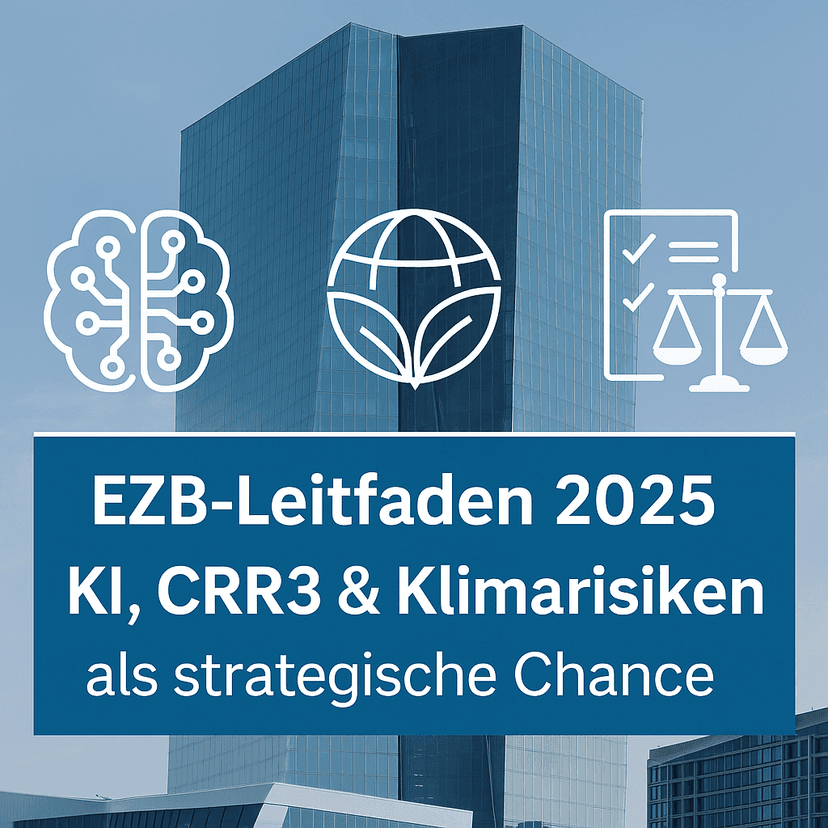
EZB-Leitfaden für interne Modelle: Strategische Orientierung für Banken in der neuen Regulierungslandschaft
Risikomanagement

EZB-Leitfaden für interne Modelle: Strategische Orientierung für Banken in der neuen Regulierungslandschaft

July 29, 2025
8 Min.

Die Juli-2025-Revision des EZB-Leitfadens verpflichtet Banken, interne Modelle strategisch neu auszurichten. Kernpunkte: 1) Künstliche Intelligenz und Machine Learning sind zulässig, jedoch nur in erklärbarer Form und unter strenger Governance. 2) Das Top-Management trägt explizit die Verantwortung für Qualität und Compliance aller Modelle. 3) CRR3-Vorgaben und Klimarisiken müssen proaktiv in Kredit-, Markt- und Kontrahentenrisikomodelle integriert werden. 4) Genehmigte Modelländerungen sind innerhalb von drei Monaten umzusetzen, was agile IT-Architekturen und automatisierte Validierungsprozesse erfordert. Institute, die frühzeitig Explainable-AI-Kompetenzen, robuste ESG-Datenbanken und modulare Systeme aufbauen, verwandeln die verschärften Anforderungen in einen nachhaltigen Wettbewerbsvorteil.

Andreas Krekel
Read
 Erklärbare KI (XAI) in der Softwarearchitektur: Von der Black Box zum strategischen Werkzeug
Digitale Transformation

Erklärbare KI (XAI) in der Softwarearchitektur: Von der Black Box zum strategischen Werkzeug

June 24, 2025
5 Min.

Verwandeln Sie Ihre KI von einer undurchsichtigen Black Box in einen nachvollziehbaren, vertrauenswürdigen Geschäftspartner.

Arosan Annalingam
Read
KI Softwarearchitektur: Risiken beherrschen & strategische Vorteile sichern
Digitale Transformation

KI Softwarearchitektur: Risiken beherrschen & strategische Vorteile sichern

June 19, 2025
5 Min.

KI verändert Softwarearchitektur fundamental. Erkennen Sie die Risiken von „Blackbox“-Verhalten bis zu versteckten Kosten und lernen Sie, wie Sie durchdachte Architekturen für robuste KI-Systeme gestalten. Sichern Sie jetzt Ihre Zukunftsfähigkeit.

Arosan Annalingam
Read
ChatGPT-Ausfall: Warum deutsche Unternehmen eigene KI-Lösungen brauchen
Künstliche Intelligenz - KI

ChatGPT-Ausfall: Warum deutsche Unternehmen eigene KI-Lösungen brauchen

June 10, 2025
5 Min.

Der siebenstündige ChatGPT-Ausfall vom 10. Juni 2025 zeigt deutschen Unternehmen die kritischen Risiken zentralisierter KI-Dienste auf.

Phil Hansen
Read
KI-Risiko: Copilot, ChatGPT & Co. -  Wenn externe KI durch MCP's zu interner Spionage wird
Künstliche Intelligenz - KI

KI-Risiko: Copilot, ChatGPT & Co. - Wenn externe KI durch MCP's zu interner Spionage wird

June 9, 2025
5 Min.

KI Risiken wie Prompt Injection & Tool Poisoning bedrohen Ihr Unternehmen. Schützen Sie geistiges Eigentum mit MCP-Sicherheitsarchitektur. Praxisleitfaden zur Anwendung im eignen Unternehmen.

Boris Friedrich
Read
Live Chatbot Hacking - Wie Microsoft, OpenAI, Google & Co zum unsichtbaren Risiko für Ihr geistiges Eigentum werden
Informationssicherheit

Live Chatbot Hacking - Wie Microsoft, OpenAI, Google & Co zum unsichtbaren Risiko für Ihr geistiges Eigentum werden

June 8, 2025
7 Min.

Live-Hacking-Demonstrationen zeigen schockierend einfach: KI-Assistenten lassen sich mit harmlosen Nachrichten manipulieren.

Boris Friedrich
Read
View All Articles