Short answer: An AI agent is software that pursues a goal autonomously: it breaks tasks into steps, uses tools such as databases, e-mail or business applications, and adapts its approach based on intermediate results. The difference from a chatbot: a chatbot answers, an agent acts. In the enterprise, AI agents belong on a platform with governance, audit trail and a permission model, GDPR-compliant and EU AI Act ready.
Few AI terms are used as loosely in 2026 as "AI agents". Vendors promise digital employees that relieve entire departments; sceptics see rebranded chatbots. The truth sits in between, and it matters for decision-makers: deployed correctly, agents already handle invoice verification, customer communication, risk analysis and knowledge work, measurably and around the clock. Deployed carelessly, they produce errors with system access.
This guide explains without buzzwords what AI agents are, how they work, which types exist and how enterprises get from use case to productive agent in five steps. It is part of our series on local AI and sovereign AI infrastructure.
What are AI agents? A definition without buzzwords
An AI agent is a software system that pursues a given goal autonomously. Instead of returning a single answer to a single request, the agent plans the necessary steps, executes them through connected tools, checks intermediate results and corrects course until the goal is reached or a defined boundary applies. The underlying large language model (LLM) acts as the reasoning layer, the tools as its hands.
Four properties distinguish a real agent from classic automation:
- Goal-driven: The agent receives an outcome ("verify this invoice against the purchase order"), not a sequence of clicks.
- Tool use: It accesses systems through interfaces: ERP, CRM, e-mail, databases, search services or other agents.
- Iterative behaviour: It evaluates intermediate results and revises its plan instead of failing at the first deviation.
- Context and memory: It maintains working state, history and company knowledge, typically via retrieval augmented generation (RAG).
The umbrella term agentic AI describes this architectural approach as a whole: AI systems that do not merely generate content but plan and execute actions. A single AI agent is the smallest unit of agentic AI; multi-agent systems combine several specialised agents into a division of labour.
How do AI agents work? The loop of perceiving, planning, acting
Technically, every agent runs in a loop: it perceives the current state (new e-mail, record, user request), plans the next step, executes it through a tool and evaluates the result. The loop runs until the goal is reached, a human needs to be consulted or a guardrail applies.
A practical example: a sales agent is asked to prepare a quote. It reads the customer request, pulls master data from the CRM, checks price lists and discount rules, drafts the quote in the correct format and submits it to the sales rep for approval. Five systems, one request, no manual hand-offs.
The five building blocks of an agent architecture
- Language model: The reasoning layer. Depending on requirements, a frontier model from the cloud or a local language model in your own data center.
- Orchestration: Controls planning loops, tool calls, error handling and collaboration between multiple agents.
- Tools and integrations: Connections to business systems. The more systems are reachable, the more processes can be automated.
- Knowledge: Company documents, policies and data, usually connected via RAG, so the agent works with facts instead of guesses.
- Governance: Permissions, audit trail, approval thresholds and monitoring. In the enterprise this is not optional, it is the prerequisite.
On the integration side, the Model Context Protocol (MCP) has been establishing itself as the open standard since 2025: agent and business application speak a common protocol language instead of requiring a custom connector per system. That lowers integration cost and lock-in risk. When selecting a platform, it pays to check whether open standards such as MCP are supported.
AI agent, chatbot, RPA or workflow: the distinction
The market mixes these terms freely. What helps is asking who decides and who acts:
- Chatbot: Answers questions in a dialogue. It does not act in systems, it produces text. A chatbot can be the front end of an agent, but it is not one.
- RPA (robotic process automation): Replays hard-coded click sequences. Strong for stable, identical procedures; fragile as soon as screens, formats or exceptions vary.
- Workflow automation: Connects systems through fixed if-then rules. Reliable, but every exception must be modelled in advance.
- AI agent: Decides situationally how to reach the goal. It handles exceptions, interprets unstructured data (e-mails, PDFs, contracts) and escalates to humans when uncertain.
Mature setups combine all three layers: workflows for the predictable, agents for the unstructured, humans for decisions with real impact.
Which types of AI agents exist?
Textbook taxonomies range from simple reflex agents to learning agents. For enterprises, a classification by task is more useful:
- Assistant agents: Support individual employees with research, drafting or scheduling. Low risk, fast value.
- Process agents: Run defined business processes end to end, such as invoice verification or master data maintenance. This is where measurable ROI lives.
- Knowledge agents: Answer questions from company documents, policies and systems, an internal search that understands instead of merely finding.
- Security and monitoring agents: Watch systems or other agents and raise alarms on anomalies. Our article on the security concept for autonomous AI agents shows what this looks like in practice.
Multi-agent systems: when agents collaborate
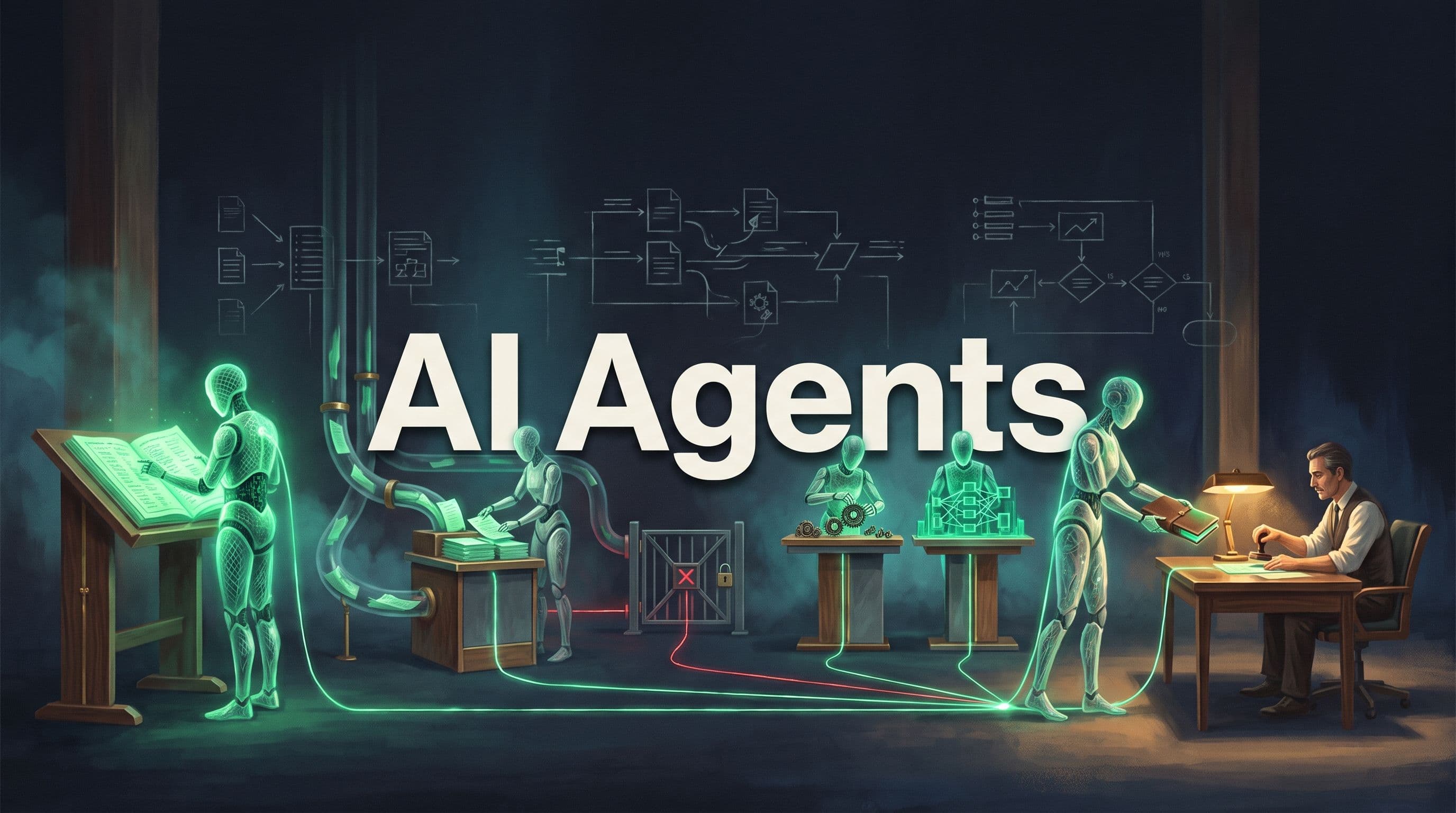
Complex processes exceed what a single agent can do. Multi-agent systems divide the work: one agent analyses the customer request, a second drafts the quote, a third checks compliance requirements, a fourth monitors the others. This division of labour raises quality and traceability but demands more from orchestration and governance. Platforms such as Synthara AI Studio ship this orchestration with governance built in.
AI agent examples: 7 enterprise use cases
Where do AI agents pay off first? These seven examples come from areas where enterprises achieve productive results today:
1. Customer service and communication
Agents resolve standard requests completely, classify and prioritise the rest, and prepare draft replies with customer history for staff. The difference from a classic chatbot: the agent resolves the issue in the system, such as an address change or a status enquiry, instead of just talking about it.
2. Invoice verification and finance
An agent reads incoming invoices regardless of format, matches them against purchase orders and goods receipts, flags deviations and prepares approval. Our AI invoice verification shows this live.
3. Risk management and compliance
Agents monitor portfolios, suppliers or transactions continuously and report anomalies before they become losses. In credit risk, multi-agent systems detect early-warning signals far earlier than processes based on annual statements.
4. Knowledge management and internal search
Instead of digging through folder structures, employees ask in natural language: "Which notice periods apply in the contract with supplier X?" The knowledge agent finds the passage, cites the source and links the document, while respecting the permission model.
5. Sales and quote preparation
From lead research through qualification to the quote draft: agents take over the legwork between customer conversations. Sales teams regain time for what closes deals, and every quote follows the same quality standards.
6. IT operations and security
Agents categorise tickets, resolve standard cases such as password resets, document changes and support alarm triage in the security operations center. Here more than anywhere: tight guardrails, because an agent with admin rights is a high-risk tool.
7. HR and recruiting
Scheduling, applicant correspondence, onboarding checklists: agents visibly relieve HR teams. Caution with anything that means evaluating people: automated candidate selection falls into the high-risk category of the EU AI Act and requires particular care.
Creating and introducing AI agents: 5 steps to a productive agent
Between an impressive demo video and a productive agent in daily operations lie a few decisive choices. This approach has proven itself:
Step 1: Choose the right use case
Good candidates are processes that occur frequently, follow clear rules but contain exceptions and unstructured data, and whose outcome is measurable: cycle time, error rate, cost per case. Poor starting candidates: rare processes with high stakes and unclear success criteria.
Step 2: Clarify data and interfaces
An agent is only as good as its connections. Which systems must it read, which must it write to? Are there APIs or only user interfaces? Answering this early avoids the most common project blocker.
Step 3: Platform or custom build
Custom development with frameworks offers maximum freedom but requires an engineering team and permanent care for security, monitoring and model updates. An enterprise platform such as Synthara AI Studio ships a no-code studio, over 1,500 integrations, governance and audit trail; first agents go live in 3 to 4 weeks instead of months. For most enterprises the platform is the faster and safer path; custom builds pay off for highly specific core processes.
Step 4: Governance from day one
Least-privilege permissions, approval thresholds for critical actions, complete logging and a human in the loop wherever decisions carry weight. Retrofitting governance is expensive; designed in from the start, it is the reason audit signs off on the project.
Step 5: Measure the pilot, then scale
Four to six weeks of pilot operation with clear metrics: automation rate, error rate, processing time, business-unit satisfaction. What works is extended to neighbouring processes; the platform ensures every additional agent is built faster than the first.
AI agent tools and platforms: a map of the market
The market for agent tooling falls into four groups that differ substantially in audience, effort and data sovereignty:
- Hyperscaler ecosystems (Microsoft Copilot Studio, Google Agentspace, Amazon Bedrock Agents): deeply integrated into their cloud, quick to start, at the price of vendor lock-in and their data space. Strong if your company already lives entirely in one of these ecosystems.
- Developer frameworks (LangChain, CrewAI, AutoGen): maximum flexibility for in-house engineering teams. Governance, monitoring, operations and updates remain entirely with you; realistic only with a dedicated team.
- Specialised SaaS agents: ready-made agents for one purpose, such as customer communication or recruiting. Fast entry for one department, but every additional task means another tool and another data-processing agreement.
- Sovereign enterprise platforms such as Synthara AI Studio: no-code configuration, broad integration coverage and governance in one system, operated on-premise or in Germany. The right path when agents are meant to serve several departments and data sovereignty is a requirement.
The selection question is rarely "which tool is best", but: where should your data be processed, who operates the system, and how many different processes should it carry in two years?
Five common mistakes when introducing AI agents
Five patterns keep recurring in projects and slow agent initiatives down:
- Technology before use case: Buying the platform first, then searching for applications. The right order is the reverse: measurable process first, tool second.
- Governance as an afterthought: An agent without a permission model and logging survives neither an audit nor a security incident. Guardrails belong in the architecture, not in the closing report.
- No metrics: Without a baseline (processing time, error rate, cost per case) the value can neither be proven nor managed. What is not measured gets cut in the next budget round.
- Big bang instead of pilot: Agentifying ten processes at once overwhelms business units and IT. One visible, successful pilot creates the pull the programme needs.
- Underestimating interfaces: The agent is configured in days, the ERP connection takes weeks. Clarifying interfaces and data quality early keeps the schedule.
Sovereignty: running AI agents on local language models
AI agents inevitably see sensitive data: contracts, customer records, financials, internal policies. If the language model runs with a US hyperscaler, that data passes through foreign infrastructure with the familiar CLOUD Act questions. The alternative: local language models in your own data center or with a German operator. Open frontier models such as DeepSeek, Qwen or Llama deliver more than sufficient quality for agent workloads, at predictable cost and without data leaving your control.
Vendor independence at the platform level is key: Synthara AI Studio works with any LLM, cloud-based, local or mixed. A pilot can start on a cloud model and switch to a local one for production without rebuilding any agents.
Governance, security and the EU AI Act: agents under control
Capability creates responsibility. The three most important risk areas and their countermeasures:
- Prompt injection and manipulation: Attackers hide instructions in e-mails or documents the agent processes. Countermeasures: input filtering, separated contexts, restrictive tool permissions and monitoring agents.
- Excessive permissions: An agent that is allowed to do everything is a security risk with system access. Countermeasures: least privilege, approval thresholds, separate identities per agent, tamper-proof logs.
- Wrong decisions with real effect: With agents, hallucinations are not just wrong text but wrong actions. Countermeasures: validation steps, four-eyes principle for critical actions, clear escalation rules.
On the regulatory side, the EU AI Act classifies AI systems by purpose. Many assistant and process agents mainly face transparency and documentation duties; applications affecting people, such as recruiting or credit scoring, count as high-risk systems with much stricter requirements. GDPR duties apply as soon as personal data is processed, and financial institutions add DORA ICT requirements. Our EU AI Act overview helps with classification; the platform governance features produce the evidence auditors and supervisors expect.
Frequently asked questions about AI agents (FAQ)
What does an AI agent do?
An AI agent pursues a given goal autonomously: it plans the necessary steps, executes them through connected systems, checks results and adapts its approach. Examples: verifying invoices, resolving customer requests, preparing quotes, monitoring risks.
What is the difference between an AI agent and ChatGPT?
ChatGPT is a language model with a chat interface: it answers requests with text. An AI agent uses such a model as its reasoning layer but additionally acts in systems: it retrieves data, writes to applications and works through multi-step tasks until the goal is reached.
Which types of AI agents exist?
Four types have become established in the enterprise: assistant agents for individual employees, process agents for end-to-end procedures such as invoice verification, knowledge agents for questions against company documents, and security agents for monitoring. Multi-agent systems combine several specialised agents.
How do you build an AI agent in the enterprise?
The proven path runs through an enterprise platform: define the use case, connect systems, configure the agent in a no-code studio, set guardrails, measure the pilot, scale. With a platform such as Synthara AI Studio, first agents go live in 3 to 4 weeks; custom development with frameworks typically takes months.
Can AI agents be operated in a GDPR-compliant way?
Yes, provided data flows, legal bases and processing agreements are properly arranged. The strongest lever is infrastructure: if the language model runs locally or in a German data center, personal data never leaves the controlled environment in the first place.
How much does introducing AI agents cost?
The range is wide: a pilot on an existing platform starts at modest five-figure project budgets; custom developments with a dedicated team and infrastructure quickly reach six figures per year. What matters is the business case: for high-volume processes, agents frequently pay for themselves within the first year.
Do AI agents fall under the EU AI Act?
Yes, like any AI system, but the obligations depend on the purpose. Most assistant and process agents mainly face transparency and documentation duties. High-risk applications, such as automated candidate selection or creditworthiness assessment, are subject to strict requirements for risk management, data quality and human oversight.
What is the Model Context Protocol (MCP)?
MCP is an open standard that defines how AI agents communicate with tools and data sources. Introduced by Anthropic in 2024, it is now supported by all major model providers. For enterprises, MCP significantly lowers integration effort: a connection built once works with any compatible agent, regardless of the model behind it.
Conclusion: from pilot project to agent-driven organisation
AI agents are the step from AI that talks to AI that works. The value does not come from the most impressive model but from the combination of the right use case, clean interfaces and governance from day one. Enterprises that start with a measurable pilot now build a lead that becomes hard to catch.
ADVISORI supports both paths: Synthara AI Studio as the sovereign platform on which agents become productive in weeks, and AI consulting for strategy, governance and architecture, on request entirely on local language models.

Sovereign AI · ADVISORI
Frontier AI on European infrastructure
Frontier performance, entirely in Europe and under European law: as local language models in your infrastructure or orchestrated through Synthara AI Studio.
- EU inference: no CLOUD Act, no kill switch
- GDPR-compliant on European hardware
- Live in a few weeks, no vendor lock-in