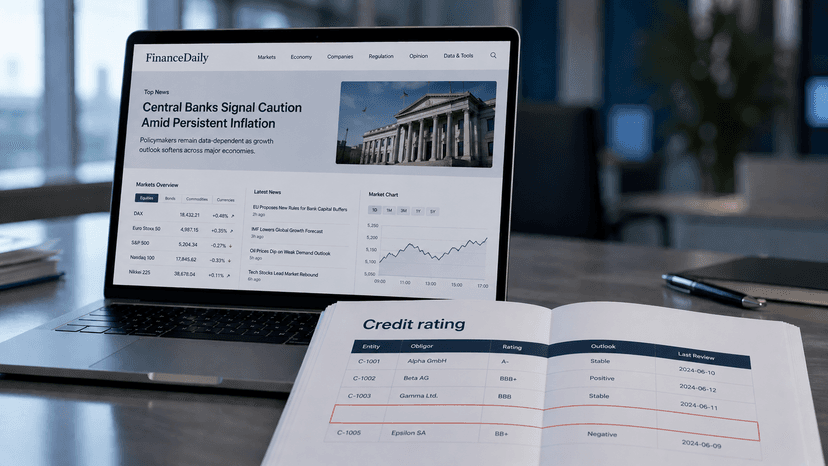
Effective management of financial risks
Financial Risk
Comprehensive consulting for the identification, assessment, and control of market, credit, and liquidity risks in your organization.
- ✓Risk-adjusted decision-making
- ✓Optimized capital allocation
- ✓Regulatory compliance
Your strategic success starts here
Our clients trust our expertise in digital transformation, compliance, and risk management
30 Minutes • Non-binding • Immediately available
For optimal preparation of your strategy session:
- Your strategic goals and objectives
- Desired business outcomes and ROI
- Steps already taken
Or contact us directly:
Certifications, Partners and more...










Comprehensive Financial Risk Management
Our Strengths
- Comprehensive expertise across all areas of financial risk
- Proven methods and tools
- Tailored solutions for your specific requirements
⚠
Expert Tip
Effective Financial Risk Management is more than just compliance. It creates competitive advantages through better decision-making and optimized capital allocation.
ADVISORI in Numbers
11+
Years of Experience
120+
Employees
520+
Projects
We support you with a structured approach to developing and implementing your Financial Risk Management.
Our Approach:
Analysis of the existing risk situation and processes
Development of tailored risk management solutions
Implementation, training, and continuous improvement
"Effective Financial Risk Management is the key to securing financial stability and optimizing capital allocation in an increasingly volatile market environment."

Melanie Düring
Head of Risk Management
Our Services
We offer you tailored solutions for your digital transformation
Market Risk Management
Identification, assessment, and control of market risks
- Value-at-Risk (VaR) modeling
- Sensitivity analyses and stress tests
- Hedging strategies and implementation
Credit Risk Management
Development and implementation of credit risk models and processes
- Scoring and rating models
- Credit portfolio management
- Credit risk transfer and mitigation
Liquidity Risk Management
Optimization of liquidity management and liquidity risk control
- Cash flow forecasting and gap analyses
- Liquidity stress tests and contingency planning
- Working capital optimization
Our Competencies in Financial Risk
Choose the area that fits your requirements
Credit Risk Management & Rating Procedures
We support financial institutions in developing and validating PD, LGD, and EAD models, optimizing internal rating systems, and implementing Basel IV regulatory requirements.
Liquidity Management
Liquidity management and liquidity risk management for banks. LCR, NSFR, stress testing and regulatory liquidity requirements.
Market Risk Assessment & Limit Systems
Market risk assessment and limit systems are regulatory obligations for financial institutions. We develop VaR models, implement stress tests and build hierarchical limit systems compliant with CRR, MaRisk and FRTB.
Model Development
Risk model development for financial institutions. Credit, market and operational risk models to regulatory standards.
Model Governance
Comprehensive model governance framework for banks and financial institutions. Model risk management per SR 11-7, model validation, inventory management, and regulatory compliance for risk models.
Model Validation
Independent model validation for risk models per MaRisk AT 4.3.5, EBA guidelines and BCBS 239. We assess model accuracy, assumptions, data quality and regulatory conformity — quantitatively and qualitatively.
Portfolio Risk Analysis
Professional portfolio risk analysis for financial institutions: From quantification through stress testing to data-driven portfolio optimization. We identify correlations, assess concentration risks, and develop effective limit systems for your portfolio.
Stress Tests & Scenario Analysis
Comprehensive consulting for the development and implementation of stress tests and scenario analysis to assess your resilience and strategic preparation for multiple future developments.
Frequently Asked Questions about Financial Risk
What does Financial Risk Management encompass?
Financial Risk Management encompasses the systematic identification, assessment, and control of financial risks within an organization:
🔍 Main Categories of Financial Risks
•
Market risk: Risks arising from changes in market prices (e.g., interest rates, exchange rates, equities, commodities)
•
Credit risk: Risks arising from the default of business partners or debtors
•
Liquidity risk: Risks arising from insufficient liquidity to meet financial obligations
•
Operational financial risks: Risks arising from processes, systems, or human error in the financial domain
🎯 Core Processes
•
Risk identification: Systematic capture of all relevant risks
•
Risk assessment: Quantitative and qualitative evaluation of risks
•
Risk control: Implementation of risk mitigation measures
•
Risk monitoring: Continuous monitoring of the risk situation
⚙ ️ Governance and Organization
•
Risk strategy and appetite: Definition of the fundamental risk tolerance
•
Limit systems: Setting boundaries for risk exposures
•
Risk reporting: Regular reporting to management and supervisory bodies
•
Risk culture: Embedding risk awareness within the organization
What regulatory requirements apply to Financial Risk Management?
Regulatory requirements for Financial Risk Management vary by industry and region, but typically include:
📜 Banks and Financial Institutions
•
Basel framework: Capital requirements, risk management, and disclosure obligations
•
MaRisk: Minimum Requirements for Risk Management (MaRisk) in Germany
•
CRR/CRD: European Capital Requirements Regulation and Directive
•
Dodd-Frank Act: US regulation for financial institutions
🏢 Insurance Companies
•
Solvency II: European regulatory framework for insurers
•
VAG: Insurance Supervision Act in Germany
•
ORSA: Own Risk and Solvency Assessment
🌐 Corporate Sector in General
•
IFRS 7/9/13: International accounting standards for financial instruments
•
Corporate Governance Code: Recommendations for corporate governance
•
KonTraG: Act on Control and Transparency in Business
📊 Cross-Sector Requirements
•
Internal control systems and risk management
•
Stress tests and scenario analyses
•
Disclosure obligations and transparency requirements
•
Documentation of risk processes and decisions
How does one develop an effective Financial Risk Management strategy?
Developing an effective Financial Risk Management strategy involves several key steps:
🎯 Strategic Foundations
•
Alignment with corporate objectives: Aligning the risk strategy with the overall strategy
•
Defining risk tolerance: Establishing the fundamental risk appetite
•
Determining risk-bearing capacity: Analyzing the financial capacity to absorb risk
•
Setting risk priorities: Focusing on the most material risks
📊 Analytical Components
•
Conducting a risk inventory: Systematic capture of all relevant risks
•
Developing risk assessment models: Quantitative and qualitative methods
•
Defining risk scenarios: Analysis of stress and extreme scenarios
•
Designing risk aggregation: Determining the overall risk profile
⚙ ️ Operational Implementation
•
Developing limit systems: Establishing boundaries for risk exposures
•
Defining escalation processes: Procedures for limit breaches
•
Designing control measures: Instruments for risk mitigation
•
Establishing reporting: Regular risk reporting
👥 Organizational Embedding
•
Defining governance structures: Roles and responsibilities
•
Establishing risk management committees: Decision-making bodies
•
Promoting risk culture: Awareness and training
•
Adjusting incentive systems: Rewarding risk-conscious behavior
What are the most important methods for quantifying market risks?
Various advanced methods are used to quantify market risks:
📊 Value-at-Risk (VaR)
•
Definition: Maximum loss over a given time horizon at a specified confidence level
•
Calculation methods: Historical simulation, variance-covariance approach, Monte Carlo simulation
•
Application: Daily risk management, limit setting, regulatory requirements
•
Formula: VaR_α = μ + σ · Φ^(-1)(α) (for normally distributed returns)
⚠ ️ Expected Shortfall (ES) / Conditional VaR
•
Definition: Expected loss in the worst α% of cases
•
Advantage: Better accounts for the severity of extreme events than VaR
•
Application: Complement to VaR, Basel III requirements
•
Formula: ES_α = E[X | X > VaR_α]
🔄 Sensitivity Analyses
•
Delta: Change in value for a small change in the underlying
•
Gamma: Rate of change of delta
•
Vega: Sensitivity to changes in volatility
•
Theta: Time value decay
•
Rho: Sensitivity to interest rate changes
📈 Stress Tests and Scenario Analyses
•
Historical scenarios: Replication of historical crisis periods
•
Hypothetical scenarios: Simulation of extreme but plausible events
•
Reverse stress tests: Identification of scenarios leading to specific losses
🔍 Copula Models
•
Purpose: Modeling complex dependency structures between risk factors
•
Types: Gaussian copula, t-copula, Archimedean copulas (Clayton, Gumbel)
•
Advantage: Capturing non-linear dependencies and tail dependence
How does credit risk management work in organizations?
Credit risk management in organizations encompasses several key components:
🔍 Credit Risk Identification and Assessment
•
Credit analysis: Assessment of the creditworthiness of business partners
•
Scoring models: Quantitative assessment of default probabilities
•
Rating systems: Internal or external classification of credit quality
•
Expected Loss (EL): EL = PD × LGD × EAD - PD (Probability of Default): Probability of default - LGD (Loss Given Default): Loss rate in the event of default - EAD (Exposure at Default): Exposure amount at the time of default
🛡 ️ Credit Risk Mitigation
•
Credit limits: Setting maximum exposures per business partner
•
Collateral: Securing receivables through assets
•
Guarantees and sureties: Protection through third parties
•
Netting agreements: Offsetting mutual claims
📊 Portfolio Management
•
Diversification: Spreading credit risk across various counterparties
•
Concentration limits: Limiting concentration risks
•
Correlation analysis: Assessment of dependencies within the portfolio
•
Economic capital: Capital allocation based on risk contribution
🔄 Risk Transfer
•
Receivables sale: Factoring, forfaiting
•
Credit insurance: Protection against payment defaults
•
Credit derivatives: Credit Default Swaps (CDS), Credit Linked Notes (CLN)
•
Securitizations: Conversion of receivables into tradable securities
📱 Technology Support
•
AI-based early warning systems: Detection of credit quality deterioration
•
Blockchain for trade finance: Transparency and fraud prevention
•
Big Data Analytics: Use of alternative data sources for credit assessment
How does one manage liquidity risks effectively?
Effective liquidity risk management encompasses several key components:
🎯 Liquidity Risk Measurement
•
Liquidity ratios: LCR (Liquidity Coverage Ratio), NSFR (Net Stable Funding Ratio)
•
Cash flow forecasting: Short-, medium-, and long-term liquidity projections
•
Liquidity gap analysis: Analysis of maturity mismatches
•
Liquidity-at-Risk: Statistical measurement of potential liquidity shortfalls
🛡 ️ Liquidity Reserves
•
Primary reserves: Cash, central bank balances
•
Secondary reserves: Highly liquid securities (e.g., government bonds)
•
Committed credit lines: Committed credit facilities with banks
•
Diversification of funding sources: Avoiding dependencies
⚠ ️ Stress Testing and Contingency Planning
•
Liquidity stress tests: Simulation of market and idiosyncratic stress scenarios
•
Contingency Funding Plan (CFP): Action plan for liquidity shortfalls
•
Early warning indicators: Signals for potential liquidity problems
•
Recovery options: Emergency measures for liquidity procurement
🔄 Active Liquidity Management
•
Cash pooling: Centralization of liquidity within the group
•
Working capital management: Optimization of receivables, payables, and inventories
•
Intraday liquidity management: Control of intra-day liquidity flows
•
Maturity management: Avoiding liquidity shortfalls through staggered maturities
📊 Governance and Reporting
•
Clear responsibilities: ALCO (Asset Liability Committee)
•
Limit systems: Setting tolerance thresholds for liquidity risks
•
Regular reporting: Reporting to management and supervisory bodies
•
Integrated risk management: Linkage with other risk types
What role do stress tests play in Financial Risk Management?
Stress tests play a central role in Financial Risk Management and serve several important functions:
🎯 Objectives of Stress Tests
•
Identification of vulnerabilities: Uncovering weaknesses in the risk profile
•
Quantification of extreme risks: Measuring potential losses in crisis scenarios
•
Review of risk-bearing capacity: Testing financial resilience
•
Complement to VaR models: Overcoming the limitations of classical risk models
📊 Types of Stress Tests
•
Sensitivity analyses: Impact of individual risk factors (e.g., interest rate increase of
200 basis points)
•
Scenario analyses: Simulation of complex events with multiple risk factors
•
Historical scenarios: Replication of past crises (e.g., financial crisis 2008)
•
Hypothetical scenarios: Simulation of plausible but not yet occurred events
•
Reverse stress tests: Identification of scenarios leading to predefined losses
🔄 Integrated Stress Test Programs
•
Top-down vs. bottom-up: Strategic vs. detailed operational perspective
•
Enterprise-wide integration: Consideration of all relevant risk types
•
Dynamic stress tests: Multi-period simulation with management responses
•
Macroeconomic scenarios: Linkage with macroeconomic developments
⚙ ️ Implementation and Governance
•
Scenario development: Process for defining plausible stress scenarios
•
Model infrastructure: Technical implementation of stress tests
•
Validation: Review of plausibility and consistency
•
Reporting: Communication of results to decision-makers
🛠 ️ Areas of Application
•
Capital planning: Ensuring adequate capital buffers
•
Liquidity management: Identification of potential liquidity shortfalls
•
Strategic planning: Consideration of extreme scenarios in business planning
•
Risk tolerance: Calibration of risk limits and appetite
How does one integrate ESG risks into Financial Risk Management?
Integrating ESG risks (Environmental, Social, Governance) into Financial Risk Management encompasses several dimensions: Identification and Assessment of ESG Risks Climate risks: Physical risks (e.g., extreme weather events) and transition risks (e.g., CO 2 pricing) Social risks: Working conditions, human rights, community relations Governance risks: Corporate governance, compliance, ethics Double materiality: Financial impact on the company and the company's impact on the environment and society Methods for ESG Risk Quantification ESG scoring: Assessment of ESG factors based on qualitative and quantitative indicators Climate scenario analyses: Assessment of climate risks under various warming scenarios (e.g., 1.5°C, 2°C, 3°C) ESG-VaR: Integration of ESG factors into Value-at-Risk models Carbon stress testing: Simulation of the impact of CO 2 price changes Integration into Existing Risk Processes Expansion of risk taxonomy: Inclusion of ESG risks in the risk inventory Adaptation of risk models: Consideration of ESG factors in credit, market, and operational risk models ESG factors in due diligence: Review of ESG risks.
What role does digitalization play in Financial Risk Management?
Digitalization is transforming Financial Risk Management across several dimensions:
🔍 Data Management and Analysis
•
Big Data: Processing large, heterogeneous data volumes in real time
•
Alternative data sources: Use of satellite data, social media, IoT sensors
•
Data lakes: Centralized data storage for integrated risk analyses
•
Data governance: Ensuring data quality, consistency, and availability
🤖 Artificial Intelligence and Machine Learning
•
Predictive risk models: Forecasting default probabilities and market movements
•
Anomaly detection: Identification of unusual patterns and potential risks
•
Natural language processing: Analysis of news reports and documents
•
Reinforcement learning: Optimization of hedging strategies and portfolio allocation
⚙ ️ Process Automation
•
Robotic Process Automation (RPA): Automation of repetitive risk processes
•
Straight-through processing: End-to-end automation of risk assessments
•
Automated reporting: Dynamic dashboards and self-service reporting
•
Workflow management: Digitalization of approval processes and escalations
🔐 Cybersecurity and Resilience
•
Cyber risk management: Integration of cyber risks into overall risk management
•
Digital resilience: Ensuring the continuity of digital processes
•
Penetration tests and red team exercises: Proactive identification of vulnerabilities
•
Cyber insurance: Risk transfer for cyber risks
🌐 Platforms and Ecosystems
•
Integrated GRC platforms: Unification of governance, risk, and compliance
•
Cloud-based solutions: Flexible infrastructure for risk analyses
•
APIs and microservices: Flexible integration of various risk management tools
•
RegTech: Specialized technology solutions for regulatory requirements
How does one measure the effectiveness of Financial Risk Management?
Measuring the effectiveness of Financial Risk Management encompasses several dimensions:
📊 Quantitative Metrics
•
Risk-adjusted performance metrics: RAROC (Risk-Adjusted Return on Capital), RORAC (Return on Risk-Adjusted Capital)
•
Volatility reduction: Reduction in earnings and cash flow fluctuations
•
Loss statistics: Frequency and severity of losses compared to expectations
•
Capital efficiency: Optimization of capital allocation for a given risk profile
🎯 Process-Oriented Metrics
•
Risk identification rate: Share of risks identified in a timely manner
•
Limit utilization and breaches: Adherence to defined risk limits
•
Response time: Speed of response to changes in the risk situation
•
Forecast accuracy: Precision of risk models and scenarios
🔄 Maturity Models
•
Capability Maturity Model (CMM) for risk management
•
Benchmarking against industry standards and best practices
•
Gap analyses against regulatory requirements
•
Self-assessments and independent reviews
👥 Qualitative Aspects
•
Risk culture and awareness within the organization
•
Integration of risk considerations into decision-making processes
•
Quality of risk reporting and communication
•
Stakeholder feedback (management, supervisory board, investors)
💼 Business Impact
•
Crisis resilience: Ability to withstand stress situations
•
Strategic flexibility: Capacity to adapt to changing risk landscapes
•
Competitive advantages: Differentiation through superior risk management
•
Sustainable value creation: Long-term corporate development
How does one organize effective Financial Risk Management?
Organizing effective Financial Risk Management encompasses several key elements:
🏗 ️ Governance Structure
•
Three Lines Model: Clear separation between risk-taking, risk control, and independent review
•
Risk management committees: ALCO (Asset Liability Committee), RMC (Risk Management Committee)
•
Board-level responsibility: CRO (Chief Risk Officer) at board level
•
Supervisory board oversight: Risk committee of the supervisory board
👥 Roles and Responsibilities
•
Risk owner: Responsibility for risks within business units
•
Risk control function: Independent monitoring and control
•
Risk specialists: Expertise for specific risk types
•
Internal audit: Independent review of risk management processes
📋 Policies and Processes
•
Risk strategy and policy: Principles of risk management
•
Risk management framework: Structured approach for all risk types
•
Methodology manuals: Documentation of assessment methods
•
Process descriptions: Standardized procedures and responsibilities
🔄 Integrated Processes
•
Risk management cycle: Identification, assessment, control, monitoring
•
Integration into business processes: Risk assessment in decision-making
•
Linkage with strategy and planning processes
•
Escalation mechanisms: Clear pathways for risk escalations
🛠 ️ Supporting Infrastructure
•
IT systems: Integrated risk management platforms
•
Data management: Centralized data storage for risk analyses
•
Reporting tools: Dashboards and report generators
•
Training programs: Building risk competence
How does Financial Risk Management differ across industries?
Financial Risk Management has specific characteristics depending on the industry:
🏦 Banks and Financial Services Providers
•
Focus: Credit, market, liquidity, and operational risks
•
Regulatory framework: Basel III/IV, MaRisk, CRR/CRD
•
Particularities: High utilize, complex financial products, systemic importance
•
Methods: Advanced internal models, comprehensive stress tests, ICAAP/ILAAP
🏢 Insurance Companies
•
Focus: Underwriting risks, market risks, ALM risks
•
Regulatory framework: Solvency II, VAG, ORSA
•
Particularities: Long-term liabilities, natural catastrophe risks
•
Methods: Stochastic modeling, reinsurance, catastrophe models
🏭 Industrial Companies
•
Focus: Commodity price risks, currency risks, supply chain risks
•
Regulatory framework: IFRS, Corporate Governance Code
•
Particularities: Operating margins, investment cycles, global supply chains
•
Methods: Hedging strategies, working capital management, supplier risk management
🛒 Retail Companies
•
Focus: Currency risks, credit risks, inventory risks
•
Regulatory framework: HGB, IFRS
•
Particularities: Low margins, high turnover rates, seasonality
•
Methods: Dynamic pricing, just-in-time procurement, receivables management
🏗 ️ Real Estate Companies
•
Focus: Interest rate risks, valuation risks, vacancy risks
•
Regulatory framework: IFRS 13, Real Estate Valuation Ordinance
•
Particularities: Long-term financing, illiquid assets, location dependency
•
Methods: Interest rate management, diversification by region and use type, lease management
What role do derivatives play in Financial Risk Management?
Derivatives play a central role in Financial Risk Management and serve several important functions:
🛡 ️ Hedging Instruments
•
Interest rate derivatives: Hedging against interest rate risks (swaps, caps, floors)
•
Currency derivatives: Hedging against exchange rate risks (forwards, options)
•
Commodity derivatives: Hedging against price fluctuations in commodities (futures, swaps)
•
Credit derivatives: Hedging against default risks (CDS, CLN)
📊 Types of Derivatives
•
Forwards and futures: Obligation to buy/sell at a fixed price and date
•
Options: Right (not obligation) to buy/sell at a fixed price
•
Swaps: Exchange of cash flows over a defined period
•
Structured products: Combination of various derivatives for specific risk profiles
⚙ ️ Application Strategies
•
Micro-hedging: Hedging individual transactions or positions
•
Macro-hedging: Hedging the overall risk of a portfolio
•
Dynamic hedging: Continuous adjustment of the hedging strategy
•
Proxy hedging: Use of correlated instruments when direct hedging is not possible
⚠ ️ Risks and Challenges
•
Basis risk: Imperfect correlation between the hedging instrument and the hedged position
•
Counterparty risk: Risk of default by the counterparty to the derivative contract
•
Liquidity risk: Risk of being unable to close positions at reasonable prices
•
Operational risks: Complexity of valuing and managing derivatives
📋 Governance and Control
•
Clear policies: Definition of permissible instruments and strategies
•
Limit systems: Restriction of exposures and risks
•
Independent valuation: Control by risk management and middle office
•
Regular reporting: Transparency over derivative positions and risks
How does one integrate Financial Risk Management into corporate management?
Integrating Financial Risk Management into corporate management encompasses several dimensions:
🎯 Strategic Integration
•
Risk strategy as part of the corporate strategy
•
Risk-adjusted strategic planning: Consideration of risks in strategic decisions
•
Risk appetite as a guiding framework for strategic initiatives
•
Scenario analyses for strategic options
📊 Risk-Adjusted Management Metrics
•
RAROC (Risk-Adjusted Return on Capital): Consideration of risk in performance measurement
•
Economic capital: Capital allocation based on risk contribution
•
Risk-adjusted KPIs: Integration of risk aspects into performance indicators
•
Risk-adjusted hurdle rates for investment decisions
🔄 Integration into Management Processes
•
Budgeting and planning: Risk scenarios in financial planning
•
Investment management: Risk assessment in investment decisions
•
Product development: Risk analysis of new products and services
•
M&A: Due diligence and risk assessment in corporate transactions
👥 Incentive Systems and Remuneration
•
Risk-adjusted remuneration models
•
Long-term incentive components to avoid short-term risk-taking
•
Malus and clawback provisions for excessive risk-taking
•
Qualitative risk objectives in target agreements
📋 Integrated Reporting
•
Combined performance and risk reporting
•
Balanced scorecard with a risk perspective
•
Integrated dashboards for management and supervisory bodies
•
Linkage of financial and non-financial reporting
What trends are shaping the future of Financial Risk Management?
The future of Financial Risk Management is shaped by several trends:
🤖 Technological Innovation
•
AI and machine learning: Advanced forecasting models and anomaly detection
•
Quantum computing: Transformation of complex risk calculations
•
Blockchain: Transparency and efficiency in risk transactions
•
Digital twins: Simulation of risk scenarios in virtual environments
🌱 ESG Integration
•
Climate risk management: Physical and transition risks of climate change
•
Biodiversity risks: Impact on supply chains and business models
•
Social risk management: Human rights, working conditions, community relations
•
Double materiality: Financial and non-financial risk perspectives
🔄 Resilience and Agility
•
Dynamic risk management: Continuous adaptation to changing conditions
•
Operational resilience: Resilience of critical business processes
•
Scenario planning: Preparation for multiple future scenarios
•
Adaptive risk governance: Flexible governance structures for rapid responses
🌐 Geopolitical Complexity
•
Fragmentation of global markets: Deglobalization and regionalization
•
Geopolitical risks: Conflicts, sanctions, trade wars
•
Regulatory divergence: Differing standards across regions
•
Cyber geopolitics: State-sponsored cyberattacks and digital sovereignty
📊 Data-Centric Risk Management
•
Alternative data sources: Satellite data, social media, IoT
•
Real-time risk intelligence: Real-time analysis of risk information
•
Predictive risk analytics: Forecasting the emergence and development of risks
•
Data-driven risk culture: Decision-making based on data and analysis
Success Stories
Discover how we support companies in their digital transformation
Digitalization in Steel Trading
Klöckner & Co
Digital Transformation in Steel Trading
Case Study

Results
Over 2 billion euros in annual revenue through digital channels
Goal to achieve 60% of revenue online by 2022
Improved customer satisfaction through automated processes
AI-Powered Manufacturing Optimization
Siemens
Smart Manufacturing Solutions for Maximum Value Creation
Case Study

Results
Significant increase in production performance
Reduction of downtime and production costs
Improved sustainability through more efficient resource utilization
AI Automation in Production
Festo
Intelligent Networking for Future-Proof Production Systems
Case Study

Results
Improved production speed and flexibility
Reduced manufacturing costs through more efficient resource utilization
Increased customer satisfaction through personalized products
Generative AI in Manufacturing
Bosch
AI Process Optimization for Improved Production Efficiency
Case Study

Results
Reduction of AI application implementation time to just a few weeks
Improvement in product quality through early defect detection
Increased manufacturing efficiency through reduced downtime
Let's
Work Together!
Is your organization ready for the next step into the digital future? Contact us for a personal consultation.
Your strategic success starts here
Our clients trust our expertise in digital transformation, compliance, and risk management
Ready for the next step?
Schedule a strategic consultation with our experts now
30 Minutes • Non-binding • Immediately available
For optimal preparation of your strategy session:
Your strategic goals and challenges
Desired business outcomes and ROI expectations
Current compliance and risk situation
Stakeholders and decision-makers in the project
Prefer direct contact?
Direct hotline for decision-makers
Strategic inquiries via email
Detailed Project Inquiry
For complex inquiries or if you want to provide specific information in advance