Systematic Management and Monitoring of Risk Models
Model Governance
Comprehensive model governance framework for banks and financial institutions. Model risk management per SR 11-7, model validation, inventory management, and regulatory compliance for risk models.
- ✓Minimization of model risks through systematic governance
- ✓Enhancement of model quality and performance
- ✓Ensuring regulatory compliance
- ✓Optimized resource allocation for model development and maintenance
Your strategic success starts here
Our clients trust our expertise in digital transformation, compliance, and risk management
30 Minutes • Non-binding • Immediately available
For optimal preparation of your strategy session:
- Your strategic goals and objectives
- Desired business outcomes and ROI
- Steps already taken
Or contact us directly:
Certifications, Partners and more...







Comprehensive Model Governance for Future-Proof Risk Management
Our Strengths
- Comprehensive expertise in regulatory requirements and international standards
- Practical experience with Model Governance implementation across various industries
- Combination of methodological knowledge with pragmatic solution approaches
- Specialized competence for AI-specific governance challenges
⚠
Expert Tip
An integrated Model Governance framework pays off multiple times: It not only reduces direct model risks by an average of 65%, but also increases model performance by up to 40% and shortens time-to-market for new models by approximately 30%. Particularly effective is the establishment of a central Model Inventory with automated documentation and monitoring of model performance.
ADVISORI in Numbers
11+
Years of Experience
120+
Employees
520+
Projects
We pursue a systematic, phase-oriented approach to develop and implement customized Model Governance frameworks. Our proven methodology considers both regulatory requirements and the specific characteristics of your model landscape and organizational circumstances.
Our Approach:
Phase 1: Analysis & Assessment - Inventory of existing models, processes, and governance structures as well as identification of gaps and improvement potentials
Phase 2: Conception - Development of a customized Model Governance framework including roles, responsibilities, processes, and documentation standards
Phase 3: Implementation - Gradual introduction of governance components, employee training, and establishment of required committees and control processes
Phase 4: Validation & Quality Assurance - Development and implementation of solid validation methods and quality assurance processes for all relevant model types
Phase 5: Continuous Optimization - Establishment of processes for ongoing monitoring, assessment, and enhancement of Model Governance
"Model Governance is far more than a regulatory obligation – it is a strategic lever to ensure the quality, transparency, and reliability of model-based decisions. A well-designed governance framework creates the balance between methodological rigor and practical applicability, thereby forming the foundation for responsible innovation in the field of modeling."

Melanie Düring
Head of Risk Management
Our Services
We offer you tailored solutions for your digital transformation
Model Governance Framework
Development and implementation of comprehensive Model Governance frameworks covering all aspects of the model lifecycle – from conception and development through validation and deployment to enhancement or decommissioning of models.
- Customized governance structures and processes
- Definition of roles, responsibilities, and committees
- Development of policies, standards, and guidelines
- Integration into existing risk management and decision processes
Model Validation
Conception and implementation of methodologically sound validation processes that ensure the conceptual appropriateness, technical correctness, and operational performance of your models – both for initial validation and regular follow-up validations.
- Development of model-specific validation methods
- Conceptual, methodological, and procedural validation
- Backtesting and performance analyses
- Benchmarking and comparative analyses
Model Monitoring & Reporting
Establishment of systematic monitoring and reporting processes that ensure continuous assessment of model performance, early detection of model weaknesses, and transparent reporting to relevant stakeholders.
- Development of Key Performance Indicators (KPIs) for models
- Implementation of automated monitoring systems
- Conception of meaningful management reports
- Integration of early warning indicators for model weaknesses
AI-Specific Governance
Development of specialized governance approaches for AI and Machine Learning models that consider their particular characteristics such as black-box issues, continuous learning, or bias risks and ensure responsible AI usage.
- Transparency and explainability standards for AI models
- Bias identification and minimization
- Special validation methods for Machine Learning models
- Ethical guidelines and responsibility principles for AI
Our Competencies in Financial Risk
Choose the area that fits your requirements
Credit Risk Management & Rating Procedures
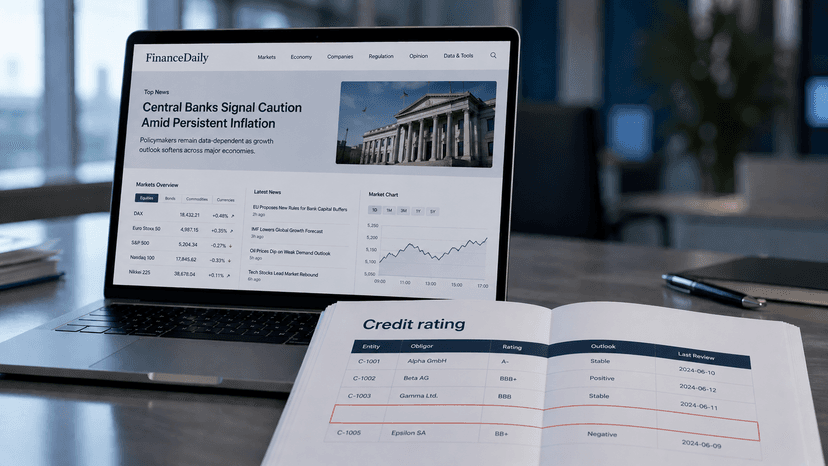
We support financial institutions in developing and validating PD, LGD, and EAD models, optimizing internal rating systems, and implementing Basel IV regulatory requirements.
Liquidity Management
Liquidity management and liquidity risk management for banks. LCR, NSFR, stress testing and regulatory liquidity requirements.
Market Risk Assessment & Limit Systems
Market risk assessment and limit systems are regulatory obligations for financial institutions. We develop VaR models, implement stress tests and build hierarchical limit systems compliant with CRR, MaRisk and FRTB.
Model Development
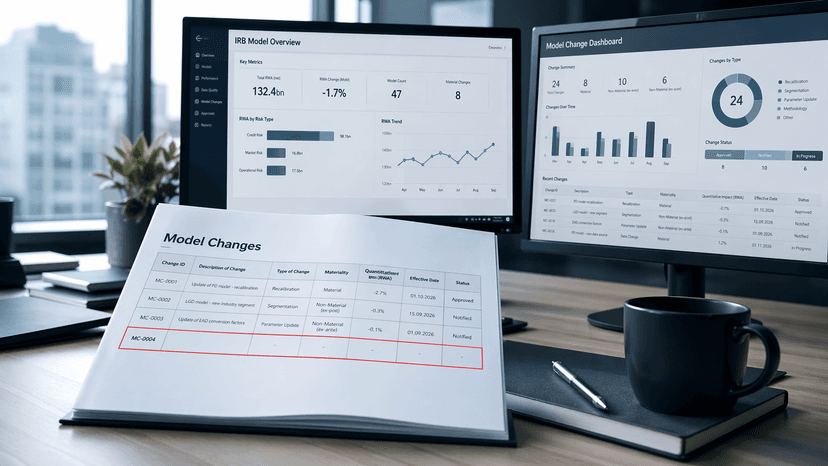
Risk model development for financial institutions. Credit, market and operational risk models to regulatory standards.
Model Validation
Independent model validation for risk models per MaRisk AT 4.3.5, EBA guidelines and BCBS 239. We assess model accuracy, assumptions, data quality and regulatory conformity — quantitatively and qualitatively.
Portfolio Risk Analysis
Professional portfolio risk analysis for financial institutions: From quantification through stress testing to data-driven portfolio optimization. We identify correlations, assess concentration risks, and develop effective limit systems for your portfolio.
Stress Tests & Scenario Analysis
Comprehensive consulting for the development and implementation of stress tests and scenario analysis to assess your resilience and strategic preparation for multiple future developments.
Frequently Asked Questions about Model Governance
What is Model Governance and why is it important?
Model Governance encompasses the principles, processes, and controls for the responsible development, implementation, and monitoring of analytical and AI/ML models. In a data-driven business world, Model Governance is indispensable for the following reasons: Definition and Scope Systematic approach to managing the entire model lifecycle: from conception through development to operation and decommissioning Establishment of a framework of policies, standards, and processes for consistent model management Integration of risk management, compliance, and ethical principles into all phases of model development and usage Clear responsibilities and accountabilities for all parties involved in model development and usage Central platform for documentation, validation, and continuous monitoring of all models Risk Aspects and Challenges Model risk: Danger of financial losses or wrong decisions due to unsuitable models Compliance risk: Non-compliance with regulatory requirements (e.g., GDPR, BDSG, MaRisk) Reputational risk: Loss of trust due to erroneous or discriminatory model decisions Transparency deficit: Lack of traceability of model decisions ("black box" problem).
What key components does a Model Governance Framework include?
An effective Model Governance Framework consists of several interconnected components that together provide a structured approach for managing, monitoring, and controlling models: Policies and Standards Model Risk Management Policy: Overarching principles and guidelines for handling model risks Model categorization: Systematic classification of models by risk, complexity, and business relevance Development standards: Binding methodological and technical specifications for model development Documentation standards: Uniform requirements for model description and documentation Ethics guidelines: Principles for fair, transparent, and responsible model usage Processes and Workflows Model lifecycle management: End-to-end processes from conception to decommissioning Model Request and Approval: Structured request and approval process for new models Validation process: Independent review of methodological correctness and implementation Change Management: Controlled introduction of model changes and improvements Incidents and Issues Management: Systematic handling of model errors and problems Roles and Responsibilities Three Lines of Defense: Clear separation between model development, independent validation, and audit Model Owner: Business responsibility for model usage and.
What roles and responsibilities are crucial in Model Governance?
An effective Model Governance system requires a clear definition and separation of roles and responsibilities. The Three Lines of Defense model provides a proven foundation for this: Leadership and Management Level Chief Risk Officer (CRO): Overall responsibility for model risk management at the enterprise level Model Risk Committee: Decision-making body for strategic governance questions and risk appetite Chief Data Officer (CDO): Ensuring data quality and availability for model development Chief Analytics Officer (CAO): Strategic alignment of model development with corporate objectives Executive Sponsors: Support for Model Governance initiatives at the highest management level First Line of Defense Model Owner: Business-side responsibility for the model, its usage, and results
•
Definition of model requirements and business objectives
•
Decision on model deployment based on validation results
•
Budget and resource responsibility for the model
•
Escalation and reporting of model problems Model Developer/Data Scientist: Technical development and implementation of the model
•
Method selection and algorithmic.
How does Model Governance relate to AI Ethics and regulatory compliance?
Model Governance, AI Ethics, and regulatory compliance are closely interconnected and together form a comprehensive framework for the responsible development and use of models. Relationship between Model Governance and AI Ethics Complementary approaches: Model Governance provides the operational framework, while AI Ethics supplies the normative principles Principles integration: Ethical principles such as fairness, transparency, and non-discrimination are operationalized in governance processes Chain of responsibility: Governance structures define who is responsible for compliance with ethical standards Bias management: The ethical postulate of fairness is implemented through governance controls for bias detection and mitigation Cultural alignment: Model Governance promotes a corporate culture that considers ethical aspects in model decisions Regulatory Requirements for Model Governance Industry-specific requirements: Different requirements depending on sector (financial services, healthcare, etc.) SR 11–7 (Fed): Fundamental framework for banks on model risk management GDPR/DSGVO: Requirements regarding automated decisions and right to explanation EU AI Act: Risk-based regulation of AI systems with specific governance requirements Sector-specific regulations: Basel III/IV for banks, MDR for medical devices, etc.
How do you implement a Model Governance Framework?
Implementing a Model Governance Framework requires a structured approach that considers both organizational and technical dimensions. A successful implementation typically proceeds in several phases: Assessment and Preparation Inventory: Capture of all existing models and their current governance status Gap analysis: Identification of gaps between current state and regulatory/best practice requirements Stakeholder mapping: Identification of all relevant actors and their interests/concerns Risk appetite definition: Determination of organization-wide tolerance for model risks Business case: Development of a compelling justification for investments in Model Governance Strategy and Framework Governance principles: Definition of fundamental guidelines and principles for model management Roles and responsibilities: Clear assignment of tasks and decision-making authority Policies and standards: Development of binding specifications for model development and usage Process design: Definition of end-to-end processes for the entire model lifecycle Escalation paths: Establishment of mechanisms for problem handling and conflict resolution Operational Implementation Pilot project: Testing of the framework on selected models with high importance or.
What documentation is required for Model Governance?
Comprehensive documentation is a central component of every Model Governance Framework. It serves not only regulatory compliance but also knowledge preservation, quality assurance, and facilitates collaboration between different stakeholders. Model-Specific Documentation Model specification: Detailed description of model purpose, assumptions, and limitations Data specification: Documentation of data sources used, data transformations, and data quality Method documentation: Description of mathematical/statistical methods and algorithms Development documentation: Recording of the development process including rejected alternatives Implementation documentation: Technical details on model implementation in code Test documentation: Description of tests performed and their results Performance documentation: Evidence of model performance based on relevant metrics Lifecycle Documentation Change history: Complete record of all model changes and updates Validation reports: Results of independent model reviews and their implications Monitoring reports: Regular documentation of model performance in production Issue tracking: Tracking of identified problems and their resolution Usage documentation: Recording of business usage and use cases End-of-life documentation: Justification and process for model.
What tools support Model Governance?
Modern Model Governance is supported by specialized technology solutions that cover various aspects of the model lifecycle and facilitate compliance with governance requirements. These tools can be categorized into several groups: Model Inventory and Cataloging Central model registers: Capture and management of all models in the organization Metadata management: Structured capture of model-related metadata Version control: Tracking of different model versions and iterations Dependency tracking: Mapping of dependencies between models and components Tagging and classification: Systematic categorization by risk classes and application areas Status tracking: Monitoring of the current lifecycle status of each model Integrated approval processes: Workflow management for model approvals Validation and Risk Assessment Automated validation tools: Standardized tests for different model types Bias detection: Detection of unwanted biases in models Sensitivity analysis: Tools for testing model solidness Explainability tools: Solutions for increasing model interpretability Risk scoring: Automated assessment of model risks Compliance checkers: Automatic verification against regulatory requirements Code review tools: Support.
How do you balance innovation and governance in model development?
The balance between innovation and governance is a central challenge for organizations developing analytical and AI/ML models. Too much governance can inhibit innovation, while too little control poses significant risks. An intelligent balancing of these apparent opposites is crucial for sustainable success. Core Principles for Balancing Risk-based approach: Graduation of governance intensity according to model risk and criticality Early integration: Incorporation of governance aspects already in early development phases Common language: Establishment of a unified understanding between Business, Data Science, and Risk Agile governance: Flexible, iterative processes instead of rigid gate structures Continuous learning: Systematic derivation of lessons learned from governance processes Promoting Innovation within the Governance Framework Sandbox environments: Protected spaces for experiments with reduced governance requirements Fast-track processes: Accelerated approval procedures for prototypes and proof-of-concepts Innovation labs: Dedicated teams with greater degrees of freedom while limiting risk Template-based approaches: Predefined, tested building blocks for faster development Reuse: Utilization of already validated components to.
What are best practices in Model Risk Management?
Model Risk Management (MRM) has established itself as an independent discipline to address the specific risks associated with the development and use of models. The following best practices have proven effective: Sound Framework Risk-based tiering structure: Classification of models according to their risk potential and business criticality Clear governance structure: Unambiguous assignment of responsibilities and decision-making authority Three Lines of Defense: Separation of model development, independent validation, and audit Comprehensive model risk policy: Documentation of binding principles and procedures Control mechanisms: Implementation of effective controls in all phases of the model lifecycle Thorough Model Documentation Complete specification: Detailed description of model purpose, methodology, and assumptions Transparent data foundation: Documentation of all data sources, transformations, and quality controls Traceable development steps: Justification of methodological decisions and rejected alternatives Implementation details: Documentation of technical implementation and system integration Usage guidelines: Clear description of permissible application scenarios and boundaries Solid Validation Independent validation function: Organizational separation of development.
How do you ensure model transparency and explainability?
Model transparency and explainability are central requirements for modern analytical and AI/ML models, especially in regulated industries and critical decision processes. They enable trust, traceability, and responsible model usage. Fundamentals of Model Transparency Method transparency: Disclosure of algorithms and mathematical procedures used Data transparency: Documentation of training data, their origin, quality, and limitations Process transparency: Traceable description of the development and validation process Usage transparency: Clarity about application scenarios and deployment boundaries of the model Decision transparency: Disclosure of how model outputs flow into business decisions Methods for Explainable AI (XAI) Intrinsically interpretable models: Preference for inherently explainable algorithms such as decision trees, linear models, or rule-based systems Post-hoc explainability methods: Application of techniques for subsequent explanation of complex models Local explanations: Explanation of individual predictions through methods like LIME or SHAP Global explanations: Overarching explanation of model behavior through Feature Importance, Partial Dependence Plots, or Global Surrogate Models Counterfactual explanations: Showing what changes would.
How do you validate and test AI/ML models?
Validation and testing of AI/ML models requires a comprehensive, multi-dimensional approach that goes beyond traditional testing procedures. A structured framework for model validation includes the following key elements: Conceptual Validation Theoretical foundation: Review of the scientific and mathematical foundations of the model Assumption validation: Assessment of the appropriateness and validity of all model assumptions Method adequacy: Evaluation of the suitability of chosen algorithms for the use case Conceptual limitations: Identification of conceptual boundaries and constraints Alternative approaches: Comparison with other methodological approaches Input Validation and Data Quality Data quality metrics: Systematic assessment of completeness, correctness, timeliness, etc. Data coverage: Verification of the representativeness of training data for the target domain Distribution analysis: Examination of distribution properties and changes Bias detection: Identification of unwanted biases in training data Data lineage: Traceability of data origin and transformations Implementation Validation Code review: Systematic review of implementation for errors and vulnerabilities Unit tests: Isolated tests of individual model components.
What regulatory requirements exist for Model Governance?
Regulatory requirements for Model Governance have increased significantly in recent years, especially for the use of AI/ML models in critical application areas. These requirements vary by industry and region, with some central regulatory approaches emerging: Financial Sector-Specific Regulation SR 11–7 (USA): The Federal Reserve guideline on model risk management as a fundamental standard
•
Comprehensive definition of model risk and its components
•
Requirements for solidly documented development processes
•
Necessity of independent validation and effective governance
•
Regular monitoring and continuous improvement TRIM Guide (EU): Targeted Review of Internal Models by the European Central Bank
•
Harmonized assessment of internal models of banks
•
Detailed requirements for model validation and documentation
•
Focus on consistent and risk-appropriate model application MaRisk (Germany): Minimum Requirements for Risk Management with specific provisions for model validation PRA SS3/18 (UK): Supervisory Statement on model risk management in the banking sector OSFI E‑23 (Canada): Guidelines on Enterprise-wide Model Risk Management.
How do you monitor models in production?
Effective monitoring of models in production is crucial for long-term model quality and risk minimization. A comprehensive monitoring framework encompasses several dimensions: Statistical Performance Monitoring Model accuracy metrics: Continuous measurement of Accuracy, Precision, Recall, F1-Score, etc. Population stability: Monitoring of target variable distribution stability over time Discrimination capability: Control of model discriminatory power (e.g., AUC, Gini) Calibration: Verification of agreement between predicted and actual probabilities Confidence intervals: Calculation and monitoring of uncertainty measures for model predictions Drift Monitoring Input drift: Detection of changes in input data distributions Concept drift: Identification of changes in the relationship between input and output variables Feature importance drift: Monitoring of shifts in relative influence of features Segment-specific drift: Analysis of drift phenomena in specific customer segments Threshold-based alerts: Automatic warnings when defined drift thresholds are exceeded Operational Monitoring Runtime performance: Monitoring of response times, throughput, and resource utilization Availability: Control of model availability and downtime Error detection: Identification and tracking.
How do you handle Model Drift and model degradation?
Model Drift and model degradation are inevitable challenges in the lifecycle of AI/ML models. Effective handling of these phenomena requires a systematic approach to detection, analysis, and countermeasures: Detection of Drift and Degradation Statistical drift detection: Use of distribution tests (KS test, PSI, JS divergence) to compare training and production data Performance monitoring: Continuous monitoring of model performance metrics (Accuracy, F1-Score, etc.) Concept drift detection: Detection of changes in the relationship between input and output Segment analysis: Identification of drift in specific data segments or user groups Early warning system: Implementation of thresholds and alerting mechanisms for early drift detection Classification and Analysis of Causes Data drift: Changes in the distribution of input data without change in underlying relationships Concept drift: Changes in the fundamental relationships between input and output variables Gradual vs. abrupt drift: Distinction between slow changes and sudden shifts Cyclical drift: Detection of seasonal or periodic patterns in model degradation Root cause.
How do you conduct Model Audits and Reviews?
Model audits and reviews are crucial mechanisms for quality assurance, risk minimization, and compliance assurance within the Model Governance framework. A systematic approach includes the following elements: Types of Model Reviews Initial validation: Thorough review of new models before production deployment Regular reviews: Periodic review at defined time intervals Trigger-based reviews: Unscheduled reviews upon significant events
•
Performance degradation: Review when defined performance thresholds are breached
•
Significant changes: Review after substantial model or data changes
•
External factors: Review after relevant market or regulatory changes Compliance audits: Specific review of compliance with regulatory requirements Thematic reviews: Focused review of specific aspects (e.g., fairness, security) Key Components of a Model Audit Methodological assessment: Review of conceptual correctness and method suitability Implementation validation: Verification of correct technical implementation Data quality review: Assessment of data used and data preparation processes Performance evaluation: Analysis of model performance based on relevant metrics Governance review: Verification of compliance with internal.
What KPIs should be monitored for Model Governance?
Effective Model Governance requires systematic monitoring of specific Key Performance Indicators (KPIs) that make the quality, risks, and value contribution of models measurable. A comprehensive KPI framework for Model Governance encompasses various dimensions: Model Quality and Performance KPIs Statistical performance metrics: Accuracy, Precision, Recall, F1-Score, AUC, RMSE, etc. Model stability: Population Stability Index (PSI), Characteristic Stability Index (CSI) Calibration: Brier Score, Expected Calibration Error (ECE) Discrimination capability: Gini coefficient, Kolmogorov-Smirnov statistic Solidness: Performance variance across different data segments and time periods Comparison metrics: Performance relative to benchmark or predecessor models Degradation rate: Speed of performance decline over time Risk and Compliance KPIs Model risk score: Aggregated assessment of overall risk of a model Validation quality: Scope and depth of validations performed Compliance rate: Degree of compliance with relevant regulatory requirements Documentation quality: Completeness and timeliness of model documentation Override rate: Frequency of manual overrides of model decisions Incident rate: Number of model-related incidents and problems.
What are the differences between traditional and AI/ML Model Governance?
The governance of AI/ML models differs in several essential aspects from traditional model governance, which was primarily oriented towards statistical and rule-based models. These differences require specific adaptations in the governance approach: Development Process and Lifecycle Traditional models: Linear and largely deterministic development processes
•
Clearly defined requirements and specifications
•
Transparent and traceable mathematical methods
•
Stable model structures with infrequent changes
•
Focus on analytical validation and explicit rules AI/ML models: Iterative, experimental development processes
•
Exploratory approach with evolutionary requirement definition
•
Data-driven pattern discovery instead of explicit programming
•
Continuous learning and frequent model adjustments
•
Empirical validation and performance optimization Data Dependency and Complexity Traditional models: Limited, structured datasets
•
Focus on causal relationships and theoretical foundation
•
Manageable data volume with clear structuring
•
Data quality primarily ensured through manual processes
•
Low dependency on training data after model development AI/ML models: Massive, heterogeneous datasets
•
Recognition of complex.
How do you implement Model Governance in an agile environment?
The integration of Model Governance into agile development environments presents a particular challenge, as seemingly opposing principles must be reconciled: the flexibility and speed of agile methods on one hand and the control and structure of governance processes on the other. A successful integration is based on the following approaches: Agile Model Governance Principles Shift-left approach: Integration of governance aspects from the beginning of the development process Incremental validation: Continuous verification in small, manageable steps Adaptive framework: Adaptable governance processes instead of rigid gate structures Risk proportionality: Alignment of governance intensity with model risk and complexity Collaborative model: Close cooperation between development and governance teams Integration into Agile Workflows Governance user stories: Inclusion of governance requirements as user stories in the backlog Definition of Done: Explicit integration of governance criteria in DoD checklists Governance epics: Overarching governance themes as separate epics in the agile framework Sprint planning: Consideration of governance activities in sprint planning Incremental.
What challenges exist in Model Governance in large organizations?
Large organizations face specific challenges in implementing and maintaining effective Model Governance that result from their size, complexity, and organizational structure. Understanding these challenges and possible solutions is crucial for success. Organizational Complexity and Silos Distributed model development: Uncoordinated development of models in different departments Inconsistent standards: Different practices and requirements in different business areas Coordination problems: Difficulties in coordination between Business, IT, Risk, and Compliance Knowledge islands: Isolated expertise without organization-wide exchange Matrix structures: Complex reporting lines and unclear responsibilities Scaling Problems Model proliferation: Exponential increase in the number and variety of models Resource bottlenecks: Limited capacities for specialized validation and monitoring Bottlenecks: Delays due to centralized governance processes Diversity of model technologies: Broad spectrum of methods and technologies Legacy integration: Coexistence of new and old models with different standards Technical Infrastructure Fragmented systems: Heterogeneous IT landscape without unified governance platform Data silos: Isolated data stores with limited accessibility Integration problems: Difficulties in connecting.
How can Model Governance be integrated into enterprise-wide risk management?
A successful integration of Model Governance into enterprise-wide risk management (Enterprise Risk Management, ERM) requires a systematic approach that treats model risks as an integral part of a company's overall risk profile. This integration offers comprehensive benefits for comprehensive risk management. Strategic Alignment Principles Common risk appetite: Alignment of model risk tolerance with overarching risk appetite Integrated risk taxonomy: Embedding of model risks in the general risk categorization Consistent risk assessment: Harmonized methods for assessing different risk types Comprehensive risk aggregation: Consideration of model risks in the overall risk position Strategic value contribution: Alignment of Model Governance with overarching corporate objectives Organizational Integration Governance structures: Integration of Model Governance into existing risk governance bodies Reporting lines: Clear reporting paths from Model Risk Management to corporate leadership Committee structures: Integration of model risk topics into risk committees Clear responsibilities: Unambiguous assignment of responsibilities for model risks Three Lines of Defense: Embedding of Model Governance in the.
Success Stories
Discover how we support companies in their digital transformation
Digitalization in Steel Trading
Klöckner & Co
Digital Transformation in Steel Trading
Case Study
Results
Over 2 billion euros in annual revenue through digital channels
Goal to achieve 60% of revenue online by 2022
Improved customer satisfaction through automated processes
AI-Powered Manufacturing Optimization
Siemens
Smart Manufacturing Solutions for Maximum Value Creation
Case Study
Results
Significant increase in production performance
Reduction of downtime and production costs
Improved sustainability through more efficient resource utilization
AI Automation in Production
Festo
Intelligent Networking for Future-Proof Production Systems
Case Study
Results
Improved production speed and flexibility
Reduced manufacturing costs through more efficient resource utilization
Increased customer satisfaction through personalized products
Generative AI in Manufacturing
Bosch
AI Process Optimization for Improved Production Efficiency
Case Study

Results
Reduction of AI application implementation time to just a few weeks
Improvement in product quality through early defect detection
Increased manufacturing efficiency through reduced downtime
Let's
Work Together!
Is your organization ready for the next step into the digital future? Contact us for a personal consultation.
Your strategic success starts here
Our clients trust our expertise in digital transformation, compliance, and risk management
Ready for the next step?
Schedule a strategic consultation with our experts now
30 Minutes • Non-binding • Immediately available
For optimal preparation of your strategy session:
Your strategic goals and challenges
Desired business outcomes and ROI expectations
Current compliance and risk situation
Stakeholders and decision-makers in the project
Prefer direct contact?
Direct hotline for decision-makers
Strategic inquiries via email
Detailed Project Inquiry
For complex inquiries or if you want to provide specific information in advance